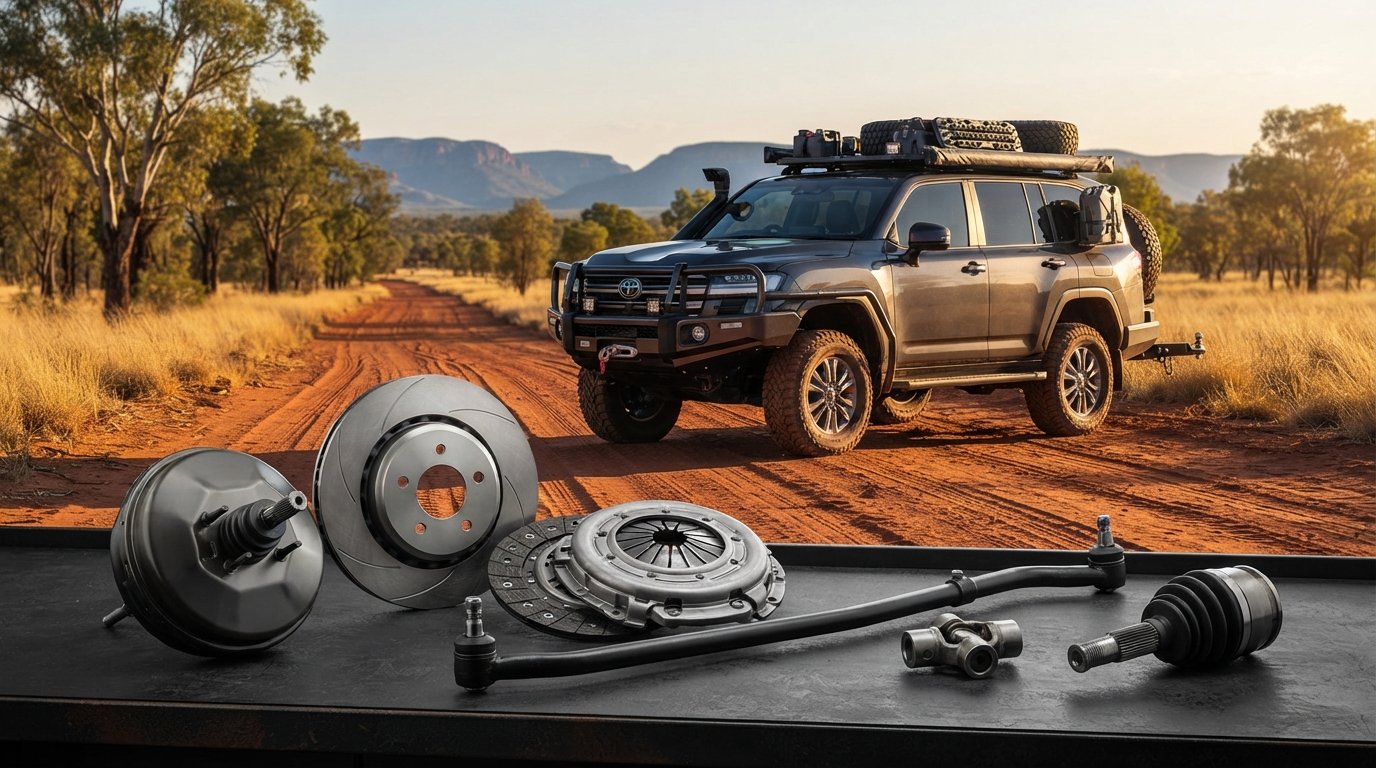
What if your high-clearance suspension lift is the direct cause of your next driveline failure? Most Australian owners prioritise aesthetic accessories while neglecting the mechanical strain of increased gross vehicle mass. You know that genuine reliability requires high-spec 4wd upgrade parts engineered for extreme thermal loads and corrugated terrain. This guide provides the technical roadmap for 2026 mechanical builds.
Expect a direct analysis of critical performance bottlenecks. We cover brake fade during heavy towing, driveline vibration, and component wear. You will gain the specifications needed to source dual-diaphragm boosters, high-torque Kevlar clutches, and chromoly steering links. This overview prioritises improved stopping power, driveline longevity, and precise component selection for heavy-duty touring platforms.
Key Takeaways
- Understand why increased GVM from bullbars and winches requires dual-diaphragm brake boosters to maintain safe stopping distances.
- Learn to diagnose driveline vibrations caused by suspension lifts to prevent premature universal joint and CV assembly failure.
- Utilise a technical framework for sourcing 4wd upgrade parts to ensure accurate fitment using VIN data and specific model variants.
- Optimise off-road reliability by selecting mechanical components based on engineering specifications rather than aftermarket branding.
Essential Brake and Booster Upgrades for Heavy 4WDs
Stock braking systems often fail to provide adequate deceleration when vehicles carry heavy aftermarket hardware. Bullbars and winches add significant front-end weight. Larger tyre diameters increase the leverage ratio required for effective clamping. This combination leads to increased pedal pressure and dangerous brake fade. Sourcing specific 4wd upgrade parts for the braking system is essential for maintaining safety on steep descents or during heavy towing. This is especially critical for vehicles operating at their maximum Gross Vehicle Mass.
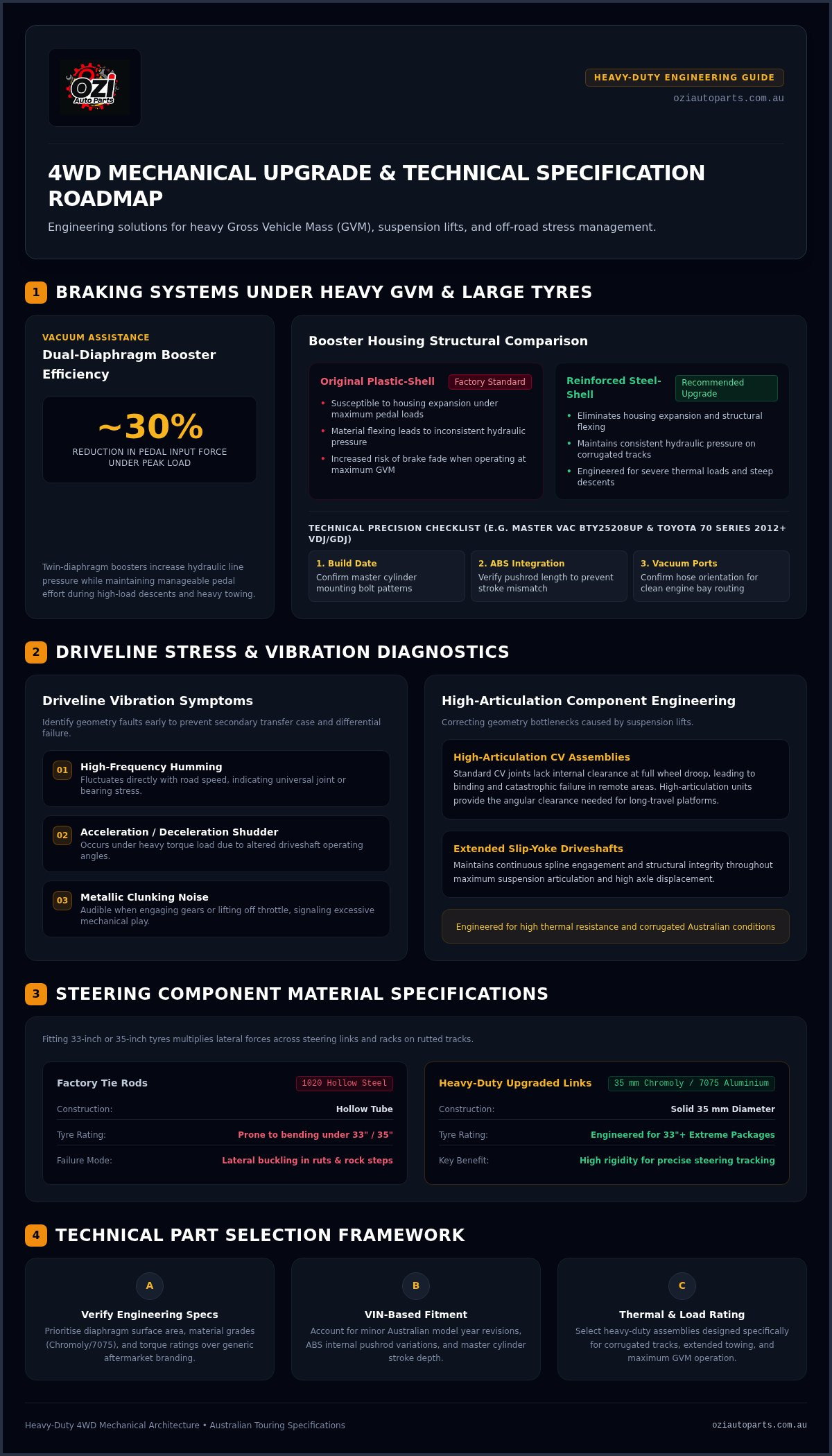
Upgrading to a high-performance brake booster provides the mechanical advantage needed to manage this extra mass. These units increase vacuum assistance. Twin-diaphragm vacuum boosters can reduce brake pedal input force by approximately 30 per cent under peak load. This results in shorter stopping distances without requiring excessive driver leg force. For extreme Australian conditions, transitioning from original plastic-shell units to reinforced steel-shell boosters is a priority. Steel shells eliminate the expansion and flexing common in plastic designs, maintaining consistent hydraulic pressure during high-load braking events on corrugated tracks.
To better understand the impact of mechanical upgrades on vehicle longevity, watch this helpful video:
High-Performance Master Vac Boosters for Lifted 4x4s
High-performance builds require specialised 4wd upgrade parts such as the BTY25208UP Master Vac. Fitment on popular Australian models like the Ford Ranger and Toyota Hilux demands technical precision.
- Confirm build date for master cylinder mounting patterns.
- Identify ABS presence for internal pushrod compatibility.
- Verify vacuum hose orientation for clear engine bay routing.
For example, Toyota 70 Series variants (VDJ/GDJ) from 2012 onwards require specific ABS-compatible boosters. Accurate sourcing prevents piston travel mismatch and ensures the master cylinder operates within its intended stroke range.
Driveline and Steering Parts: Managing Off-Road Stress
Suspension lifts alter factory geometry. Raising a vehicle increases the operating angle of the driveshaft, placing extreme stress on universal joints and CV assemblies. Standard components often bind or overheat when operating at these steep angles. Sourcing robust 4wd upgrade parts is the only way to ensure driveline longevity on corrugated Australian tracks. High-load scenarios, such as climbing steep rock steps, often expose these mechanical weaknesses instantly.
Identifying driveline vibrations early prevents secondary damage to transfer cases and differentials. Use this diagnostic checklist to monitor performance:
- High-frequency humming that fluctuates with road speed.
- Driveline shuddering specifically during heavy acceleration or deceleration.
- Metallic clunking when engaging gears or lifting off the throttle.
Heavy-duty steering components maintain vehicle control when navigating rutted terrain. Factory tie rods are often hollow 1020-grade steel and prone to bending under the weight of 33-inch or 35-inch tyres. Upgrading to solid 35 mm chromoly or 7075 aluminium links provides the rigidity needed for precise tracking. Steering racks also require reinforced mounting and high-spec ends to resist the lateral forces generated by oversized wheel packages on uneven surfaces.
CV Joints and Driveshafts for Increased Suspension Travel
Long-travel suspension kits require high-articulation CV joints to prevent binding at full wheel droop. Standard joints lack the internal clearance for these extreme angles. It's critical to identify failing CV joints before they shatter in remote locations. Specialised driveshafts with extended slip yokes maintain driveline integrity during maximum articulation. Browse the full inventory of specialised mechanical spares to find the correct fitment for your specific 4x4 platform.
Sourcing 4WD Upgrade Parts: A Selection Framework
Reliable builds depend on objective data rather than marketing claims. When selecting 4wd upgrade parts, prioritise technical specifications like diaphragm surface area, material grades, and torque ratings. Avoid generic "heavy-duty" labels that lack engineering verification. Efficiency-driven procurement requires a focus on technical compatibility. High-volume e-commerce resources provide the fastest access to these specialised spares, ensuring nationwide delivery for heavy mechanical components across Australia.
Verifying vehicle fitment using a VIN is the standard for avoiding incorrect orders. In the Australian market, minor model transitions create significant mechanical differences. For instance, the Ford Falcon BA and BF series utilise different brake booster configurations despite visual similarities. Always check the build date and specific model variant to ensure the master cylinder and vacuum lines align perfectly. This precision prevents downtime and ensures the component performs to its rated capacity in remote conditions.
Technical Fitment Verification for Australian Models
Selecting the correct component requires understanding specific platform requirements. Choosing between standard and upgraded boosters, such as the Falcon BA-BF series, depends on the vehicle's laden weight and braking performance targets. Mechanical precision in steering and suspension parts is vital for vehicle stability on Australian roads, especially when navigating high-speed corrugations. Use the online auto parts guide to streamline the procurement of critical spares.
Follow these steps for accurate selection:
- Identify the exact vehicle build date and series code.
- Match component specifications to the intended GVM load rating.
- Confirm inner-barrel clearance for any brake caliper upgrades.
- Verify delivery lead times for remote regional locations.
Optimising Mechanical Reliability for the 2026 Season
Mechanical reliability on Australian tracks depends on engineering precision. Upgrading to dual-diaphragm boosters and reinforced driveline components isn't optional for heavy-duty touring. These 4wd upgrade parts resolve the performance gaps created by increased GVM and suspension lifts. Precise fitment verification ensures your vehicle maintains control on high-speed corrugations and steep descents. Prioritising technical specifications over aesthetic accessories prevents catastrophic failure in remote locations.
Ozi Auto Parts serves as a high-volume resource for these critical components. As specialised mechanical experts and high-performance brake booster specialists, we ensure you receive the correct part the first time. Our efficiency-driven model provides nationwide Australian delivery to keep your build moving. Browse the full range of heavy-duty 4WD upgrade parts at Ozi Auto Parts to secure your drivetrain's longevity. Build with confidence and prepare your vehicle for the toughest conditions in the country.
Frequently Asked Questions
What are the most critical 4WD upgrade parts for towing?
High-performance brake boosters and heavy-duty clutch kits are the most critical 4wd upgrade parts for towing. Standard systems often struggle with the thermal loads of a three-tonne caravan or heavy boat trailer. Upgrading to a dual-diaphragm booster reduces pedal effort, while a fortified clutch handles the increased torque requirements. These components prevent brake fade and driveline slippage during steep alpine ascents.
How do I know if my 4WD needs an upgraded brake booster?
You need an upgraded brake booster if the pedal feels hard or unresponsive after installing heavy accessories. Bullbars, winches, and 35-inch tyres increase the vehicle's rolling mass significantly. If you're exerting excessive leg force to stop, the factory vacuum assistance is likely insufficient. A twin-diaphragm unit provides the necessary mechanical advantage to manage the increased gross vehicle mass safely.
Will a suspension lift damage my original driveshafts?
A suspension lift alters driveshaft geometry, which can lead to accelerated wear. Lifting a 4x4 increases the working angle of universal joints and CV assemblies. This often results in high-frequency vibrations and premature failure of needle bearings. Installing high-articulation driveshafts or spacer kits helps maintain driveline integrity by restoring appropriate operating angles for the increased suspension travel.
Can I install these mechanical upgrade parts myself?
Installation requires advanced mechanical proficiency and specialised automotive tools. Components like brake boosters and driveshafts are safety-critical systems. Incorrect fitment leads to hydraulic failure or driveline breakage. While Ozi Auto Parts provides technical specifications for accurate sourcing, we recommend professional installation. Ensure all fasteners are torqued to factory specifications to maintain vehicle stability and reliability on remote tracks.