
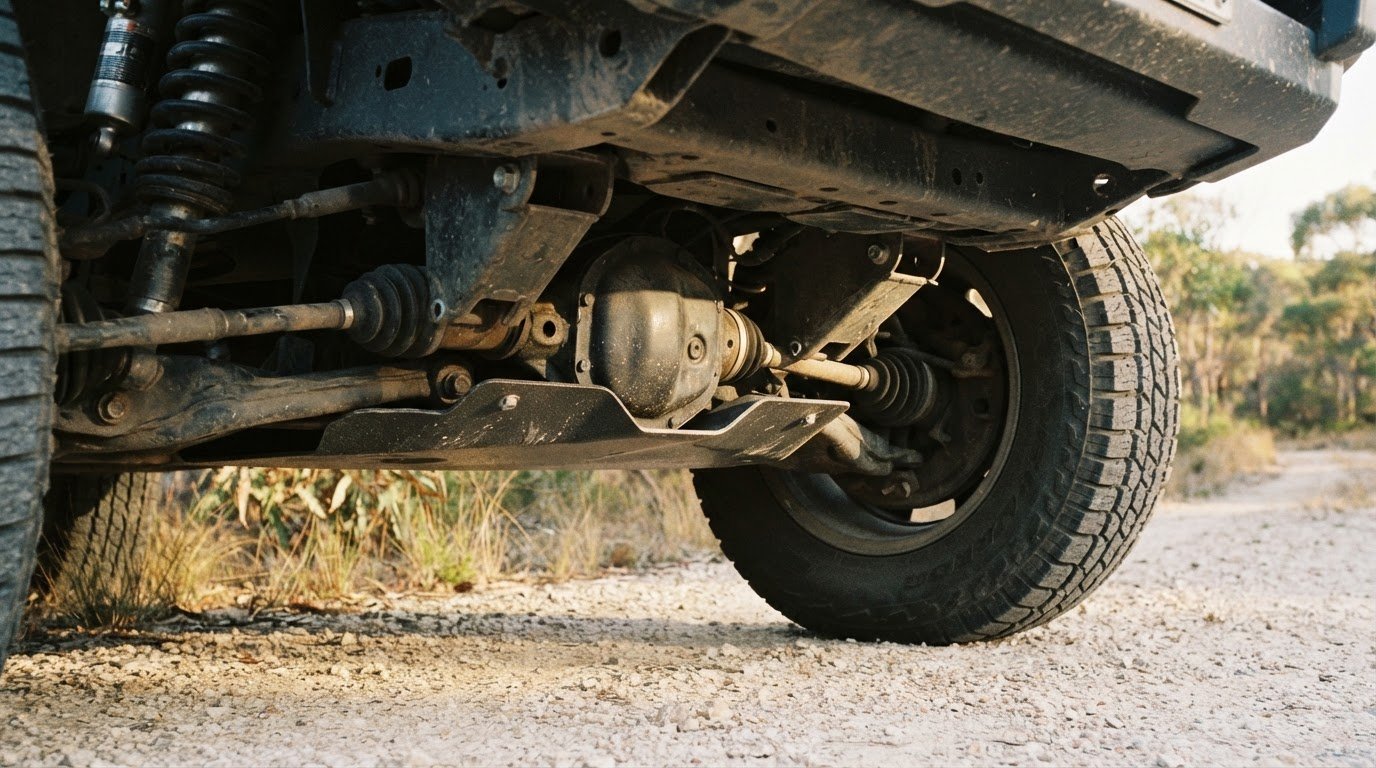
A suspension lift can leave front CV joints working at a steeper angle, so more lift doesn’t automatically mean better component geometry. For an IFS 4WD lifted more than 2 inches above stock, a 4x4 diff drop kit in Australia is worth considering. It lowers the differential towards its original position to correct driveline angles and reduce angle-related CV strain. The trade-off is underbody clearance, particularly when a bash plate sits below the relocated diff.
That clearance concern is real. The right setup depends on vehicle geometry, lift height and bash plate design. This guide explains how a diff drop works after a lift, how different designs affect CV angles, and how a modified bash plate can limit clearance loss. You’ll also learn when to consider a diff drop and which fitment details matter when selecting a kit for your 4WD.
Key Takeaways
- For an IFS 4WD lifted more than 2 inches above stock, consider how the lift has changed the front differential and CV joint angles.
- A diff drop repositions the differential to help correct driveline angles and reduce angle-related strain on CV joints.
- A modified bash plate can help manage the clearance trade-off; in some setups, ground-clearance loss can be as little as 20 to 30 mm.
- Choose a kit matched to the exact 4WD and suspension configuration, as differential mounting and underbody layouts affect fitment.
Diff-drop bash plate and clearance considerations
A diff drop changes the differential’s position, so assess bash-plate clearance alongside underbody protection. A bracket’s stated drop does not determine the final clearance on every vehicle.
CV protection trade-offs and fitting risks
A diff drop addresses CV joint angle after a lift; a bash plate protects exposed underbody components from impacts. These options serve different purposes, so one doesn’t replace the other. For an IFS vehicle lifted more than 2 inches above stock, consider the geometry change alongside physical protection. Incorrect bracket fitment or a plate that contacts the differential can create clearance or movement issues.
Kit selection and vehicle compatibility
Match the kit to the vehicle’s make, model, year and front-end configuration. Check bracket design, mounting points and compatibility with the existing bash plate. Braced relocation brackets show a 34 mm drop, but that figure alone doesn’t establish fitment. The correct selection also depends on the vehicle’s lift and differential layout.
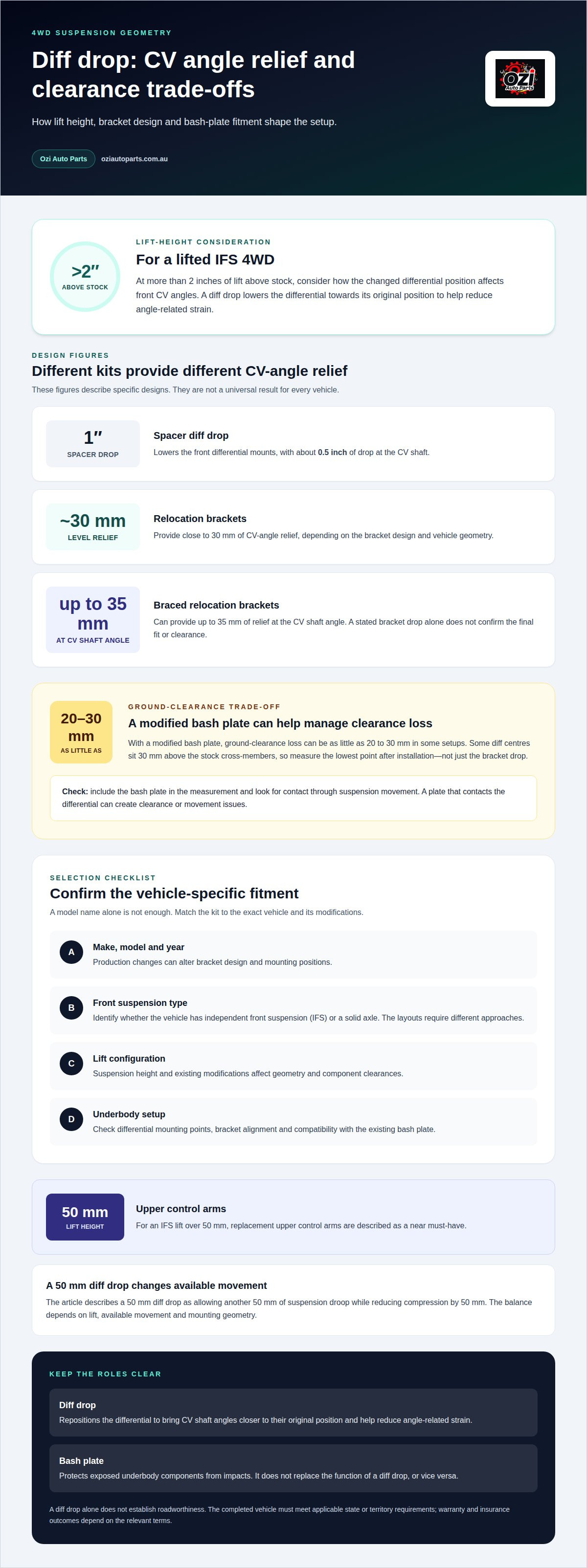
With a modified bash plate, ground-clearance loss can be as little as 20 to 30 mm. Some diff centres sit 30 mm above the stock cross-members, so the final position matters more than the bracket measurement alone. Measure the lowest point after installation, including the plate, and look for contact through suspension movement.
A diff drop alone does not establish roadworthiness; the completed vehicle must meet applicable state or territory requirements. Warranty and insurance outcomes depend on the relevant policy and warranty terms. Kit and fitting costs vary by application, parts and labour. Installation involves supporting the differential, fitting the brackets and checking clearance. Fitting time varies with the vehicle layout and any bash-plate modification.
How a diff drop works after a suspension lift
A suspension lift changes the relationship between the differential and front CV joints. A diff drop lowers the differential, bringing the CV shaft angles closer to their original position.
For an IFS 4WD lifted more than 2 inches above stock, consider a diff drop. At this lift height, changed CV angles can add strain to driveline components. Replacement upper control arms are also a near must-have for an IFS lift over 50 mm.
The kit relocates the differential mounting points; the exact CV-angle change depends on its design. A 1-inch spacer diff drop lowers the front diff mounts but provides only about 0.5 inch of drop at the CV shaft. Relocation brackets provide close to 30 mm of level CV-angle relief, while braced brackets can provide up to 35 mm at the CV shaft angle.
These figures describe different designs, not a universal result for every vehicle. A 50 mm diff drop is described as allowing another 50 mm of suspension droop while reducing compression by 50 mm. The right balance depends on the lift, available movement and mounting geometry. Lowering the differential also moves it closer to the ground, so clearance remains part of the upgrade decision.
Reducing CV angle-related strain can help reduce stress on the joints. Corrected driveline angles can also reduce vibration and improve handling. The diff drop changes component position; it doesn’t alter how the drivetrain transfers power. For related 4WD upgrade parts, match the selection to the vehicle and suspension setup.
A diff drop is a suspension modification that lowers a 4x4's differential after a vehicle lift. A vehicle lift changes driveline angles and can put extra strain on CV joints, driveshafts and other components.
Consider a diff drop for a 4x4 that has had a lift kit or larger tyres installed. A diff drop that lowers the diff centre by 40mm puts it 40mm closer to the ground.
Which Australian 4x4 models are compatible with diff drop kits?
Compatibility depends on the vehicle’s front suspension and differential mounting points, not just its badge. Diff drop kits are designed for many popular 4x4 models, but they aren’t universal. An independent front suspension (IFS) vehicle uses differential mounting points that a kit can relocate. A solid-axle front end has a different layout and requires a different approach.
Use your vehicle details to narrow down the correct fitment:
- Make, model and year: production changes can alter brackets and mounting positions.
- Front suspension type: identify whether the vehicle has IFS or a solid axle.
- Lift configuration: suspension height and existing modifications affect component clearances.
- Underbody setup: note any bash plate or other hardware around the differential.
A Toyota Hilux, Ford Ranger or Mitsubishi Triton name alone is not enough to identify a compatible kit. Each model can have different generations, suspension layouts and mounting points. Match the kit’s stated vehicle application to the exact model year and configuration, and do not select by brand alone. Account for modifications made after manufacture, including a lift or aftermarket bash plate.
For a lifted IFS 4WD, the key compatibility question is whether the brackets align with the vehicle’s differential mounts while preserving clearance around nearby components. A kit designed for another model can create mounting or clearance conflicts, even if both vehicles are four-wheel drives. Review vehicle-specific fitment details before choosing. Browse 4WD upgrade parts by vehicle application to narrow your selection.
The page states that the kits come with everything needed for installation. Keep that in mind alongside vehicle-specific fitment checks: a complete installation package does not establish that a kit suits every configuration. Before proceeding, match the stated application to the vehicle details and modifications rather than treating the included installation items as proof of compatibility.
Ozi Auto Parts
Ozi Auto Parts supplies 4WD Upgrade Parts and Steering and Suspension Parts for Australian vehicle applications. If a lift has changed your front-end geometry, these categories provide a practical starting point for selecting related components. Driveshafts are also part of the range, supporting readers considering the wider driveline setup alongside suspension changes.
Before choosing parts, note your vehicle’s make, model, year, suspension type and lift configuration. These details help narrow the relevant application and keep the selection focused on your 4WD. Contact Ozi Auto Parts to discuss your parts requirements.
Plan your next 4WD upgrade
Use your diff drop decision as part of a complete suspension and driveline plan, not as an isolated modification. The right 4x4 diff drop kit in Australia depends on how the lift, differential position and underbody protection work together on your vehicle. Keep those factors in view as you plan future upgrades, so each component supports the overall setup.
Ozi Auto Parts can help you take the next step with parts for your 4WD requirements. Contact Ozi Auto Parts to discuss your parts needs and move forward with a considered setup.
Frequently Asked Questions
Why Is a Diff Drop Kit Important?
It’s a setup decision for a lifted 4WD, not a universal accessory. Note existing driveline vibration or CV wear before modifying the vehicle. That baseline provides a useful comparison after suspension work. Also consider how underbody protection fits the planned configuration, so component choices work together rather than being assessed in isolation.
What is a 4x4 diff drop kit and what does it do?
A 4x4 diff drop kit in Australia is vehicle-specific mounting hardware, not a lift kit. It doesn’t raise ride height or alter differential gearing. Application depends on the vehicle’s model, year and front-end configuration, so use the full vehicle details when matching a kit. This distinction helps avoid treating every 4WD upgrade as interchangeable.
How do you install a 4x4 diff drop kit, and how long does fitting take?
Installation involves supporting the differential, fitting the brackets and checking clearance. Fitting time varies with the vehicle layout and any bash-plate modification.