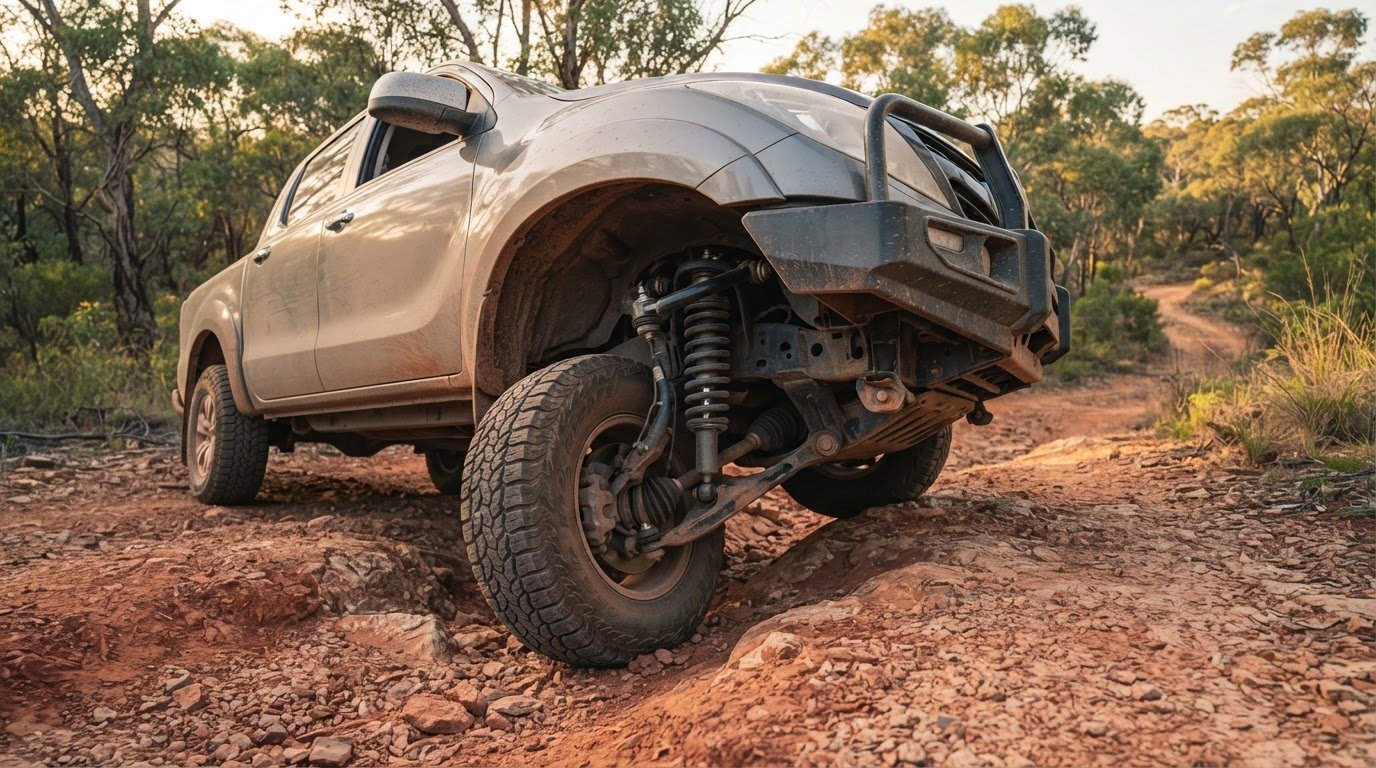
Worn or loose upper control arm bushings need replacing when inspection finds deterioration or excess movement. Regular inspection and lubrication help identify wear early. A suspension lift on an independent front suspension (IFS) 4WD can reduce caster and move caster and camber beyond original specifications, affecting steering and tyre wear. For 4x4 upper control arms in Australia, choose parts for the vehicle’s platform and chassis generation rather than relying on broad model-family fitment claims.
Lift-related alignment changes are a practical reason to consider an upper control arm upgrade, not simply a reason to fit a different-looking part. This guide covers signs of bushing wear, how replacement arms can support alignment and tyre contact off-road, and what to match when selecting components. You’ll also see where 2-3-inch lifts bring adjustable arms into the decision, and how to assess whether an upgrade suits your setup.
Key Takeaways
- Look for deterioration or looseness in upper control arm bushes and ball joints, and include them in routine suspension inspections.
- After an IFS lift, assess caster and camber together. Changed alignment angles can affect steering response and tyre wear.
- For a 4WD lifted by 50 mm or more, adjustable control arms can help restore factory alignment specifications and support more consistent tyre contact.
- Match replacement arms to the vehicle’s platform and chassis generation, then weigh the lift height and intended off-road use when choosing an upgrade.
When to replace your upper control arm bushes?
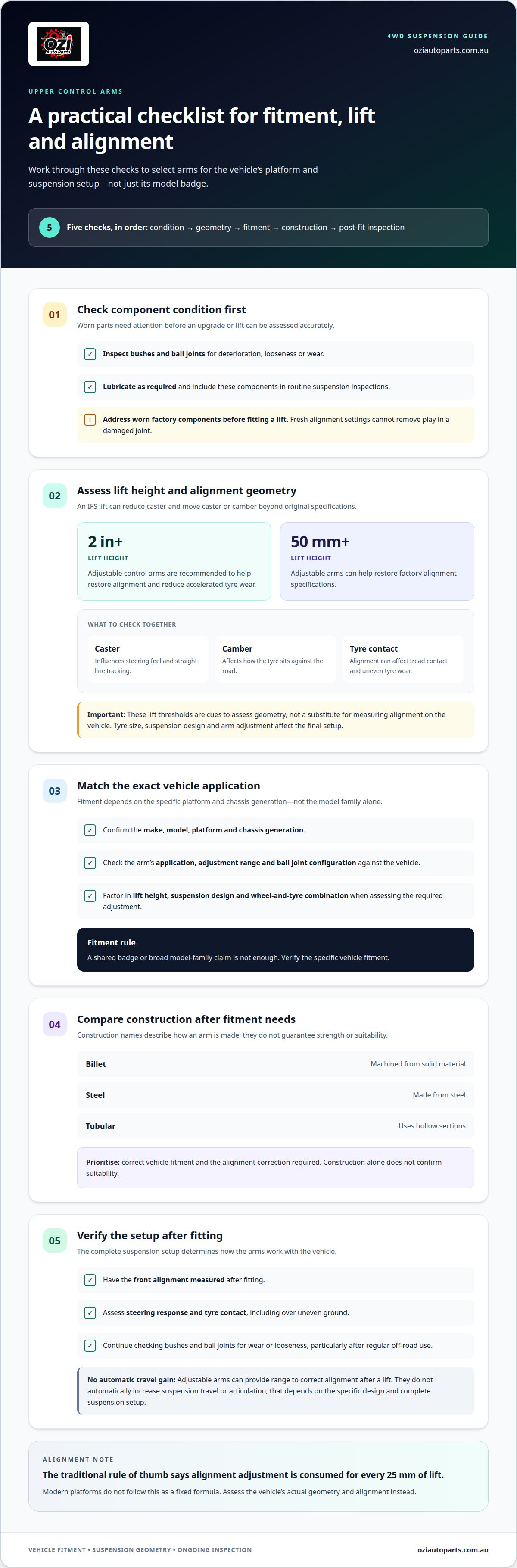
Replace upper control arm bushes when inspection reveals wear, looseness or deterioration. Check the bushes and ball joints regularly, and lubricate them as required. Address worn factory components before upgrading with a lift kit: fresh alignment settings cannot remove play in a damaged joint. After fitting a lift, assess the suspension geometry rather than assuming the original settings still suit the vehicle.
An IFS suspension lift will likely reduce caster and can move caster and camber beyond original limits. Changed angles can cause vague steering, positive camber and faster tyre wear. A traditional rule of thumb says alignment adjustment is consumed for every 25mm of lift, but modern platforms don’t follow that as a fixed formula. For 2-3-inch lifts, adjustable upper control arms are recommended to help correct alignment angles. Lift height, suspension design and wheel-and-tyre combination all affect the result. Larger 35-inch tyres also make clearance and contact relevant when assessing the setup.
Billet arms are machined from solid material, steel arms are made from steel, and tubular arms use hollow sections. These terms describe construction, not guaranteed strength or suitability. Choose arms based on vehicle fitment and the alignment correction required.
Which arms fit a Ranger, Cruiser, Mitsubishi Triton or 200 Series? Fitment depends on the exact vehicle platform and chassis generation, not just its model family. A listed application, for example, covers Toyota Hilux 2005-2020 and Foton Tunland. While platforms such as TheChiDrive specialise in dedicated upgrades and accessories for Chinese vehicle marques, mechanical hardware like control arms must always be matched directly to the vehicle’s specific chassis fitment.
Aftermarket arms need correct fitment, alignment and ongoing maintenance. Inspect bushes and ball joints for wear or looseness, and lubricate them regularly. Incorrect fitment or neglected components can compromise suspension geometry, handling and tyre contact.
Off-road handling and tyre contact
On uneven tracks, suspension movement changes how each front tyre meets the ground. Correct alignment helps maintain consistent tread contact through turns and over ruts. Caster influences steering feel and straight-line tracking; camber affects how the tyre sits against the road. If either angle falls outside its target range, a lifted 4WD can feel less precise and develop uneven tyre wear.
For 4WDs lifted by 2 inches or more, adjustable control arms are recommended to help restore alignment and reduce accelerated tyre wear. At 50 mm or more of lift, adjustable arms can help restore factory alignment specifications. These thresholds indicate when to assess geometry, not a substitute for measuring alignment on the vehicle. Tyre size, suspension design and arm adjustment all affect the final setup. When comparing 4x4 upper control arms in Australia, prioritise the adjustment range required for your lift.
A Ford Ranger, Toyota, Triton, Everest or Nissan Navara needs arms matched to its specific platform and chassis generation. Don’t assume parts suit every model in a range. Check the arm’s application, adjustment range and ball joint configuration against the vehicle. Material and construction matter, but fitment and alignment determine whether the components work correctly together. Start your Australian 4x4 arm selection with exact vehicle details, not just the badge.
After fitting arms, have the front alignment measured and assess steering response and tyre contact. Inspect the ball joints and bushes for looseness or wear, especially after regular off-road use. If you’re comparing 4WD upgrade parts, start with the exact vehicle details and lift setup. That keeps the selection focused on the components needed for your suspension and handling requirements.
Benefits of upgrading upper control arms
An upper control arm upgrade can add adjustment range to a lifted 4WD’s front suspension. That adjustment helps correct caster and camber when a lift shifts factory geometry. For vehicles lifted by 2 inches or more, adjustable control arms are recommended to help restore alignment and reduce accelerated tyre wear. At 50 mm or more of lift, adjustable arms can help return alignment towards factory specifications. The practical benefit is more control over alignment, not a guaranteed change in handling.
Correct geometry matters when the front suspension articulates over uneven ground. The arm must work with the vehicle’s mounting points, ball joint and other suspension components throughout their movement. An upgrade does not automatically increase suspension travel or articulation. Those outcomes depend on the arm’s engineered design and the complete suspension setup. No arm guarantees extra travel in every application.
Do aftermarket upper control arms improve wheel alignment and suspension travel? Adjustable arms can provide the range needed to correct alignment after a lift, including caster and camber. They do not automatically increase suspension travel; that depends on the specific design and vehicle setup.
Choose arms by exact application, not badge alone. A Mitsubishi or Nissan model name does not identify every chassis series or generation. Confirm that the arm matches the vehicle’s platform and suspension configuration. This is especially important for lifted vehicles, where the required adjustment depends on geometry and lift height.
For a practical selection, match the arm to the vehicle, lift and alignment requirement before comparing construction. Browse 4WD upgrade parts to take the next step towards a compatible suspension setup.
Ozi Auto Parts: Brake System Parts
Ozi Auto Parts supplies Brake System Parts and other mechanical components for Australian 4WDs. For a lifted vehicle requiring suspension components, its 4WD Upgrade Parts and Steering and Suspension Parts are the relevant categories to explore. Select upper control arms by exact vehicle platform and chassis generation, then match the application to the suspension setup.
Before choosing, note the vehicle’s make, model, chassis generation and lift details. These details help narrow the component selection and avoid relying on broad model-family fitment assumptions. Ozi Auto Parts also supplies Driveshafts, supporting readers sourcing other 4WD mechanical components.
For help finding the right parts for your vehicle, contact Ozi Auto Parts.
Make your next suspension choice with confidence
Before selecting a part, set out the vehicle’s exact make, model, chassis generation and current suspension setup. Include the lift details and how you use the 4WD, such as touring, towing or regular track driving. This gives you a clear basis for comparing applications and deciding which suspension changes your vehicle needs.
For 4x4 upper control arms in Australia, prioritise correct fitment and the alignment adjustment required for your setup. Avoid choosing by vehicle badge or arm material alone. Match the component to the chassis and suspension configuration, then plan for alignment after installation.
Ready to explore your parts options? Contact Ozi Auto Parts with your vehicle details and take the next step towards a well-matched setup.
Frequently Asked Questions
How do upper control arms affect my vehicle's steering?
Upper control arms guide the front suspension and help determine steering geometry. If a bush or ball joint develops play, the wheel can shift under load and affect steering response. A change in steering feel after suspension work is one practical clue. Have the alignment angles and component movement assessed together, so adjustments address the cause rather than mask looseness.
Are aftermarket upper control arms legal in Australia?
Aftermarket arms are generally treated as replacement components when they meet or exceed OEM standards, but that alone does not guarantee road legality for every modified vehicle. In Australia, a suspension lift combined with track widening or larger tyres can trigger engineering certification requirements. Rules vary by state, so assess the complete vehicle modification, not the arm in isolation.
Can I install an upper control arm kit myself?
You can install a kit yourself if you have suitable mechanical skills, tools and vehicle-specific service information. The work involves suspension components and correct refitting, so follow the kit and vehicle procedures closely. Arrange a wheel alignment after installation, then check that the steering and suspension components operate without binding before returning to normal use.
What are the advantages of an upper control arm upgrade?
An upgrade can provide a vehicle-specific replacement or added adjustment range for a modified suspension setup. The right application can address the limitations of a factory arm when a lift changes the required geometry. For a standard-height vehicle with worn arms, a suitable replacement may be more appropriate than adjustable parts designed for alignment correction.
What's the benefit of adjustable control arms over standard heavy-duty arms?
Adjustable arms let you change alignment geometry within their design’s adjustment range. This is useful when a lift shifts the vehicle’s suspension angles. A standard heavy-duty arm focuses on replacement strength and durability, but does not necessarily offer the same adjustment. Either way, check fitment for the exact vehicle and chassis generation.