
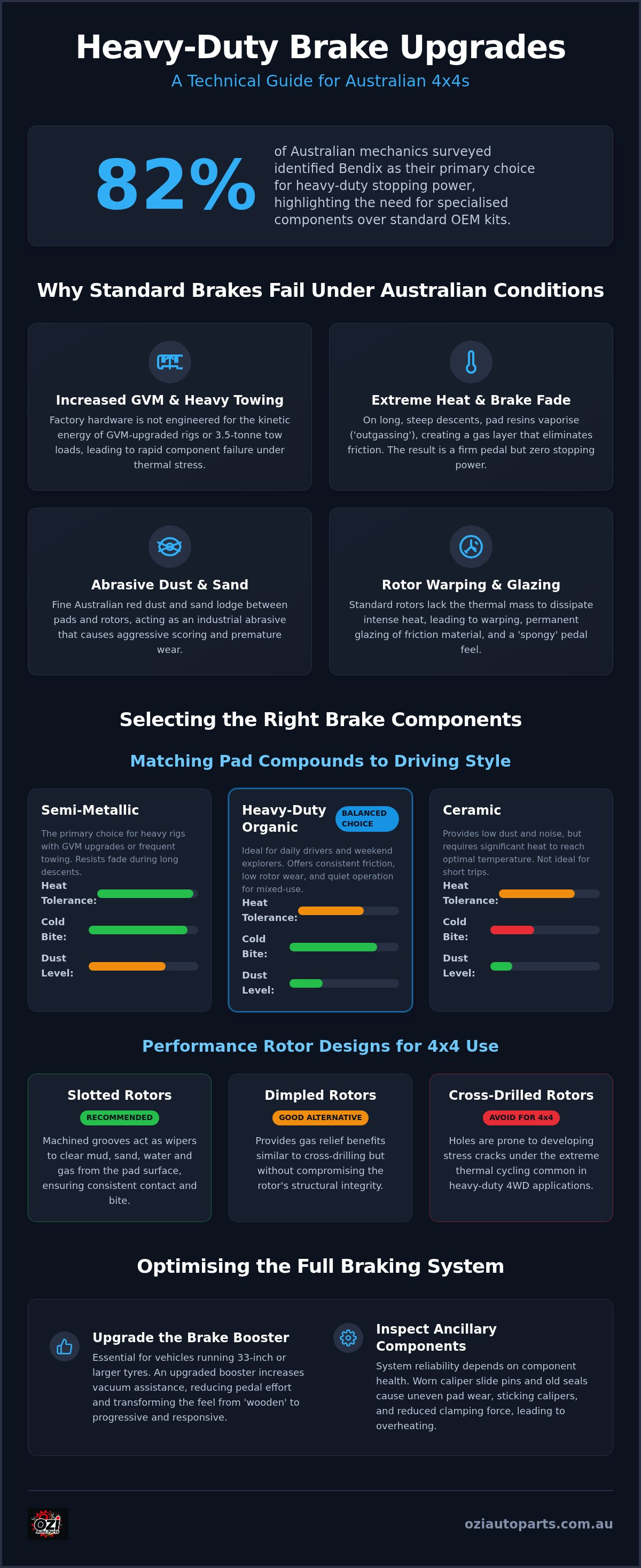
82% of Australian mechanics surveyed in 2026 identified Bendix as their primary choice for heavy-duty stopping power. Standard OEM kits fail under thermal stress. GVM upgrades. Remote touring. Heavy towing. You've likely felt the spongy pedal on a long range descent or seen rapid rotor warping caused by excessive heat soak. Factory hardware isn't engineered for 3.5-tonne GVM loads or the abrasive dust of the Pilbara. This guide identifies the best brake pads and rotors for 4x4 Australia to restore pedal firmness and secure shorter stopping distances. Evaluate high-performance ceramic compounds, heat-dissipating slotted rotors, and ADR-compliant hydraulic upgrades. Use these technical breakdowns to manage thermal loads, ensure component synergy, and handle increased kinetic energy. Prioritise mechanical precision and inventory depth for your next heavy-duty build.
Key Takeaways
- Understand thermal mass limitations of factory rotors. Prevent heat-induced warping during GVM-loaded descents.
- Identify the best brake pads and rotors for 4x4 australia. Compare ceramic compounds and slotted designs for peak thermal management.
- Optimise system performance with upgraded brake boosters. Reduce pedal effort for lifted rigs running oversized tyres.
- Mitigate component scoring from Australian red dust. Select abrasive-resistant materials for extended service intervals in harsh environments.
Why Standard Brake Components Fail on Australian 4x4s
Standard factory-spec rotors lack the thermal mass required for heavily modified rigs. Increasing Gross Vehicle Mass (GVM) through bull bars, winches, and long-range tanks pushes kinetic energy levels beyond original design limits. When you're towing a 3-tonne caravan, the required coefficient of friction spikes significantly compared to daily commuting. Standard systems can't dissipate this heat fast enough. This leads to rapid rotor warping and permanent friction material glazing. Identifying the best brake pads and rotors for 4x4 australia requires understanding these specific failure points to ensure heavy-duty safety.
Australian environments introduce unique mechanical stressors. Fine red dust and coastal sand act as industrial abrasives. These particles lodge between the Brake pad and the rotor surface. The result is aggressive scoring and premature thinning of the disc. Technical reliability depends on matching component metallurgy to these harsh conditions. Sourcing the best brake pads and rotors for 4x4 australia is a technical necessity for those operating in remote regions. For a deeper dive into mechanical longevity, consult All Brake Systems: The Master Guide.
Managing Heat Fade in Harsh Off-Road Conditions
Sustained high-temperature braking during steep range descents triggers 'outgassing'. Bonding resins in the pad material vaporise under extreme heat. This creates a high-pressure gas cushion between the friction material and the rotor. Pedal feel remains firm, but stopping power vanishes. Heavy-duty rotors with directional venting or slots are essential to vent these gases and maintain surface contact. Consistent performance requires hardware that manages these thermal peaks without compromising structural integrity or pedal response.
Selecting the Best 4x4 Brake Pads and Rotors for Your Rig
Selecting the best brake pads and rotors for 4x4 australia requires balancing friction coefficients against thermal stability. Semi-metallic pads offer superior cold bite and high-temperature recovery. This makes them the primary choice for heavy rigs. Ceramic compounds provide low dust and noise. However, they often require significant heat to reach optimal operating temperatures. This delay can be problematic during cold morning starts or short suburban trips before the system warms up.
Rotor geometry dictates debris management and structural life. Slotted rotors are the technical standard for off-road use. Machined grooves act as wipers to clear mud, sand, and gas from the pad surface. Dimpled rotors provide similar degassing benefits without the structural compromise of cross-drilling. Cross-drilled holes often develop stress cracks under the extreme thermal cycling common in Australian 4WD applications. Dimpled surfaces maintain the integrity of the rotor casting while still allowing gas to escape.
Top criteria for 4x4 brake selection:
- Heat rating: Ability to maintain friction levels above 500°C.
- Dust level: Balance between abrasive wear and wheel cleanliness.
- Noise suppression: Use of advanced shims to eliminate high-frequency squeal.
- Cold bite: Immediate stopping power from the first pedal application.
Matching Pad Compounds to Driving Style
Daily drivers and weekend explorers benefit from heavy-duty organic pads. These offer consistent friction and low rotor wear for mixed-use conditions. If your vehicle runs a permanent GVM upgrade or pulls a heavy caravan, high-performance metallic pads are mandatory. These materials resist fade during long descents where standard organic pads would glaze. You can source technical hardware and Brake Rotors: Understanding Performance components through our specialist inventory. Matching pad compound to vehicle weight ensures predictable stopping distances.
Optimising 4WD Braking Performance with System Upgrades
Even the best brake pads and rotors for 4x4 australia can't overcome a weak hydraulic foundation. Larger tyres increase rolling inertia and leverage against the braking system. This requires significantly higher pedal effort to achieve safe stopping distances. Upgrading to a Master Vac booster increases vacuum assistance. It transforms pedal feel from wooden to progressive. This upgrade is essential for vehicles with increased GVM or those running 33-inch plus tyres where factory boosters lack sufficient displacement.
System reliability depends on ancillary component health. Worn caliper sleeve slide pins are a common cause of uneven pad wear and sticking calipers. Seized pins prevent the caliper from floating correctly. This reduces effective clamping force and overheats one side of the rotor. High-quality hydraulic seals and pins ensure the friction materials operate at peak efficiency. Sourcing matched components from a specialist Australian retailer prevents hydraulic bottlenecks and ensures every part of the system handles the increased thermal load.
Sourcing High-Performance 4x4 Brakes Online
Procurement speed is vital for mechanical repairs. Buying online auto parts provides access to heavy-duty inventory and nationwide delivery. Specialist retailers offer technical depth that generalist shops lack. Always verify vehicle fitment using VIN or model-specific data. This ensures the mechanical supply matches your specific axle and caliper configuration. Accurate sourcing is the final step in securing the best brake pads and rotors for 4x4 australia for your rig.
Secure Your 4x4 Stopping Power Today
Thermal management is critical for GVM-upgraded rigs. Standard hardware cannot dissipate the kinetic energy of a 3.5-tonne setup. Match high-friction semi-metallic pads with slotted rotors. This combination clears abrasive red dust and vents outgassing. Hydraulic efficiency remains the final requirement. High-performance brake boosters reduce pedal effort and provide progressive control on steep descents. Selecting the best brake pads and rotors for 4x4 australia ensures your vehicle remains compliant and safe under maximum load. We specialise in high-performance brake boosters and 4WD upgrade parts. Access our direct supply model and nationwide Australian shipping on all critical mechanical spares. Upgrade your 4x4 braking system at Ozi Auto Parts today. Prepare your rig for the toughest Australian tracks with absolute confidence.
Frequently Asked Questions
What are the best brake pads for towing a caravan in Australia?
Semi-metallic pads are the technical standard for towing heavy caravans. High-performance metallic compounds provide superior thermal recovery. This makes them a core component in the best brake pads and rotors for 4x4 australia for towing. These pads maintain friction stability above 500°C. Standard ceramic pads often lack the extreme heat tolerance required for heavy GVM loads.
Should I choose slotted or drilled rotors for my 4WD?
Slotted rotors are superior for 4WD applications. Drilled rotors suffer from stress fractures under heavy thermal loads. Slotted patterns wipe debris and mud from the pad surface. This degassing function maintains firm pedal feel. Structural integrity is critical for heavy rigs operating in harsh Australian terrain. Avoid drilled rotors for off-road use.
How often should I replace 4x4 brake rotors when off-roading frequently?
High-performance brake pads in towing applications often require replacement every 10,000 to 15,000 kilometres. Frequent off-roading in abrasive red dust or sand accelerates rotor wear. Monitor disc thickness at every service interval. Replace rotors when they reach minimum manufacturer specifications or show visible scoring and heat spotting. Don't ignore pedal pulsation.
Do high-performance brake pads create more dust on my wheels?
Visible dust is common with high-performance metallic pads. This is a technical trade-off for the superior friction needed for the best brake pads and rotors for 4x4 australia. Ceramic pads produce less dust. However, they rarely match the stopping power or cold bite required for 3.5-tonne GVM upgrades and oversized tyres. Performance takes priority over aesthetics.