Why trust a two-tonne 4WD or high-output performance vehicle to expanding rubber hoses? Many drivers accept a spongy brake pedal as a standard trade-off during heavy towing or spirited driving. This is a technical failure. Standard EPDM rubber lines soften and swell under heat. This reduces hydraulic efficiency. Upgrading to braided brake lines australia eliminates this volumetric expansion. It ensures crisp, consistent pedal pressure. This guide provides the technical data needed to select ADR 42/04 and ADR 7/00 compliant components. We'll examine PTFE inner cores, swaged stainless steel fittings, and the necessity of protective PVC sheathing for off-road durability. Discover how to maintain road-legal status and insurance compliance while improving stopping power. Expect direct facts on burst pressures, material standards, and lift-specific requirements for Australian conditions.
Key Takeaways
- Identify how high-grade braided brake lines australia eliminate volumetric expansion to maintain consistent hydraulic pressure during heavy towing or performance driving.
- Master the ADR 42/04 and 7/00 compliance standards required to pass roadworthy inspections and maintain valid insurance coverage for modified vehicles.
- Evaluate material specifications, including Grade 304 stainless steel and protective PVC sleeves, to ensure maximum component durability in harsh Australian off-road conditions.
- Determine the required line extensions for lifted 4WD suspension systems to prevent tensile stress and hose rupture at full axle articulation.
Performance Benefits of Braided Brake Lines in Australian Conditions
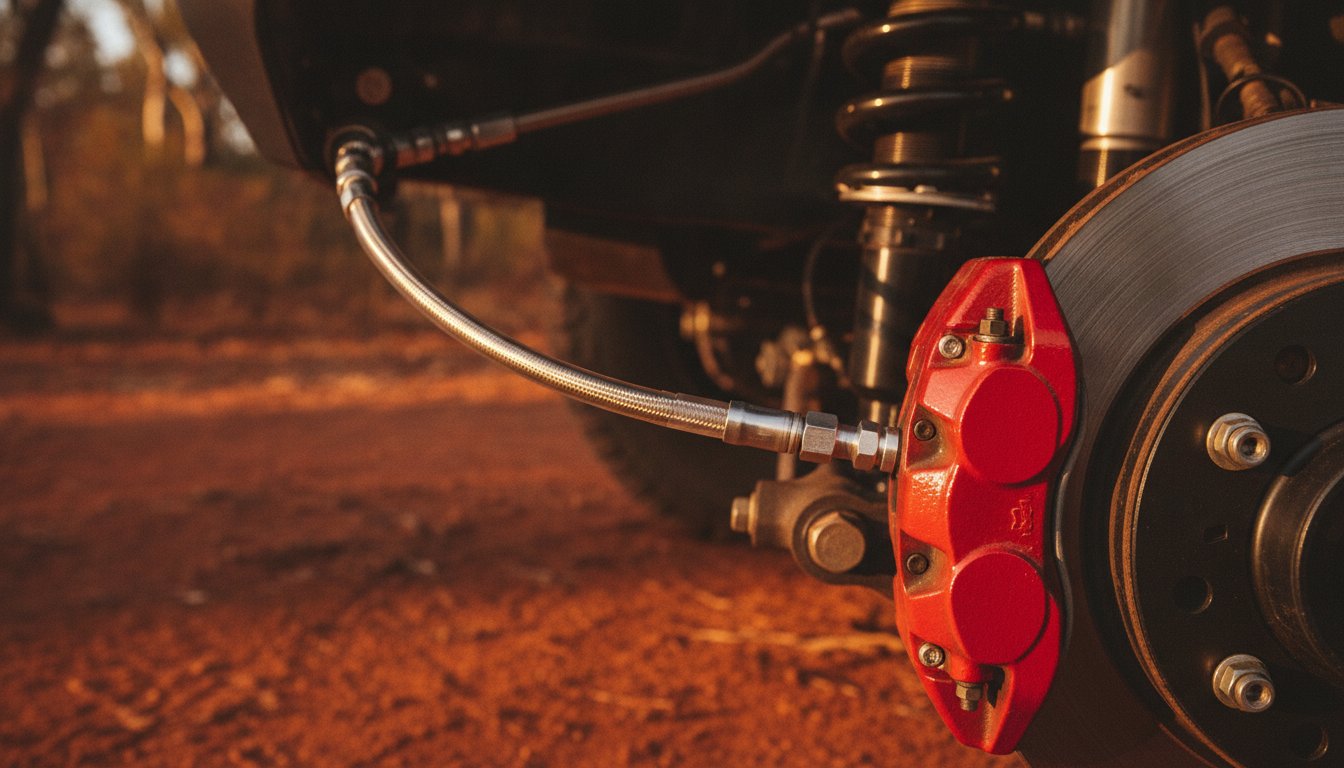
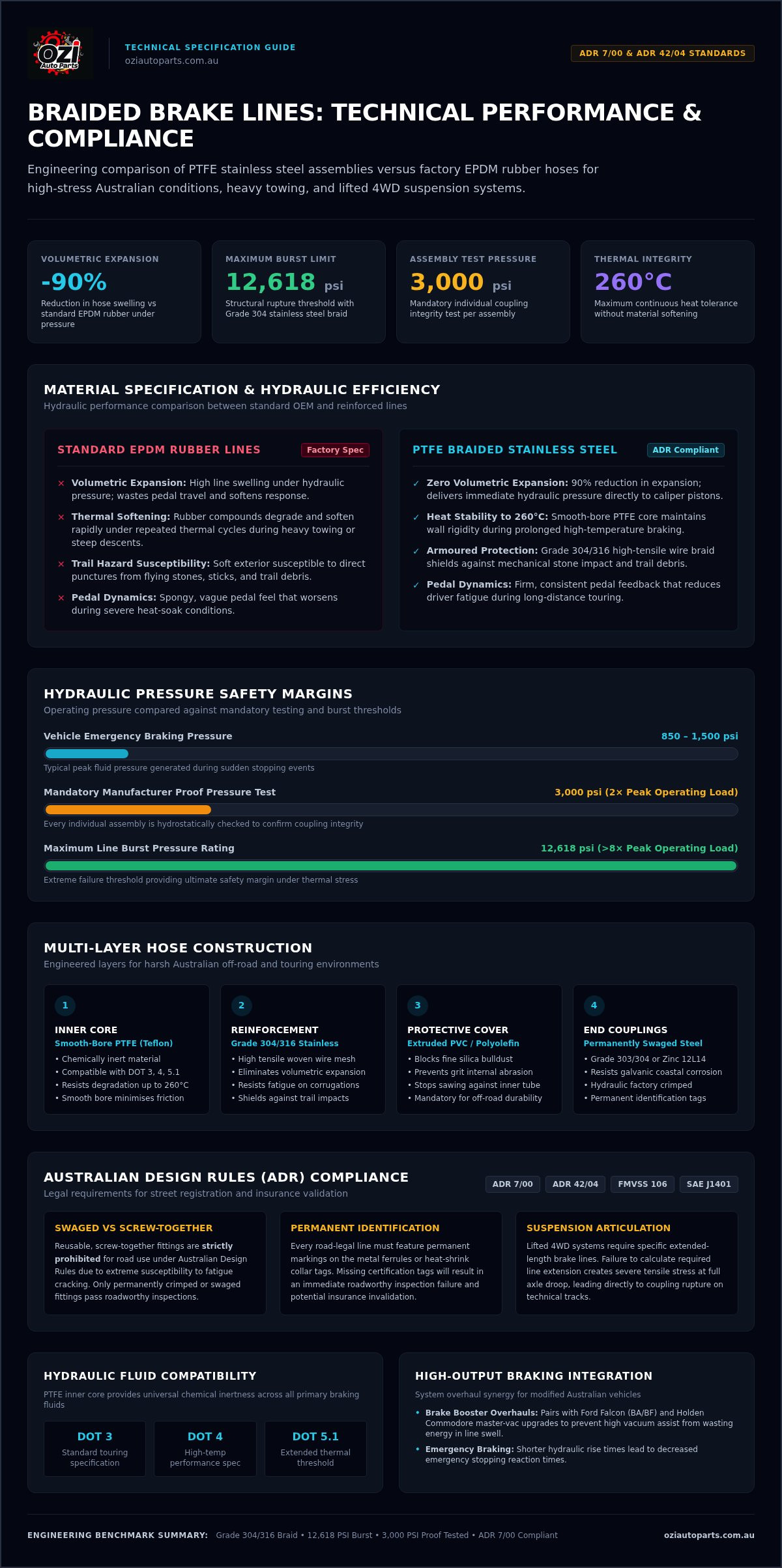
Standard rubber hoses use EPDM rubber. Under high pressure, these walls swell. This is known as hydraulic brake line expansion. It wastes pedal travel and softens response. Installing braided brake lines australia replaces these with PTFE-lined hoses wrapped in Grade 304 stainless steel. This construction handles burst pressures up to 12,618 psi. It ensures every millimetre of pedal movement translates into immediate caliper piston action.
To see these components in action on a local build, watch this installation guide:
Australian outback tracks present extreme physical risks. Flying stones and sticks can puncture soft rubber. The stainless steel braid acts as a physical shield against trail debris. It also resists heat soak. During heavy towing or steep mountain descents, brake fluid temperatures spike. Rubber hoses soften under these conditions. Braided lines maintain structural integrity up to 260°C.
Eliminating Pedal Sponge in Heavy-Duty Vehicles
Older Australian utes and sedans experience significant rubber fatigue. Constant heat cycles cause EPDM walls to soften. This results in a vague, spongy pedal feel. PTFE-lined braided hoses use a multi-layer design that resists this degradation. This upgrade is essential when pairing with high-output Ford Falcon brake boosters or Holden Commodore upgrades. A complete system overhaul ensures that increased vacuum assist is not wasted through line swelling. Consistent pedal feel reduces driver fatigue during long-distance Australian touring.
- 90% reduction in volumetric expansion compared to rubber.
- Decreased reaction times for emergency braking.
- Compatible with DOT 3, DOT 4, and DOT 5.1 fluids.
Selection Criteria: Materials, Fittings, and ADR Compliance
Material choice determines longevity in harsh environments. High-grade 304 or 316 stainless steel outer braids provide the necessary tensile strength to prevent expansion. Lower-grade alternatives often lack the fatigue resistance required for braided brake lines australia used on corrugated roads. A protective PVC or polyolefin outer sleeve is mandatory for off-road use. This jacket prevents fine silica grit, bulldust, and mud from penetrating the metal braid. Without this barrier, abrasive particles create a sawing action against the inner PTFE tube during vibration. This eventually leads to catastrophic line failure.
End fittings must resist severe galvanic corrosion. Grade 303/304 stainless steel or zinc-plated carbon steel (such as 12L14 steel) are essential specifications. This is particularly vital in coastal regions where salt spray accelerates metal oxidation. Every certified assembly must meet these technical tolerances:
- Outer Braid: Grade 304 or 316 Stainless Steel for maximum tensile strength.
- Inner Core: Smooth-bore PTFE (Teflon) for chemical inertness and heat resistance.
- Fittings: Permanently swaged Stainless Steel or Zinc-Plated 12L14 Steel.
- Outer Cover: Extruded PVC or Polyolefin to prevent internal abrasion.
Professional manufacturers perform individual pressure testing on every assembly. These tests reach 3,000 psi to confirm coupling integrity. This far exceeds the 850 to 1,500 psi generated during emergency braking. Sourcing certified braided brake lines australia ensures these safety benchmarks are strictly maintained.
ADR 7/00 Standards and Australian Road Legality
Australian Design Rule (ADR) 7/00 and ADR 42/04 govern flexible hydraulic hoses for road-registered vehicles. To remain street-legal, lines must feature permanently swaged or crimped fittings. Reusable screw-together fittings are prohibited because they are susceptible to fatigue cracking. Compliance doesn't just improve performance; it ensures your vehicle passes roadworthy inspections and maintains valid insurance coverage. Road-legal hoses must adhere to FMVSS 106 manufacturing and safety standards or SAE J1401 benchmarks. These standards mandate specific burst pressure and tensile strength ratings. Look for permanent identification markings on the ferrules or heat-shrink tags. If you are completing a full system overhaul, selecting components from an Australian brake specialist guarantees adherence to these local regulations.
Application Guide: 4WDs, Performance Sedans, and System Integration
Lifted 4WDs require specific line lengths to maintain ADR compliance. Standard hoses often experience tensile stress during full axle articulation. For suspension lifts of 50mm or greater, extended braided brake lines australia are mandatory. These typically provide an extra 50mm to 100mm of travel. This prevents the hose from ripping out at maximum droop on technical tracks. VSB 14 mandates that hydraulic lines must not experience kinking or stretching at any point during complete suspension travel.
Performance sedans like the Ford Falcon and Holden Commodore benefit from direct pressure transfer. Braided lines complement high-pressure systems by ensuring no hydraulic force is lost to hose swelling. This is critical during emergency stops or heavy track use. Before installation, confirm your fluid choice. PTFE-lined hoses are compatible with DOT 4 and DOT 5.1 fluids. Don't use DOT 5 silicone fluid in ABS systems as it causes aeration in high-frequency valves.
Upgrading the Complete Brake System
Maximum stopping power requires a holistic approach. High-output brake boosters increase the vacuum assist available to the master cylinder. Without braided brake lines australia, this extra force often results in increased hose expansion rather than improved clamping at the caliper. Integrating Holden Commodore brake boosters with stainless steel lines ensures a rock-solid pedal. For broader maintenance context, consult our comprehensive guide to brake system parts.
- Component Clearance: Cycle steering lock-to-lock and confirm zero contact with tyres or control arms.
- New Hardware: Install new annealed copper crush washers on both sides of every banjo fitting.
- Torque Accuracy: Tighten banjo bolts to 20 to 25 Nm to prevent shearing the hollow bolt.
- Pressure Check: Apply maximum pedal pressure for 60 seconds and inspect all unions for fluid weeping.
Optimise Your Hydraulic System for Australian Conditions
Upgrading to braided brake lines australia provides the final link in a heavy-duty braking system. These components eliminate volumetric expansion. They ensure every bit of hydraulic pressure from your booster reaches the calipers without delay. Choosing ADR 7/00 compliant lines with permanently swaged fittings maintains your vehicle's road legality and insurance validity. Whether you're navigating technical off-road tracks in a lifted 4WD or driving a performance sedan, stainless steel durability is essential.
Ozi Auto Parts provides technical expertise in brake system upgrades. We offer components engineered for harsh Australian environments. Browse the Ozi Auto Parts range of high-performance brake components and boosters today for fast nationwide shipping. Equip your vehicle with hardware that delivers performance and safety on every drive.
Frequently Asked Questions
Are braided brake lines legal for street use in Australia?
Yes, provided they meet ADR 7/00 and ADR 42/04 standards. Road-legal braided brake lines australia must feature permanently swaged fittings; reusable screw-together fittings are prohibited. Every assembly must carry permanent identification markings on the ferrules or heat-shrink tags. These markings verify compliance with FMVSS 106 or SAE J1401 standards. Unmarked lines fail roadworthy inspections and engineering certifications for modified vehicles.
Do braided brake lines improve stopping distance?
They improve braking efficiency by reducing the delay in hydraulic pressure transfer. Standard rubber hoses expand under pressure, wasting pedal travel. Braided lines reduce this volumetric expansion by up to 90%. This results in a firmer pedal and more immediate caliper engagement. While ultimate stopping distance depends on tyre grip, the improved pedal response significantly reduces the driver's total reaction time.
How long do stainless steel braided brake lines last?
High-quality PTFE-lined braided hoses are engineered to outlast standard EPDM rubber lines. PTFE is chemically inert and does not age, harden, or absorb moisture over time. The stainless steel outer braid provides physical protection, while a PVC jacket prevents internal abrasion from road grit. With a thermal operating range of -70°C to +260°C, these components maintain structural integrity for the vehicle's service life.
Can I install braided brake lines myself?
Installation is possible for those with mechanical experience and the correct tools. The process involves degreasing unions, installing new copper crush washers, and torqueing banjo bolts to 20 to 25 Nm. A full system bleed with fresh DOT 4 or DOT 5.1 fluid is mandatory to remove air. Incorrect installation risks hydraulic failure; always perform a 60-second pressure test to inspect for weeping at fittings.