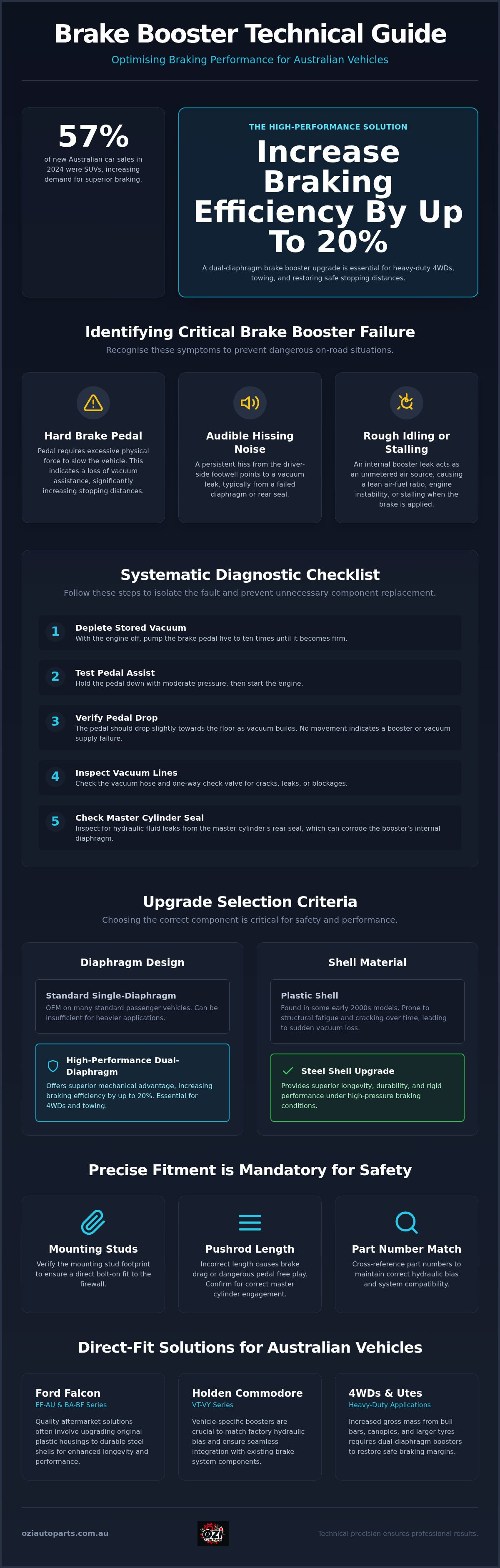
SUVs accounted for 57% of new Australian car sales in 2024. Many drivers struggle with spongy pedals and dangerous stopping distances. A high-performance upgrade brake booster australia increases braking efficiency by up to 20%. Essential for heavy-duty 4WD applications. You recognise that a hard pedal signals imminent mechanical failure. Precise part number identification across vehicle series is mandatory for safety and performance.
This guide delivers technical data to restore stopping performance. We detail vacuum leak diagnostics, dual-diaphragm selection, and 2026 ADR 98/01 compliance. Specific fitment criteria for Ford, Holden, and Toyota models included. Use these insights for rapid diagnosis and accurate part selection. Optimise braking response with direct-fit components and high-output vacuum systems. Professional results require technical precision.
Key Takeaways
- Identify critical booster failure through symptoms like hard pedal feel and audible vacuum leaks in the driver-side footwell.
- Verify mounting stud footprints and pushrod lengths to ensure direct bolt-on compatibility and correct master cylinder engagement.
- Select a high-performance upgrade brake booster australia with a dual-diaphragm design to increase braking efficiency by up to 20%.
- Source vehicle-specific boosters for Australian models including Holden Commodore and Ford Falcon to restore factory braking performance.
Identifying Brake Booster Failure and System Symptoms
Brake booster failure presents a critical safety risk. A primary symptom is a hard brake pedal requiring excessive physical force to decelerate. This occurs when the unit fails to provide atmospheric pressure assistance. Understanding how vacuum brake boosters work is essential for diagnosing these pressure differentials. Internal diaphragm ruptures or seal failures result in increased stopping distances and reduced assist efficiency. For heavy-duty 4WDs or towing vehicles, a high-output upgrade brake booster australia restores necessary safety margins.
Audible cues often accompany mechanical failure. A persistent hissing noise from the driver-side footwell indicates a vacuum leak through the rear seal. Because the booster relies on engine vacuum, a significant internal leak acts as an unmetered air source. This often causes rough idling or engine stalling when the brake pedal is depressed. The air-fuel ratio becomes lean, compromising engine stability.
Mechanical Diagnostics for Vacuum Leaks and Pedal Feel
Systemic troubleshooting prevents unnecessary component replacement. Follow these sequential steps to isolate the fault:
- Pump the brake pedal five times with the engine off to deplete stored vacuum.
- Hold the pedal down with moderate pressure and start the engine.
- Verify that the pedal drops slightly toward the floor; no movement indicates a booster or vacuum supply failure.
- Inspect vacuum hose integrity and check valve one-way operation for leaks or blockages.
- Check the mounting interface for hydraulic fluid leaks from the master cylinder rear seal that can damage the internal diaphragm.
Selection Criteria: Fitment, Shell Materials, and Specifications
Successful component selection requires precise dimensional verification. Confirm the mounting stud footprint and pushrod length to ensure a direct bolt-on fit. Incorrect pushrod length causes dragging brakes or dangerous free play. When choosing a master cylinder and booster, assist ratios must align with vehicle gross mass. Dual-diaphragm units offer superior mechanical advantage for heavy 4WDs and towing applications. These units can increase braking efficiency by up to 20% over standard single-diaphragm designs. Match part numbers against all brake systems documentation to maintain hydraulic bias. This ensures the upgrade brake booster australia integrates perfectly with existing master cylinder specifications.
Choosing Between Steel and Plastic Shell Units
Plastic boosters in early 2000s models are prone to structural fatigue and cracking. This leads to sudden vacuum loss and a hard pedal feel. Steel shell upgrades provide superior longevity and rigid performance under high-pressure braking. Specific Ford Falcon EF-AU upgrade units replace original plastic housings with durable steel shells. This is a critical upgrade brake booster australia for maintaining older Australian icons. Verify heat shield requirements when switching shell materials. High engine bay temperatures accelerate diaphragm perish if shielding is inadequate. For technical precision, source your brake system components from specialised Australian suppliers. Reliable inventory ensures fast delivery and correct fitment for local road conditions.
Sourcing High-Performance Brake Boosters for Australian Vehicles
Reliable sourcing of direct-fit components is vital for maintaining Australian vehicle fleets. Owners of the Holden Commodore VT-VY series require boosters that match factory hydraulic bias. For the Ford Falcon BA-BF range, quality aftermarket solutions address the specific demands of local road conditions. These direct-replacement units eliminate the fabrication risks associated with universal performance parts. Efficient procurement is now possible via specialised online platforms featuring nationwide logistics. This ensures rapid delivery of critical mechanical spares to workshops and enthusiasts across Australia. Choosing a vehicle-specific upgrade brake booster australia guarantees compatibility with existing mounting studs and master cylinder pushrods.
4WD Upgrades and Model-Specific Fitment Solutions
The Australian 4WD market is expanding, with 4x4 ute market share reaching 18.1% in the decade leading up to 2023. Heavy accessories like bull bars and larger tyres increase vehicle gross mass, which often exceeds the capacity of standard single-diaphragm units. High-output Toyota Master Vac upgrades significantly improve pedal response in lifted 4x4s. Dual-diaphragm boosters provide a 20% increase in braking efficiency, making them essential for modified vehicles. Follow these criteria for 4WD sourcing:
- System Balance: Ensure master cylinder compatibility when increasing booster capacity to maintain correct hydraulic pressure balance.
- Load Handling: Select dual-diaphragm units to manage the additional kinetic energy of modified utes and SUVs.
- Direct Fit: Prioritise boosters designed for specific model series to avoid complex engineering certification required for "complex modifications" in states like Queensland.
Optimise Vehicle Deceleration and System Safety
Systematic diagnosis of vacuum integrity remains critical for road safety. Transitioning from failure-prone plastic shells to durable steel upgrades ensures long-term reliability. Precise fitment data for Ford, Holden, and Toyota models is readily available, eliminating installation delays. For heavy-duty applications, a dual-diaphragm upgrade brake booster australia provides the 20% efficiency gain necessary for modified 4WDs.
Having established clear diagnosis and selection criteria, Ozi Auto Parts maintains a comprehensive catalogue backed by specialised mechanical expertise. Nationwide Australian delivery is available for all direct-fit mechanical spares. Browse the full range of Brake Boosters at Ozi Auto Parts to restore pedal feel and stopping distance, ensuring professional results through precise component matching.
Frequently Asked Questions
How can I test if my brake booster is leaking vacuum?
Perform a vacuum depletion test by pumping the brake pedal five times with the engine off. Hold the pedal down and start the engine. The pedal should drop slightly under your foot. If it remains hard or pushes back, the vacuum seal is compromised. Listen for a persistent hissing sound in the driver-side footwell when the brakes are applied.
Is it better to repair or replace a faulty brake booster?
Replacement is the only recommended solution for a failing unit. Brake boosters are sealed safety components; internal diaphragm repairs are not reliable for road use. Installing a new unit ensures compliance with current Australian Design Rules and restores factory safety margins. High-performance options are available if you intend to upgrade brake booster australia for towing or heavy 4WD applications.
What is the difference between a single and dual diaphragm brake booster?
A dual-diaphragm booster utilizes two internal membranes to provide significantly more vacuum assist than a single-diaphragm unit of the same external diameter. This design is essential for heavy vehicles like 4x4s or utes where high pedal effort is required to stop. Dual-diaphragm upgrades can increase braking efficiency by approximately 20%, making them ideal for vehicles with larger tyres.
Do I need to bleed my brakes after replacing the booster?
You must bleed the entire hydraulic system after replacement. Because the master cylinder is detached from the booster during the installation process, air can enter the lines or the cylinder reservoir. Follow a sequential bleeding procedure starting from the wheel furthest from the master cylinder. This ensures a firm pedal feel and reliable stopping performance under all local driving conditions.