
Pumping fresh fluid through your calipers won't cure a brake pedal that slowly sinks to the floor at red lights. That steady pressure loss points directly to internal piston seal bypass. When choosing a replacement brake master cylinder Australia trade mechanics and vehicle owners need exact hydraulic specifications, not generic catalogue guesses. Bore diameter mismatches and metric versus imperial thread errors directly compromise stopping performance.
Sorting through mismatched line fittings or waiting on slow freight turns routine maintenance into frustrating downtime. You deserve reliable braking without the guesswork. This guide delivers the precise technical criteria to confirm internal seal failure, calculate bore sizing, and verify pushrod configurations. Review the diagnostic steps below to identify hydraulic faults and select direct-fit replacements built for Australian road standards.
Key Takeaways
- Identify internal hydraulic seal failure early by distinguishing steady pedal creep at stoplights from fluid leaks entering the booster housing.
- Select the correct piston bore diameter to balance pedal stroke length against line pressure for your specific caliper setup.
- When sourcing a replacement brake master cylinder Australia trade buyers verify port thread standards and pair units with compatible vacuum brake boosters.
- Execute horizontal bench bleeding before final chassis mounting to prevent trapped air pockets from compromising braking performance.
Understanding Brake Master Cylinder Function and Common Failure Symptoms in Australian Vehicles
A vehicle's braking safety hinges on hydraulic integrity. Dual internal pistons convert driver pedal effort into equalised line pressure, supplying split-circuit hydraulic safety across front and rear brake circuits reliably. Understanding standard tandem brake master cylinder operation clarifies how separate chambers prevent total brake loss if an individual hydraulic line ruptures.
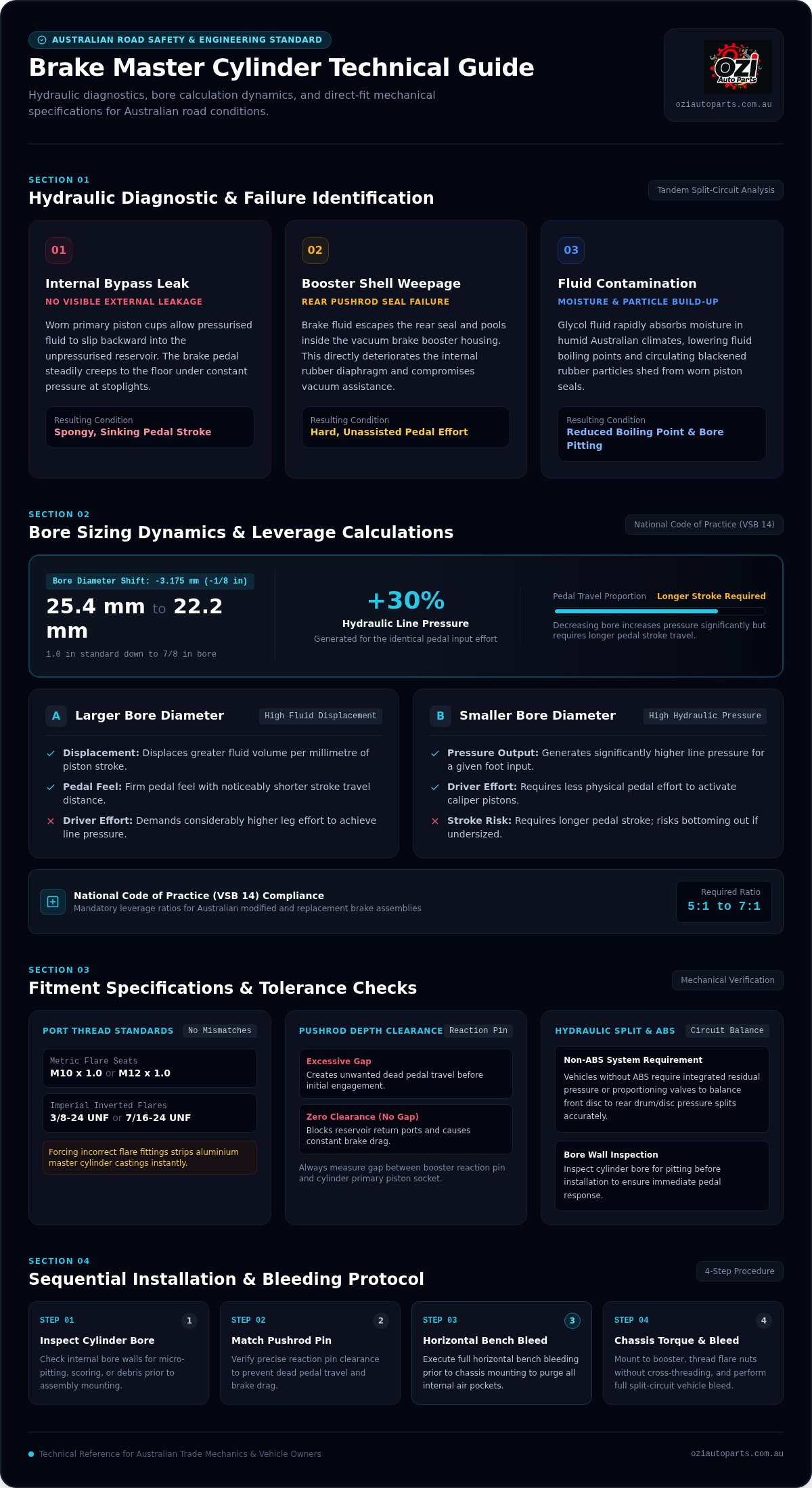
Internal bypass failure occurs when worn primary piston cups allow pressurised brake fluid to slip backward into the unpressurised reservoir, causing the pedal to creep toward the floor under steady foot pressure without any external fluid loss.
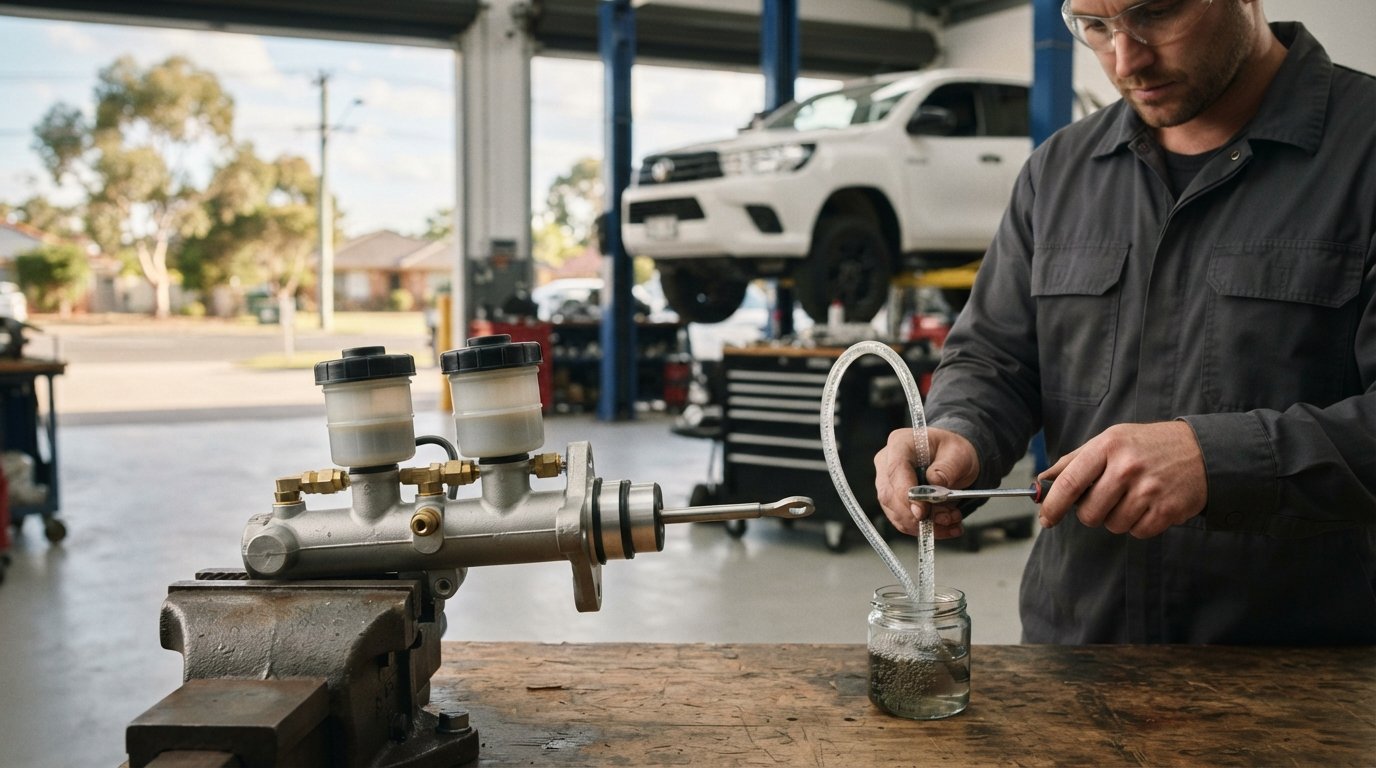
To eliminate air pockets before mounting, watch this bench bleeding procedure:
Identifying Hydraulic Pressure Loss and Spongy Pedal Symptoms
Differentiating master cylinder failure from standard caliper wear requires specific mechanical checks:
- External seal leakage: Fluid weeping past the rear pushrod seal pools inside the vacuum booster shell. This deteriorates the internal rubber diaphragm and produces a hard, unassisted pedal.
- Internal piston degradation: Scored bore walls or rolled cup lips let hydraulic fluid slip past the pressure chambers, resulting in an extended, spongy pedal travel under steady braking loads.
- Fluid contamination: Glycol fluid absorbs moisture rapidly in humid Australian climates. This drops fluid boiling points and circulates blackened rubber particles shed from breaking-down piston seals.
When selecting a replacement brake master cylinder Australia trade mechanics and DIY builders must inspect the unit bore for pitting. Replacing contaminated hydraulic assemblies restores immediate pedal responsiveness and line pressure stability.
Selecting the Correct Brake Master Cylinder Bore Size and Fitment Specifications
Hydraulic braking performance relies entirely on piston surface area. Piston bore diameter directly governs pedal travel distance versus required leg effort. Stepping down bore diameter by just 3.175 mm (1/8 inch), such as reducing from 25.4 mm (1 inch) to 22.2 mm (7/8 inch), increases hydraulic line pressure by roughly 30% for identical pedal effort, though pedal stroke travel lengthens proportionally. Any modification requires compliance with National Code of Practice (VSB 14) braking standards to ensure legal pedal leverage ratios between 5:1 and 7:1.
Bore sizing shifts balance pedal travel against physical effort:
- Larger bore diameter: Displaces greater fluid volume per millimetre of stroke. This creates a firmer pedal with shorter travel, but demands considerably higher foot effort from the driver.
- Smaller bore diameter: Generates significantly higher line pressure for a given foot input, but requires longer pedal stroke travel that risks bottoming out if undersized.
Verifying Port Thread Pitch, Pushrod Clearance, and ABS Compatibility
Precision mechanical checks prevent hydraulic leaks and fitting damage:
- Port thread standard: Confirm metric flare seats (typically M10x1.0 or M12x1.0) versus imperial inverted flares (3/8-24 or 7/16-24 UNF). Forcing incorrect flare nuts strips aluminium castings instantly.
- Pushrod depth matching: Measure the clearance between the booster reaction pin and master cylinder primary piston socket. Excessive gap causes dead pedal travel, while zero clearance blocks reservoir return ports and drags brakes.
- Proportioning valves: Vehicles without ABS require built-in residual pressure or proportioning valves to balance rear drum or disc pressure splits accurately.
When upgrading or replacing a worn brake master cylinder Australia drivers can source precision-matched brake components directly through Ozi Auto Parts for dependable nationwide dispatch.
Sourcing Reliable Replacement Brake Master Cylinders and Boosters Across Australia
Replacing a failed hydraulic cylinder requires inspecting the vacuum brake booster simultaneously. Mismatched pushrod travel or booster vacuum failure causes premature seal extrusion, while oil residue inside an aged booster rapidly deteriorates new rubber cups. Sourcing a precision-machined unit certified to SAE master cylinder performance standards guarantees hydraulic pressure containment, split-circuit reliability, and long seal life. Review our practical advice on buying online auto parts in Australia to streamline your parts sourcing and secure direct-fit replacements without retail supply delays.
Bench Bleeding Essentials and Professional System Integration Guidelines
Installing a dry hydraulic unit forces trapped air directly into ABS modulator valves, causing persistent pedal sponginess and bleeding headaches. Bench bleeding purges air from both pressure chambers prior to final chassis fitment. Follow these sequential steps:
- Clamp the cylinder horizontally in a bench vice using soft aluminium or rubber jaws to prevent bore distortion.
- Install threaded adapter fittings into both outlet ports, looping clear plastic tubing submerged beneath the fluid level in the reservoir.
- Fill the reservoir chambers with fresh, moisture-free fluid meeting required vehicle performance ratings.
- Depress the primary piston steadily using a smooth, blunt pushrod, allowing internal springs to return fully between strokes until air bubbles vanish completely.
- Plug both hydraulic ports immediately before transferring the primed master cylinder onto the vacuum booster mounting studs.
When sourcing a replacement brake master cylinder Australia trade mechanics and commercial fleet operators verify booster pushrod alignment and port pitch to guarantee dependable, immediate stopping performance under heavy braking.
Restore Firm Pedal Response and Hydraulic Safety
Accurate hydraulic diagnostics resolve pedal creep before it compromises road safety. Verifying piston bore diameter ensures the correct pressure balance, while thorough bench bleeding keeps air out of sensitive ABS valves. Pairing replacement cylinders with compatible vacuum brake boosters prevents premature seal wear and maintains consistent stopping force.
When sourcing a replacement brake master cylinder Australia mechanics and vehicle owners rely on direct-fit parts engineered for demanding local driving conditions. Access an extensive catalogue of premium brake hydraulics and vacuum boosters backed by prompt Australia-wide dispatch. Find your replacement brake master cylinder at Ozi Auto Parts today to restore firm pedal feel and drive with absolute confidence.
Frequently Asked Questions
Can I drive my vehicle if the brake pedal slowly sinks to the floor?
No, you shouldn't drive the vehicle under any circumstances. A brake pedal that sinks under steady foot pressure confirms internal seal bypass, creating an immediate road safety hazard. As primary piston cups fail, hydraulic line pressure drops unexpectedly during braking. In an emergency stop, this failure can cause total loss of braking and extended stopping distances.
What happens if I install the wrong bore size brake master cylinder?
Installing an incorrect bore size disrupts the hydraulic ratio between the pedal and calipers. A cylinder bore that is too large creates a rock-hard pedal requiring dangerous foot effort to slow down. Conversely, an undersized bore increases pedal travel, causing the pedal to bottom out against the floorpan. For any replacement brake master cylinder Australia fitments must match factory sizing.
Why is bench bleeding mandatory before bolting the master cylinder to my car?
Bench bleeding eliminates trapped air pockets inside the cylinder bore and piston springs before chassis installation. Installing a dry unit forces air directly into the vehicle's ABS modulator and hard lines. Purging this trapped air through caliper bleed nipples alone is difficult and often requires electronic scan-tool bleed routines. Priming the unit on a bench ensures immediate pressure.
How do I know whether the fault is my master cylinder or brake booster?
Inspect the specific pedal behaviour and vacuum assist response. A failing master cylinder causes the pedal to sink slowly under sustained pressure or feel spongy due to internal bypass. A failed brake booster produces a rock-hard pedal requiring heavy leg effort to slow down, often accompanied by a hissing vacuum leak. Sourcing a matched brake master cylinder Australia wide restores proper booster operation.