

Paying a 50% workshop markup on brake pads is an avoidable tax. Most Australian drivers face inconsistent quotes and confusing price gaps between brands. It's frustrating to pay premium rates while remaining uncertain about material quality. This guide provides the latest data on brake pad prices australia to ensure you pay a fair price for reliable replacement parts. We agree that navigating technical specifications shouldn't be a guessing game. This 2026 cost analysis promises to give you the benchmarks needed to spot overcharged invoices. We'll examine current market rates, compare ceramic versus semi-metallic performance, and detail the benefits of direct-to-consumer sourcing. This technical breakdown identifies high-value opportunities for 4WD and passenger vehicles. It focuses on part efficiency, stock availability, and component reliability for the informed buyer.
Key Takeaways
- Establish price benchmarks for 2026 where standard passenger car pads typically range from A$60 to A$120 for quality components.
- Evaluate the performance trade-offs between high-durability semi-metallic compounds and quiet, low-dust ceramic materials to suit your driving style.
- Analyse current brake pad prices australia to identify and eliminate the 30% to 50% markups typically applied by mechanical workshops.
- Secure high-performance 4WD and heavy-duty braking components through direct-to-consumer specialists to ensure technical reliability and cost efficiency.
Benchmarking Brake Pad Prices in Australia for 2026
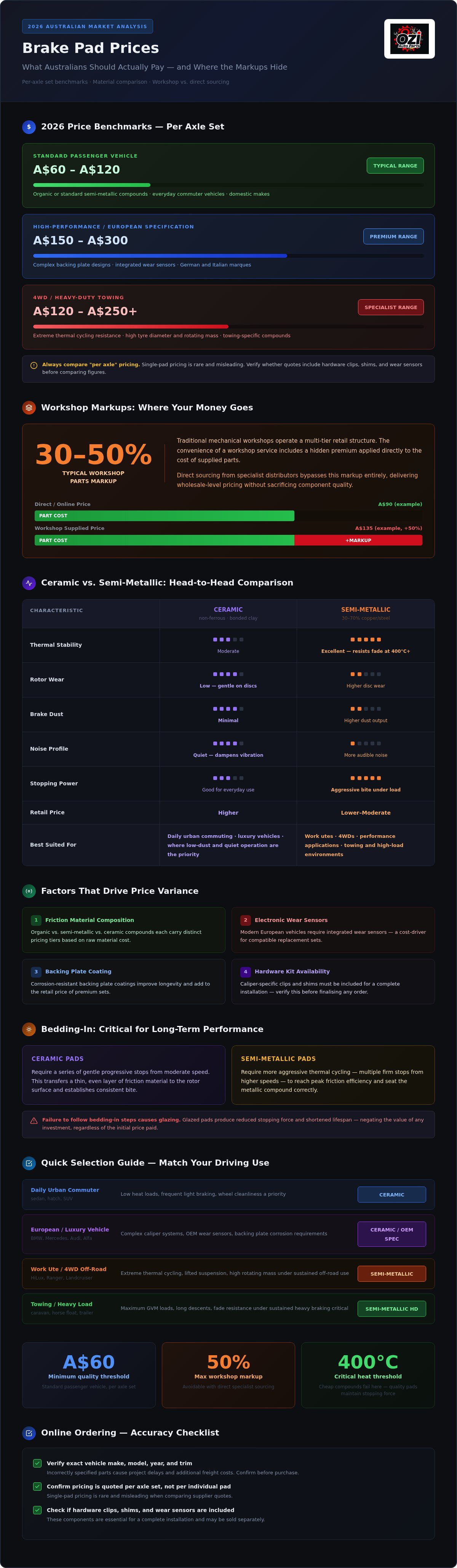
Market data for 2026 indicates significant variance in brake pad prices australia based on technical specifications. Vehicle gross mass and kinetic energy dissipation requirements dictate component cost. Standard passenger vehicles typically require friction materials costing between A$60 and A$120 for parts only. High-performance units or European specifications often reach A$150 to A$300 per axle. These higher costs reflect complex backing plate designs and integrated wear sensors common in German and Italian marques.
Accurate benchmarking requires comparing "per axle" sets. Single-pad pricing is rare and misleading. Understanding these benchmarks helps consumers evaluate brake pad prices australia when comparing online retailers against physical workshops. Always verify if the quote includes essential hardware clips or shims. Factors influencing the final retail price include:
- Friction material composition such as organic vs semi-metallic.
- Inclusion of electronic wear sensors for modern European vehicles.
- Backing plate coating for enhanced corrosion resistance.
- Hardware kit availability for specific caliper types.
Prices for 4WD and Heavy-Duty Towing Applications
Specialised 4WD upgrade pads demand higher heat tolerance for sustained off-road use. These components must withstand extreme thermal cycling without friction glazing. Expect a price premium for lifted 4x4s where increased tyre diameter and rotating mass place higher stress on the braking system. Standard passenger pads lack the thermal capacity for these high-torque environments.
Heavy-duty towing applications require high-performance friction materials to maintain reliability under maximum load. Standard compounds often suffer from brake fade during long descents; towing-specific pads ensure consistent pedal feel and stopping power. These specialised sets prioritise mechanical component reliability and rapid heat dissipation. Sourcing these through a specialist provider like Ozi Auto Parts ensures access to heavy-duty inventory without retail workshop markups.
Factors Driving Price Variance: Materials and Performance
Material composition is the primary driver of brake pad prices australia. Manufacturers engineer friction compounds to balance noise, dust, and thermal stability. Semi-metallic pads contain 30% to 70% metals like copper or steel. They offer high durability and excellent heat transfer but often generate more rotor wear and audible noise. Conversely, ceramic pads use non-ferrous materials and bonded clay. These provide quiet operation and minimal brake dust at a higher retail price point.
Key technical trade-offs include:
- Thermal Stability: Semi-metallic pads resist fade better at high temperatures.
- Rotor Wear: Ceramics are gentler on discs, extending component life.
- Acoustic Profile: Ceramic materials dampen vibration to reduce brake squeal.
Low-metallic options represent a middle ground. They utilise small amounts of metal to enhance high-speed stopping power without the extreme noise of full metallic sets. Friction coefficients and heat dissipation capabilities dictate the final retail cost. Higher-rated pads maintain stopping force at 400°C temperatures. Cheap components often fail under these thermal loads. If you need reliable brake system parts that handle high-heat environments, prioritising material quality is essential.
Choosing Between Ceramic and Semi-Metallic Friction Materials
Selection depends on vehicle usage. Ceramic pads are ideal for daily urban driving and luxury vehicles. They're preferred where comfort and low-dust properties are the priority. Semi-metallic pads suit heavy-duty work utes and performance applications. These vehicles require the aggressive bite and thermal conductivity that only metallic compounds provide. It's a trade-off between refinement and raw stopping power under load.
Bedding-in procedures vary by material and affect long-term maintenance costs. Ceramic pads often require a series of gentle stops to transfer a thin layer of material to the rotor surface. Semi-metallic pads may need more aggressive thermal cycling to reach peak efficiency. Failure to follow specific bedding steps leads to glazing; this reduces the lifespan of your investment regardless of the initial brake pad prices australia.
Maximising Value: Buying Parts Online vs. Workshop Markups
Traditional mechanical workshops prioritise convenience over cost efficiency. This service model typically includes a 30% to 50% markup on supplied hardware. These margins significantly inflate brake pad prices australia for the end user. Sourcing directly from specialist distributors ensures access to wholesale-level pricing. It bypasses the multi-tier retail structure common in the Australian automotive industry.
Accuracy is paramount when ordering online. Verify vehicle fitment using exact model, year, and trim data before finalising a purchase. Incorrectly specified parts lead to project delays and increased shipping costs. Consider bundled deals that include brake rotors; a complete system overhaul often provides superior performance and better value than replacing pads alone. This approach ensures all friction surfaces are matched for optimal braking torque.
Direct Online Sourcing for Australian DIY Mechanics
Direct delivery to your door significantly reduces vehicle downtime. You don't need to wait for a local store to order in non-stock items. Specialist brake system parts often remain unavailable in general retail outlets. Sourcing from a dedicated inventory ensures you receive the correct technical specification for your vehicle's load requirements.
Cutting out the middleman allows you to secure the best brake pad prices Australia. It provides a transparent view of part costs without hidden workshop commissions. This transparency is vital for maintaining a strict maintenance budget. Focus on high-volume retailers that prioritise stock availability and technical accuracy. These providers offer the most reliable path to cost-effective vehicle maintenance for DIY owners and fleet managers alike.
Securing Technical Reliability and Cost Efficiency
Effective vehicle maintenance requires a balance of technical precision and commercial value. Sourcing components directly eliminates the 30% to 50% markups typically applied by mechanical workshops. This strategy ensures you secure the most competitive brake pad prices australia while maintaining high standards for friction material quality. Matching material composition to your specific vehicle load and driving environment prevents premature component failure. Whether you require quiet ceramic pads for urban luxury or heavy-duty semi-metallic sets for 4WD upgrades, direct procurement is the most efficient path forward. As a specialist Australian 4WD and brake component supplier, Ozi Auto Parts provides national delivery on all critical mechanical spares and professional technical support for vehicle fitment. Take control of your maintenance budget and component reliability today. Shop Premium Brake Pads at Ozi Auto Parts Prices and ensure your vehicle is equipped for peak performance.
Frequently Asked Questions
Why do brake pad prices vary so much between Australian retailers?
Variance primarily stems from the multi-tier distribution network in the Australian automotive sector. Direct-to-consumer retailers bypass the 30% to 50% profit margins typically added by mechanical workshops. Technical specifications like ceramic compounds or integrated wear sensors also create price gaps between budget and premium product lines. Higher-priced units usually offer superior thermal stability and reduced rotor wear.
Is it cheaper to buy brake pads online and take them to a mechanic?
Sourcing components independently is generally cheaper because it eliminates workshop markups. You gain access to wholesale-level brake pad prices australia by buying from specialist distributors. However, confirm your mechanic accepts customer-supplied parts first. Some workshops refuse installation due to liability or warranty policy restrictions. Providing your own parts ensures you control the quality of the friction material used.
How much extra should I pay for ceramic brake pads in 2026?
Ceramic pads command a higher price due to their advanced non-ferrous material composition. These components prioritise quiet operation and minimal brake dust; this makes them the standard choice for luxury passenger vehicles. While the initial outlay is higher, the reduced wear on rotors can lower long-term maintenance costs for urban drivers. The premium reflects the specialised engineering required for these refinement-focused materials.
Do 4WD brake pads cost more than standard car pads?
4WD pads are more expensive because they're engineered for higher kinetic energy dissipation. These vehicles have greater rotating mass and often carry heavy towing loads; this requires high-torque friction materials. The increased physical size and specialised heat-resistant compounds naturally elevate 4WD brake pad prices australia compared to standard passenger car alternatives. These components must maintain reliability under extreme off-road thermal cycling.