
Your vehicle's stopping distance isn't just a matter of pedal feel; it's a precise calculation of thermal capacity and friction coefficients. With Queensland's 2026 roadworthy rules now mandating a 3mm minimum pad thickness, selecting the right material is a technical necessity. This brake pads buyer's guide australia provides the specifications needed to eliminate alloy dust, stop brake squeal, and prevent fade when towing heavy caravans. You'll gain a definitive understanding of ceramic versus semi-metallic compounds and ADR compliance to ensure correct fitment the first time.
We break down performance data across various heat cycles. Coverage includes material durability, noise suppression, and specific upgrades for heavy-duty 4WD applications. Learn to interpret manufacturer data sheets and identify the correct friction coefficient for your vehicle's GVM. Expect a direct, efficiency-driven analysis of the components required to maintain maximum safety and stopping performance on Australian roads.
Key Takeaways
- Distinguish between ceramic and semi-metallic compounds to eliminate brake squeal and alloy dust.
- Consult this brake pads buyer's guide australia to align friction materials with high-demand 4WD and towing loads.
- Execute precise part selection via VIN data and OEM cross-referencing to ensure correct fitment first time.
- Evaluate thermal capacity requirements based on vehicle GVM and heat cycles for optimal stopping power.
- Confirm ADR compliance for all replacement components to maintain Australian safety and legal standards.
How to Identify Brake Pad Materials and Friction Properties
Brake performance relies on the interaction between the rotor and friction material. Selecting the correct compound is the priority in this brake pads buyer's guide australia. Modern Brake pad components consist of binders, fillers, and lubricants. These manage specific thermal loads. Choose between organic, semi-metallic, and ceramic options. Base the decision on vehicle Gross Vehicle Mass (GVM) and driving environment.
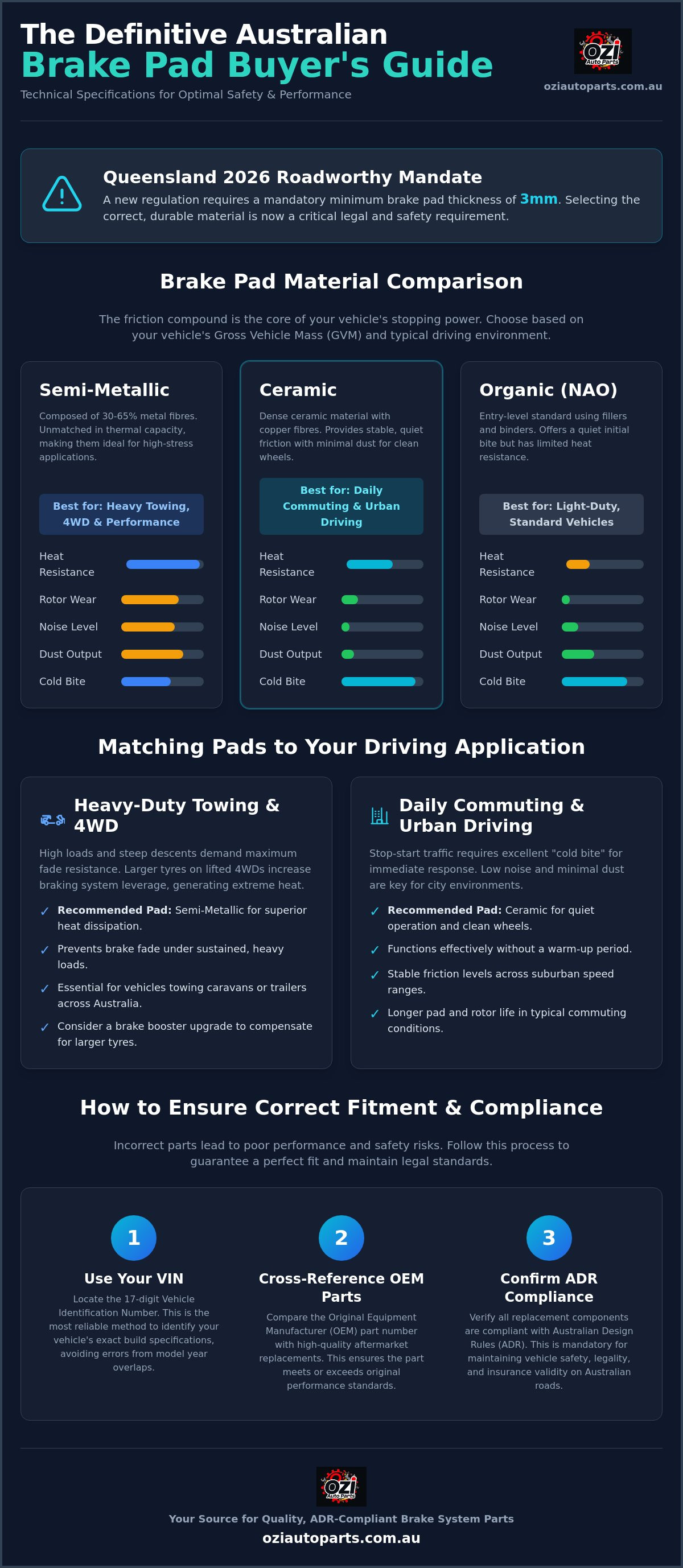
Organic pads are the entry-level standard. They provide a quiet bite. Heat resistance is limited. For heavy-duty Australian use, semi-metallic pads are superior. These contain 30% to 65% metal. They conduct heat away from the braking surface. This prevents fade during steep descents or heavy towing.
To better understand these material differences, watch this helpful video:
Semi-Metallic vs Ceramic: The Technical Trade-offs
Metallic options provide a high thermal threshold. Expect increased noise and faster rotor wear. They're the standard for 4WDs and commercial vehicles. Ceramic pads use dense ceramic material and copper fibres. They provide stable friction and minimal dust. Lifespan is longer in suburban conditions. They don't handle extreme heat cycles like high-metal alternatives.
European vs Japanese Vehicle Requirements
Vehicle origin dictates specifications. European manufacturers specify softer pads. This ensures high-speed modulation and aggressive bite. These produce heavy black dust on alloy wheels. Japanese and Australian-built vehicles typically utilise harder compounds. These prioritise longevity and lower rotor wear. This choice is ideal for long-distance highway travel across the continent.
For those maintaining European vehicles, sourcing high-quality spares from specialised retailers like ELart, UAB ensures that the replacement parts meet the stringent performance standards required for these specific braking systems.
How to Select Brake Pads Based on Driving Application
Vehicle weight and Gross Vehicle Mass (GVM) dictate friction requirements. A standard hatchback requires different thermal management than a 3.5-tonne GVM 4WD. This brake pads buyer's guide australia focuses on matching compound to application. Heavy loads create sustained heat. This alters the tribological properties of friction material, leading to accelerated wear or brake fade if the wrong pad is fitted. Determine your typical load capacity and heat cycle frequency before purchasing replacement parts.
Heavy-Duty Towing and 4WD Performance
Towing caravans or trailers across the Australian outback demands pads with high fade resistance. Heavy-duty semi-metallic compounds are the standard for these conditions. Lifted 4WDs with larger tyre diameters increase the leverage against the braking system. This generates higher surface temperatures during mountain descents. To compensate for this increased effort, consider a brake booster upgrade to enhance vacuum assistance and reduce pedal pressure. Using 4WD upgrade parts ensures reliability when the system is pushed to its thermal limits.
Daily Commuting and Urban Driving
Urban drivers should prioritise ceramic compounds for stop-start traffic. These pads provide excellent 'cold bite', meaning they function effectively without needing a warm-up period. This is critical for immediate emergency stopping in city environments. Ceramic materials also offer:
- Quiet operation with minimal brake squeal.
- Low-dust output to keep alloy wheels clean.
- Stable friction levels across standard suburban speed ranges.
Match your pad selection to your rotor type. Slotted rotors help degas the friction surface during high-heat cycles, while solid rotors are sufficient for standard commuting. For a complete system overhaul, source high-quality brake system parts that meet or exceed original equipment specifications.
How to Source and Verify Correct Brake Fitment
Precise part identification is the most critical step in this brake pads buyer's guide australia. Manufacturer build dates often overlap within a single model year, making simple year/make/model searches unreliable. Adhering to Australian vehicle repair standards ensures your replacement components operate within safe tolerances. To understand how these parts integrate with your wider assembly, consult our comprehensive guide to brake system parts.
Follow these steps to verify your vehicle's specific requirements before ordering:
- Locate the 17-digit Vehicle Identification Number (VIN) on your compliance plate or registration papers.
- Identify the Original Equipment Manufacturer (OEM) part number from the existing pad backing plate or vehicle service manual.
- Cross-reference the OEM number with specialised aftermarket spares to confirm dimensional compatibility.
- Inspect the brake caliper to determine if it is a single-piston or multi-piston design, as this dictates the required pad shape.
Ordering Online and Fitment Accuracy
Verify the contents of the brake kit before finalising your purchase. Professional-grade sets should include essential hardware like anti-rattle shims and wear sensors. Always inspect your caliper slide pins during the swap. Seized or dry pins cause uneven pad wear and reduced piston retraction. Note that front and rear pad sets utilize different friction volumes and are never interchangeable. Review nationwide shipping schedules to ensure mechanical components arrive before your scheduled maintenance window.
The Bedding-In Process for New Pads
Correct installation requires a methodical thermal bedding-in procedure. This process transfers a consistent film of friction material onto the rotor surface. Execute the following steps to ensure optimal performance:
- Perform 10 to 15 controlled decelerations from 60 km/h down to 10 km/h.
- Use moderate, even pedal pressure throughout the cycle.
- Drive for several minutes between applications to allow for cooling.
- Avoid emergency braking for the first 200 to 500 kilometres to prevent surface glazing.
Proper heat cycling prevents noise issues and maximises the service life of your new friction materials.
Optimise Your Braking Performance and Safety
Selecting the correct friction material is a technical requirement for maintaining vehicle safety and operational efficiency. You now have the data to distinguish between ceramic and semi-metallic compounds based on heat cycles and load requirements. This brake pads buyer's guide australia ensures you can match components to your vehicle's specific GVM and driving conditions with confidence. Accurate VIN verification and a methodical bedding-in process are the final steps to preventing glazing and ensuring long-term rotor health.
Ozi Auto Parts provides the inventory depth needed for every application. Our range includes specialised 4WD mechanical components designed for the Australian outback. We offer technical expert support to assist with precise part matching and provide reliable Australia-wide delivery to minimise your vehicle's downtime. High-performance braking starts with the right specifications and verified fitment.
Shop high-performance brake system parts at Ozi Auto Parts and secure your vehicle's stopping power today.
Frequently Asked Questions
How long do brake pads typically last in Australia?
Brake pads in Australia generally last between 40,000 and 100,000 kilometres. This lifespan depends on your driving style, the vehicle's weight, and the type of friction material installed. Heavy-duty 4WDs operating in off-road conditions or urban stop-start traffic typically experience faster wear rates. It's vital to monitor pad thickness regularly to ensure it stays above the 3mm legal limit now enforced in states like Queensland.
What is the average cost of brake pads for a 4WD?
The cost for 4WD brake pads varies based on material composition and specific performance ratings. Heavy-duty semi-metallic pads designed for outback conditions or towing generally require a higher investment than standard organic alternatives. High-performance upgrades for larger 4WD models involve specialised engineering to manage increased thermal loads. Consult this brake pads buyer's guide australia to identify the correct specifications for your vehicle's GVM before purchasing replacement parts.
Can I mix ceramic and semi-metallic pads on the same car?
You can install different friction materials on separate axles, but you must never mix them on the same axle. Front brakes handle roughly 70% of the braking force and often benefit from aggressive semi-metallic compounds. Rear axles can utilise ceramic pads to minimise dust. Maintaining identical material types across a single axle is critical for balanced braking and predictable vehicle handling during emergency stops.
Why are my new brake pads squealing after installation?
Squealing usually results from high-frequency vibrations between the pad and the caliper. This often happens if anti-squeal shims are missing or if the bedding-in process was skipped. Glazing of the friction material occurs when new pads face extreme heat before they've properly mated with the rotor surface. Ensure all hardware, including slide pins and clips, is correctly lubricated with high-temperature brake grease during the fitment process.