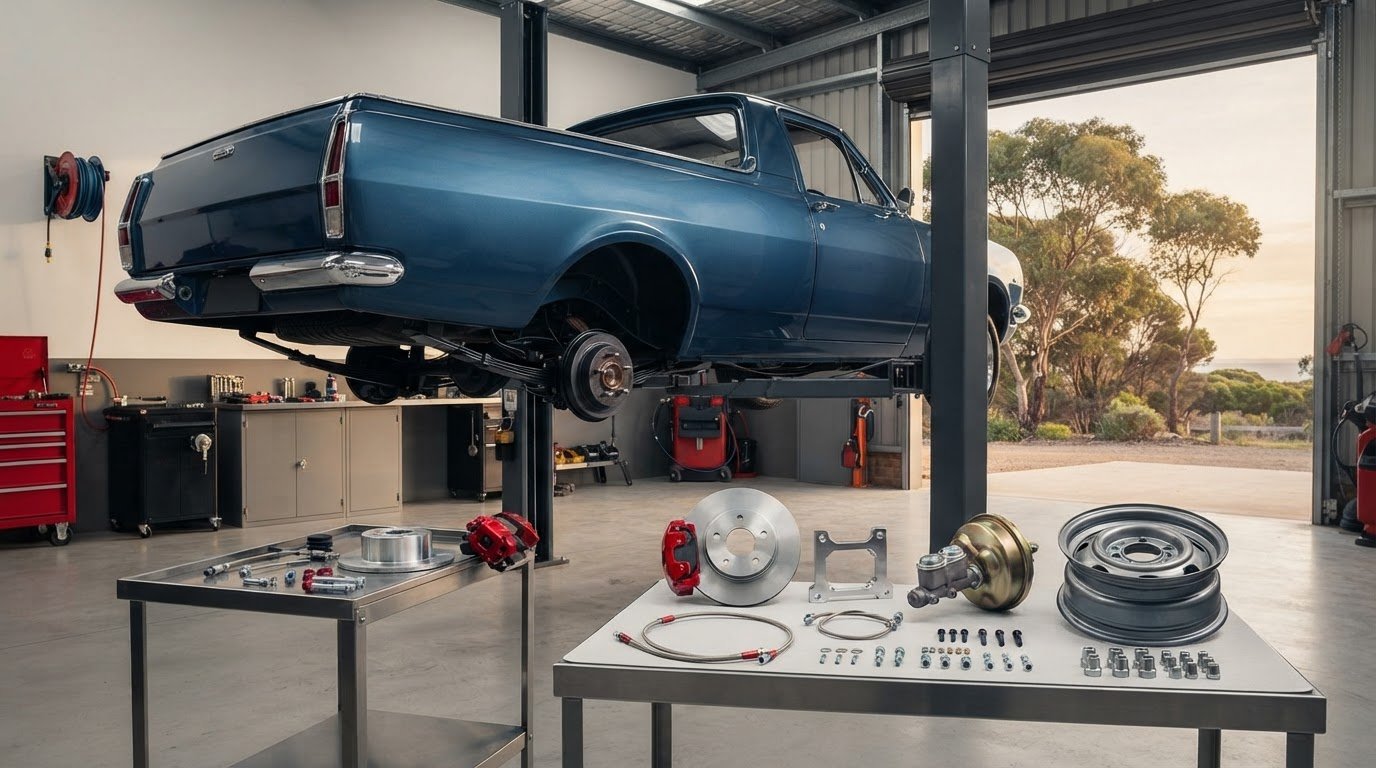
The right disc brake conversion kit isn’t chosen by make and model alone. This disc brake conversion kit Australia buying guide starts with your vehicle’s exact configuration, then checks whether the kit components match the existing brake system.
It’s easy to focus on the conversion itself and overlook details such as build year, axle setup and hydraulic connections. These can affect whether the parts work together and whether additional components are needed.
Use this guide to gather the vehicle details needed for fitment, compare kit contents and assess the interfaces with your current braking system. Pay particular attention to the master cylinder, brake booster, wheels and caliper hardware. The aim is to make a practical, informed selection based on your vehicle, not the kit label alone.
Key Takeaways
- Start your disc brake conversion kit Australia assessment with the vehicle’s exact make, model, year, variant, engine and axle configuration.
- Match the kit’s stated application to your vehicle details, not just a similar model name.
- Compare the listed calipers, rotors, mounting hardware and hydraulic parts to understand what the kit includes.
- Assess compatibility with the master cylinder, brake booster, wheels and existing hydraulic system before choosing components.
What a disc brake conversion kit changes, and when to consider one
A conversion kit is a group of components designed to change a vehicle’s existing brake configuration, such as replacing drum brakes with disc brakes on an axle. The parts required depend on the vehicle and its current setup. Assess a disc brake conversion kit Australia listing against those details rather than treating it as a universal upgrade.
For a visual overview of a drum-to-disc conversion, watch this installation video from Disc Brakes Australia:
Drum-to-disc conversion: understand the system before comparing kits
Drum brakes use curved shoes that press against the inside of a rotating drum. Disc brakes use pads that clamp onto a rotor. Each design has its own components and interfaces, and neither configuration is automatically right for every vehicle. For an overview of disc brake components and operation, see Disc brake.
Begin by identifying the axle and existing hardware. Check the hub design, available wheel clearance and hydraulic connections. Assess the master cylinder and brake booster as part of the system, rather than leaving them until after selecting components. Brake boosters and caliper hardware are separate brake system parts, not a complete conversion kit.
Consider a conversion when assessing a change to the vehicle’s braking configuration. Don’t assume the change guarantees a shorter stopping distance or a particular performance result. Outcomes depend on the complete vehicle and brake system. For broader background on braking components and spares, refer to All Brake Systems: The Master Guide to Automotive Braking and Spares.
How to check disc brake conversion kit fitment for your vehicle
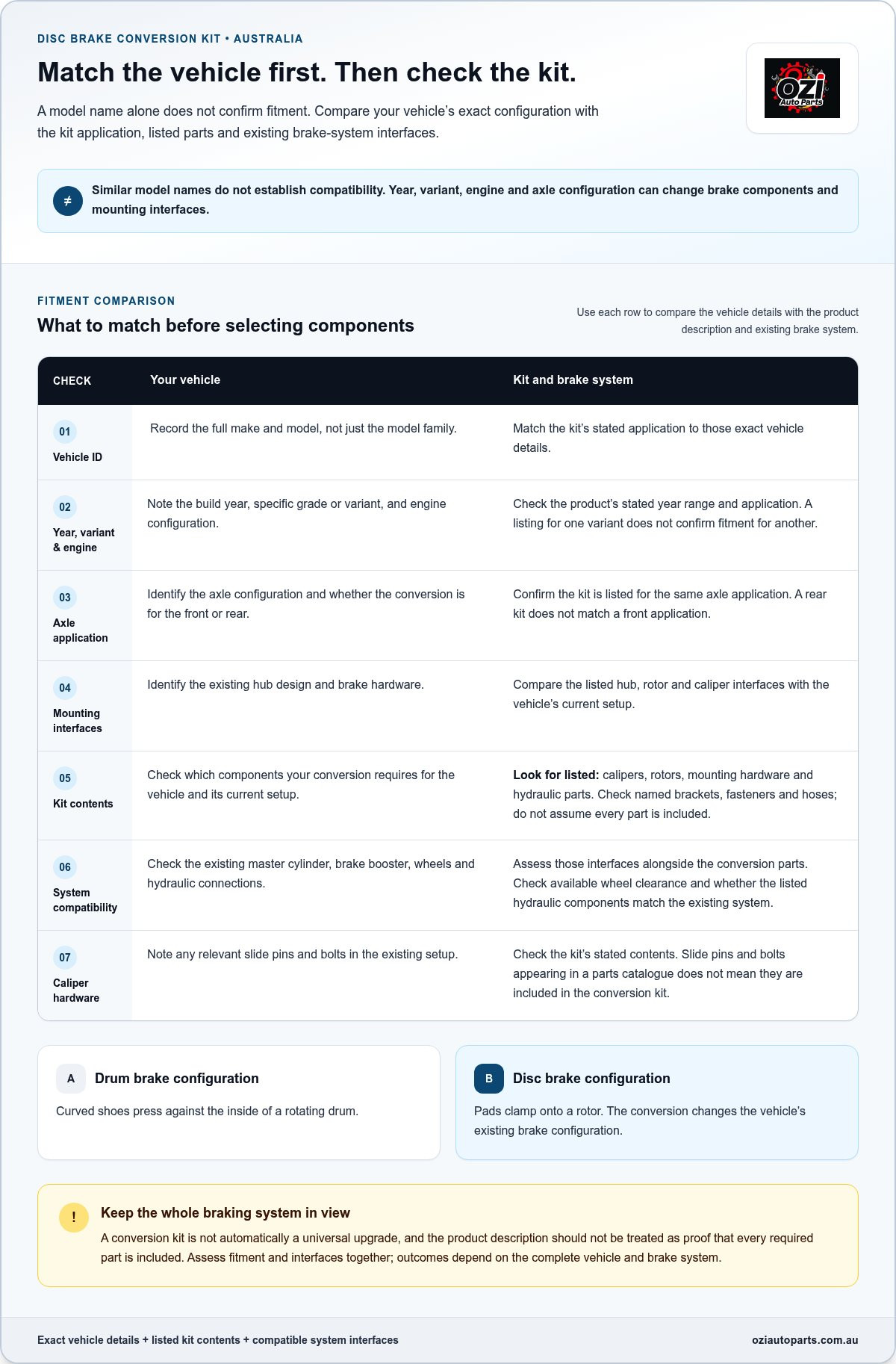
A conversion kit isn’t automatically interchangeable across vehicles with the same model name. Year, variant, engine and axle configuration can change the brake components and mounting interfaces. Before comparing features, match the kit’s stated application to your vehicle’s exact details.
Which vehicle and brake details should buyers match?
Use this checklist before selecting a disc brake conversion kit in Australia:
- Make and model: Record the full vehicle identification, not just the model family.
- Year: Match the listed year range to the vehicle’s build details.
- Variant and engine: Note the specific grade or variant and engine configuration.
- Axle application: Confirm whether the kit is for the front or rear axle, and identify the axle configuration.
- Interfaces: Compare the listed hub, rotor and caliper interfaces with the vehicle’s existing setup.
These details matter because similar model names can cover different brake or axle configurations. A rear conversion kit doesn’t match a front application, and a listing for one variant doesn’t establish fitment for another. Don’t infer compatibility from appearance or shared branding.
For more on matching parts to a vehicle, refer to Verifying Vehicle Fitment for Brake and Steering Spares. Apply the same care to related brake components. Ozi Auto Parts supplies brake system parts alongside other mechanical components.
What to compare in kit contents and related brake components
Compare the product description’s parts list with the components required for the conversion. Don’t assume a kit includes every part simply because it’s described as a conversion kit. Check whether calipers, rotors, mounting hardware and hydraulic parts are listed, then note any components identified separately.
Check the complete parts list and supporting brake hardware
Compatibility involves the full braking system, not just the rotor. Assess the master cylinder, brake booster, wheels and existing hydraulic connections alongside the conversion components. A mismatch at an interface can prevent parts from working together. Compare the kit’s stated contents with your vehicle’s existing system and the exact application in the product description.
- Calipers and rotors: Compare the listed components with the vehicle application and axle configuration.
- Mounting hardware: Check which brackets, fasteners and related hardware the description names.
- Hydraulic parts: Identify any listed hoses or other hydraulic components, then assess compatibility with the existing system.
- Supporting components: Include the master cylinder, booster and wheel clearance in the overall assessment.
Caliper hardware matters too. Slide pins and bolts support caliper movement and mounting, but their presence in a parts catalogue doesn’t mean they’re included in a conversion kit. Compare the kit’s stated contents with relevant brake caliper slide pins and bolts as separate components.
When ordering online, keep your vehicle details alongside the product description as you review the application, parts list and any stated exclusions. Ozi Auto Parts also supplies brake system parts for vehicle-specific selection.
Make your brake parts selection with confidence
A sound conversion assessment starts with exact vehicle fitment, then compares the kit’s stated components with the existing brake system. Match the make, model, year, variant, engine and axle application. Review the product description for included calipers, rotors, mounting hardware and hydraulic parts. Assess the master cylinder, booster, wheels and hydraulic connections as part of the complete setup.
Use the checks in this disc brake conversion kit australia guide to compare specifications before buying. Ozi Auto Parts is an Australian online retailer supplying brake system parts and caliper hardware, with nationwide delivery. Its range helps you compare related components for your vehicle’s braking system.
Browse brake system parts and take the next step towards a well-matched braking setup.
Frequently Asked Questions
Can a disc brake conversion kit fit any vehicle?
No. Conversion kits are designed for specific vehicle applications, and they aren’t automatically interchangeable across variants of the same model. Match the kit’s stated application to your vehicle’s make, model, year, variant, engine and relevant axle configuration. Also compare the hub, rotor and caliper interfaces with your existing setup before choosing a kit.
What parts are included in a disc brake conversion kit?
Kit contents vary, so use the product description to identify what’s included. A listing can specify components such as calipers, rotors, mounting hardware or hydraulic parts, but don’t assume every item is supplied. Note any parts identified separately, then compare the full list with the components required for your vehicle’s configuration.
Do I need to check the brake booster and master cylinder when converting to disc brakes?
Yes. Assess both as part of the full braking system, along with the existing hydraulic connections and wheel clearance. Don’t assume the conversion requires a new booster or master cylinder, or that the current components are automatically compatible. The right assessment depends on the vehicle, its existing brake setup and the conversion components specified for that application.
How do I choose the right disc brake conversion kit in Australia?
Start with your vehicle’s exact details: make, model, year, variant, engine and axle configuration. Match them to the kit’s stated application, then review its product description for included calipers, rotors, mounting hardware and hydraulic parts. Assess compatibility with the master cylinder, booster, wheels and existing hydraulic system. A disc brake conversion kit Australia buyers select should match the vehicle, not just a similar model name.