

Ignoring a high-speed vehicle shudder is a direct path to catastrophic drivetrain failure. While many drivers mistake driveline vibrations for simple wheel alignment issues, the reality is often more complex. Recognising specific driveshaft balancing symptoms is critical for maintaining mechanical integrity. A minor oscillation at 80 km/h can quickly escalate into damaged transmission seals or destroyed centre bearings. Precise diagnosis saves time. It prevents unnecessary expense.
You need a vehicle that operates with technical precision. Identifying the source of a harmonic hum or a floorboard vibration shouldn't be a guessing game. This diagnostic guide provides the technical data required to isolate balancing issues from worn universal joints. We'll examine the mechanical causes of driveline noise and the importance of ISO 1940-1:2003 balance quality requirements. You'll learn how to source high-specification replacement driveshafts with confidence. We focus on stock availability and engineering accuracy for the Australian market. From 4WD upgrades to standard passenger vehicle spares, accuracy is the priority.
Key Takeaways
- Understand the mechanical role of weight distribution in torque transmission to prevent premature transmission seal and centre bearing failure.
- Identify specific driveshaft balancing symptoms including speed-sensitive floorpan shudders occurring between 80 km/h and 110 km/h.
- Differentiate between driveshaft imbalance and worn universal joints by isolating vibration locations within the vehicle cabin.
- Source high-quality aftermarket driveshafts using VIN-specific data to ensure OEM-level performance and precision fitment.
- Minimise vehicle downtime by choosing engineered spares that withstand harsh Australian road conditions and high-speed operation.
Driveline Dynamics: Why Driveshaft Balance is Critical
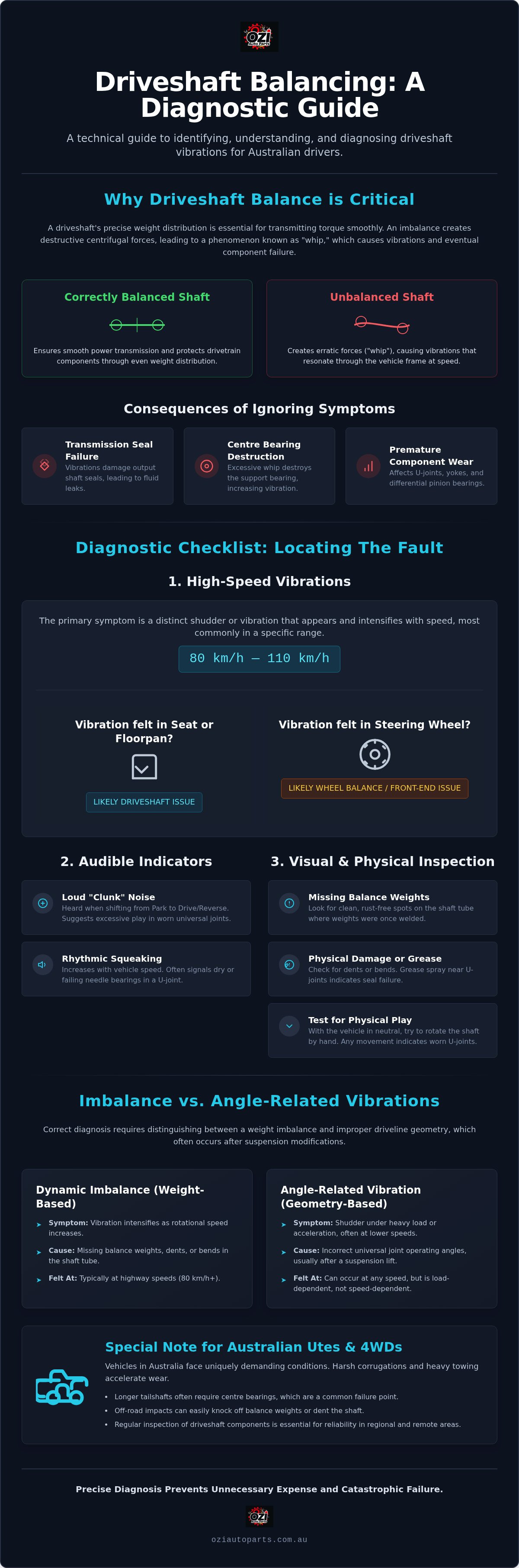
Mechanical precision is the foundation of driveline health. A driveshaft must maintain an even distribution of weight around its rotating axis. This is the definition of balance. When a shaft is out of balance, it generates erratic centrifugal forces during rotation. These forces lead to "whip," which is a physical deflection of the shaft while it spins. At Australian highway speeds, even minor weight discrepancies create massive vibrations that resonate through the vehicle frame.
The primary function of the shaft is transmitting torque from the transmission to the differential. It must perform this task while rotating at high RPM. Properly balanced components protect the entire system. They prevent premature wear on transmission output shafts and differential pinion bearings. Ignoring driveshaft balancing symptoms leads to expensive component failure and extended vehicle downtime. Reliability depends on rotational accuracy.
Dynamic vs Angle-Related Driveline Vibrations
Understanding the difference between dynamic and angle-related issues is vital for accurate diagnosis. Dynamic balance problems are weight-based. They typically intensify as rotational speed increases. These are the most common driveshaft balancing symptoms observed by Australian drivers during highway transit. Angle-related vibrations are different. They stem from improper universal joint operating angles. This frequently occurs after suspension modifications or heavy-duty lifts. If your vehicle shudders at low speeds under heavy load, verify the driveline geometry before assuming a balance issue.
The Role of Tailshafts in Australian Utes and 4WDs
Australian 4WDs and utes often utilise extended driveshafts, commonly referred to as tailshafts. These configurations frequently require centre bearings for additional support and vibration dampening. Local conditions are uniquely demanding. Harsh corrugations and heavy-duty towing accelerate the loss of balance weights and joint degradation. Maintaining tailshaft integrity is essential for regional driving and off-road performance. Check balance weights and centre bearing mounts regularly to ensure long-distance mechanical reliability.
Diagnosing Driveshaft Balancing Symptoms: A Technical Checklist
Effective diagnostic procedures isolate rotating mass issues from general suspension wear. Vibration analysis confirms that dynamic imbalance produces specific harmonic frequencies that correlate directly with vehicle speed. Most driveshaft balancing symptoms manifest as a distinct shudder between 80 km/h and 110 km/h. Vibrations felt through the floorpan typically indicate a rear driveshaft issue. Conversely, steering wheel oscillations usually suggest front-end component wear or wheel balance errors.
Visual inspection is the next logical step. Locate the shaft and check for these specific indicators:
- Missing balance weights: Look for clean spots on the tube where weights were previously welded.
- Physical damage: Dents or bends in the tube alter weight distribution instantly.
- Grease spray patterns: Excessive grease near the universal joints suggests seal failure.
High-Speed Vibrations and Floorpan Shudders
Consistent vibration that intensifies with speed is the primary indicator of dynamic imbalance. If the shudder is concentrated in the seat or floor, the rear tailshaft or centre bearing is the likely culprit. For front-end diagnostic steps, refer to our guide on CV Joint Failure Symptoms: A Diagnostic Checklist for Australian Drivers. Identifying the vibration zone prevents unnecessary parts replacement.
Audible Indicators: Clunks and Rhythmic Noises
Mechanical sounds provide critical diagnostic data. A loud clunk when shifting from Park to Drive or Reverse suggests excessive play in the universal joints. Rhythmic squeaking that increases with vehicle speed often signals dry needle bearings. Note that clicking sounds during low-speed turns are typically related to outer CV joint failure, not shaft balance. Accurate sound identification prevents misdiagnosis and reduces repair time.
Sourcing Replacement Driveshafts for Australian Conditions
Efficient part procurement is the final stage of driveline restoration. Once you identify driveshaft balancing symptoms, immediate replacement is the only way to prevent secondary damage to the transmission. Precision fitment is the priority. Use your vehicle's VIN or specific model year to verify compatibility before purchase. High-quality aftermarket driveshafts offer a utilitarian solution, providing OEM-level performance without the dealership price tag. These units are engineered for the high-torque demands of Australian towing and regional transit. Reliability in the bush depends on component strength.
Prioritise reinforced, heavy-duty shafts for 4WDs frequently used for off-roading. Standard components often fail under the stress of extreme articulation or increased load. For a detailed technical breakdown, review our guide on APG Auto Parts: Comparing Aftermarket Driveshafts for Australian Vehicles. Stock availability and technical specifications drive our inventory selection. We focus on parts that withstand the thermal and mechanical stresses of Australian highway speeds.
Fitment Accuracy for Australian 4WD and Ute Models
Driveshaft specifications are not universal. Lengths vary significantly between single cab, extra cab, and dual cab utes. Consult our Spare Driveshaft Parts: A Comprehensive Resource Guide for model-specific data. You must match the flange pattern and spline count exactly to ensure a successful installation. Incorrect fitment causes immediate mechanical interference and vibration. Accuracy is the only metric that matters during installation.
Addressing Imbalance in Lifted 4WD Vehicles
Suspension modifications change the operational landscape. A suspension lift alters driveline angles, which can mimic driveshaft balancing symptoms or accelerate wear on universal joints. Use heavy-duty joints and specialised shafts designed for increased travel. If your vehicle uses a multi-piece shaft, verify centre bearing alignment after any height modification. Correcting the geometry is as important as the balance of the shaft itself. Proper alignment ensures the longevity of your drivetrain components.
Restore Driveline Precision and Vehicle Stability
Precise diagnosis is the first step toward mechanical reliability. Identifying driveshaft balancing symptoms like floorpan shudders or harmonic hums prevents terminal damage to transmission seals and differential bearings. Maintaining rotational balance is critical for high-speed Australian highway transit and heavy-duty towing. You must address these oscillations before they compromise the integrity of the entire drivetrain.
Efficiency matters when your vehicle is off the road. As a specialist Australian mechanical part supplier, Ozi Auto Parts provides the technical expertise required for 4WD and ute drivelines. We offer nationwide delivery on all driveshaft components to ensure you receive high-specification spares regardless of your location. Our inventory focuses on aftermarket reliability and engineering precision for the local market.
Source replacement driveshafts and mechanical spares to optimise your vehicle's performance today. Technical accuracy and stock availability are our primary values. Secure the correct components and return to the road with complete confidence in your drivetrain.
Frequently Asked Questions
Can I drive with an unbalanced driveshaft?
Driving with an unbalanced driveshaft isn't recommended due to the high risk of mechanical failure. Resulting vibrations place extreme stress on transmission output seals, differential pinion bearings, and universal joints. Prolonged operation can lead to catastrophic driveline failure. The shaft may detach while the vehicle is in motion, causing severe underbody damage or total loss of control. Immediate replacement is required to maintain vehicle safety.
What is the difference between a driveshaft and a tailshaft?
A tailshaft specifically refers to the longitudinal shaft in rear-wheel drive or 4WD vehicles connecting the transmission to the rear differential. While driveshaft is a broad term in Australian terminology for any torque-transmitting shaft, tailshaft is the industry-standard label for this specific rear component. Front-wheel drive vehicles use half-shafts or CV axles instead. Understanding these labels ensures precision when ordering replacement mechanical spares.
Why does my car vibrate only at high speeds?
High-speed vibrations occurring above 80 km/h are a classic indicator of dynamic imbalance. Any weight discrepancy is magnified by centrifugal force as rotation speed increases, which causes the shaft to oscillate. These driveshaft balancing symptoms are distinct from low-speed shudders. If vibrations occur only during acceleration at low speeds, the cause is usually improper driveline angles or worn universal joints rather than balance issues.
How long do driveshafts typically last in Australia?
Driveshafts typically last over 150,000 kilometres under standard operating conditions. However, Australian environments often reduce this lifespan through heavy towing, off-road use, and exposure to dust or salt water. Regular inspections of universal joints and rubber boots are essential to prevent premature driveshaft balancing symptoms. Maintaining driveline integrity ensures the component reaches its maximum service life in harsh regional or coastal conditions.