
What if your vehicle's most critical mechanical link fails 400 kilometres from the nearest service centre? Remote breakdowns remain a constant risk when drivetrain components australia face harsh corrugated tracks and extreme heat. You likely find the overlap between powertrain and drivetrain terms confusing. This ambiguity complicates sourcing specific 4WD upgrade parts. It increases the fear of component failure in isolated locations. Sourcing specific components shouldn't be a guessing game.
Reliability requires technical precision. This 2026 reference guide delivers essential knowledge for mechanical integrity. Master drivetrain anatomy. Select replacement driveshafts and CV joints with confidence. We'll examine high-performance upgrades and the latest standards. Prepare your vehicle for long-distance travel across the continent. Focus on durability. Optimise performance. Maximise safety on every journey. This is your definitive resource for maintaining a robust, reliable vehicle in 2026.
Key Takeaways
- Distinguish between powertrain and drivetrain systems to accurately diagnose mechanical issues and component failures.
- Identify the critical functions of driveshafts and CV joints in maintaining torque transmission and suspension stability.
- Learn to mitigate the effects of extreme heat and corrugated terrain on drivetrain components australia to prevent remote breakdowns.
- Optimise sourcing efficiency by using vehicle VIN data to select high-performance drivetrain upgrades that meet or exceed OEM specifications.
Defining Drivetrain Components in the Australian Context
Reliable power delivery defines vehicle performance on Australian roads. A vehicle's drivetrain components australia must withstand high torque loads and extreme environmental stressors. The system encompasses every part behind the engine that facilitates movement. This includes the transmission, driveshafts, differentials, and final drive assemblies. Without a functional Drivetrain, engine output remains static energy. Integrity is paramount for safety when towing heavy caravans or navigating remote fire trails. Component failure in these scenarios often leads to total vehicle immobilisation.
Powertrain vs Drivetrain: Clearing the Confusion
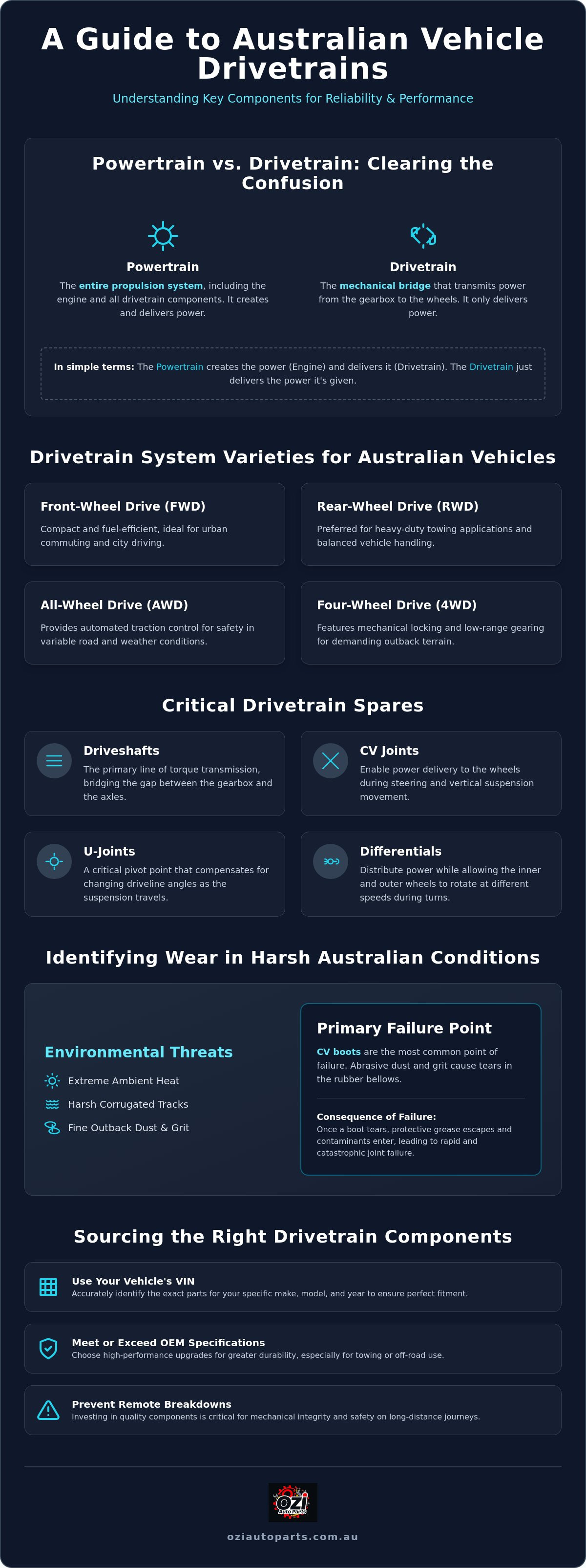
Industry terms often overlap. The powertrain is the total propulsion system. It includes the engine and all drivetrain parts. In contrast, the drivetrain is the mechanical bridge between the gearbox and the road surface. While the engine generates raw power, the drivetrain manages its distribution. Precision engineering in these parts ensures smooth acceleration and stable cruising speeds. Faults in this bridge cause vibrations, clunking, or power loss during critical manoeuvres. Technical accuracy matters when sourcing spares to ensure full compatibility with existing engine outputs.
System Varieties for Australian Vehicles
Australian drivers typically utilise four main configurations. Front-Wheel Drive (FWD) and Rear-Wheel Drive (RWD) are standard for urban commuting. However, All-Wheel Drive (AWD) and Four-Wheel Drive (4WD) dominate the regional and enthusiast markets. 4WD systems in modern utes rely on a transfer case. This component is vital for off-road applications. It distributes torque between the front and rear axles to maintain traction on loose surfaces. Choosing the correct drivetrain components australia depends entirely on your specific vehicle layout and intended use cases:
- FWD: Compact and efficient for city driving.
- RWD: Preferred for heavy-duty towing and balanced handling.
- AWD: Automated traction control for variable road conditions and safety.
- 4WD: Mechanical locking and low-range gearing for demanding outback terrain.
Critical Drivetrain Spares: Driveshafts, CV Joints, and Differentials
Maintaining high-performance drivetrain components australia requires understanding the specific stresses of local terrain. Driveshafts serve as the primary torque transmission line. They bridge the gap between the transmission and the axles. Universal joints (U-joints) are critical here. They allow the shaft to rotate freely while the suspension moves; this maintains consistent driveline angles. Without precise U-joint alignment, vehicles experience severe vibration and premature bearing wear. According to the Australian Automotive Aftermarket Association (AAAA), sourcing quality mechanical spares is essential for vehicle longevity in harsh environments. Differentials manage the speed variance between inner and outer wheels during cornering. This prevents tyre scrubbing and mechanical binding.
- Driveshafts: Transmit torque over variable distances between the gearbox and axles.
- CV Joints: Enable power delivery during steering and suspension movement.
- U-Joints: Compensate for changing driveline angles during travel.
- Differentials: Distribute power while allowing wheels to rotate at different speeds.
Driveshafts and CV Joints: The Flexible Link
Constant Velocity (CV) joints are mandatory for vehicles with independent suspension. They allow for both steering articulation and vertical suspension travel without losing power delivery. In Australia, CV boots are the primary failure point. Fine outback dust and grit act as abrasives. Once a boot tears, grease escapes and contaminants enter. This leads to rapid joint failure. Regular inspection of these rubber bellows is a non-negotiable maintenance task.
Differentials and Axle Assemblies
Heavy towing on the Stuart Highway places immense thermal and mechanical stress on rear axle assemblies. Constant high-speed travel with maximum GCM (Gross Combination Mass) can cause oil thinning and gear fatigue. Strengthening these systems with heavy-duty 4WD upgrade parts ensures the housing and internal gears can withstand these loads. If you are preparing for a long-distance trek, you can source specialised drivetrain spares to bolster your vehicle's reliability. Accurate fitment remains the priority for every component.
Identifying Drivetrain Wear in Harsh Australian Conditions
Australia's climate accelerates mechanical degradation. High ambient temperatures in the outback directly impact the chemical stability of gear lubricants. Corrugated roads act as a continuous vibration test for every bolt and bearing. Understanding these stressors helps you identify failing drivetrain components australia before they result in an expensive recovery situation. Water ingress during deep creek crossings remains a high risk for 4WD owners. Moisture emulsifies oil and destroys internal surfaces within kilometres of travel.
The Impact of Heat and Dust
Extreme heat causes gear oil to thin beyond its designed viscosity range. This reduces the protective film between moving gears and accelerates friction. Seals also suffer. High temperatures cause rubber compounds to harden and crack over time. Inspect drivetrain seals every 5,000 kilometres when operating in tropical or desert regions to ensure continued mechanical integrity. Dust ingress through compromised seals creates a grinding paste that rapidly wears down precision-machined surfaces.
Diagnostic Warning Signs
Early detection saves thousands in potential repair costs. Use this checklist to identify specific component failures through audible and tactile feedback:
- Clicking: A rapid clicking sound during low-speed turns indicates a failing CV joint.
- High-pitched Hum: A constant whine or hum that changes with vehicle speed usually points to worn differential bearings.
- Clunking: A heavy clunk when shifting from drive to reverse suggests excessive play in universal joints or driveshaft splines.
- Vibrations: Shuddering at specific speed intervals often indicates a bent or imbalanced driveshaft assembly.
If you notice any of these symptoms, you must order replacement 4WD upgrade parts immediately to restore vehicle reliability. Ignoring these warnings leads to catastrophic failure of the entire driveline assembly. Immediate action prevents collateral damage to the transmission and axle housings.
Selecting and Sourcing Drivetrain Components Australia-Wide
Precision in part procurement is as vital as the installation itself. Sourcing drivetrain components australia requires verified vehicle data to ensure a first-time fit. Using your vehicle’s VIN (Vehicle Identification Number) or specific build date eliminates the risk of receiving incompatible spares. This accuracy is essential when ordering heavy items like driveshafts or axle assemblies where return logistics are complex. Ozi Auto Parts serves as a specialised resource for these critical mechanical spares. We provide direct access to inventory without the delays associated with industrial or mining-only suppliers.
OEM vs Aftermarket: Performance Considerations
Standard OEM replacements are suitable for urban passenger vehicles. However, heavy-duty applications demand reinforced 4WD upgrade parts. These components feature higher-grade steel and improved seal designs to withstand outback conditions. Choosing upgraded components is a strategic investment for vehicles frequently used for towing or off-road touring. For those modifying their vehicle's height or load capacity, consult our guide on 4WD Suspension Upgrade Kits Australia to ensure your drivetrain angles remain within safe operational limits.
Reliable Delivery and Technical Support
Logistics for heavy mechanical parts require a robust nationwide network. We facilitate delivery across Australia; this includes regional Western Australia and Queensland. Rapid dispatch is a priority for drivers stranded in remote locations. Reliability in the drivetrain often impacts other systems. If your drivetrain issues coincide with poor stopping performance, review the All Brake Systems Guide to maintain total vehicle safety. Follow these steps to secure the correct parts:
- Identify: Locate your vehicle VIN and production month/year.
- Verify: Confirm spline counts and shaft lengths for CV joints and driveshafts.
- Select: Choose between standard duty or reinforced 4WD upgrade parts based on your typical terrain.
- Order: Utilise our online portal for transparent stock availability and shipping timeframes.
Maintain your vehicle’s mechanical integrity with parts engineered for the Australian environment. You can browse the Ozi Auto Parts drivetrain catalogue for your vehicle to find specific components today. Ensure your next journey is supported by high-performance engineering and dependable delivery.
Optimise Your Driveline for 2026
Reliability on Australian tracks depends on proactive maintenance and precision part selection. You now understand the mechanical distinction between powertrain and drivetrain systems. Identifying early warning signs of CV joint wear or driveshaft imbalance prevents catastrophic failure in remote regions. Sourcing drivetrain components australia requires technical accuracy and dependable logistics. Ozi Auto Parts provides specialised expertise for passenger vehicles and 4WD upgrades. We ensure your vehicle remains operational across demanding terrain. Benefit from nationwide shipping on heavy components and comprehensive technical fitment data. Don't risk immobilisation on your next trek. Maintain mechanical integrity with components engineered for local conditions. High-performance spares provide the durability needed for the Stuart Highway or the Simpson Desert. Trust technical expertise over guesswork for your next replacement part. Your safety depends on the strength of your driveline link.
Secure your vehicle’s reliability with Ozi Auto Parts drivetrain components
Prepare your vehicle for the road ahead with confidence.
Frequently Asked Questions
What are the most common drivetrain components to fail on a 4WD?
CV joints and universal joints are the most frequent failure points in off-road vehicles. High suspension articulation and extreme torque loads place immense stress on these flexible links. Dust ingress through torn rubber boots quickly destroys precision bearings. Regular inspection of these drivetrain components australia is essential for preventing remote breakdowns on corrugated tracks.
How do I know if my CV joint needs replacing?
A rhythmic clicking or popping sound while turning at low speeds indicates a failing CV joint. You may also experience shuddering during acceleration or notice grease sprayed inside the wheel rim. These symptoms suggest the internal bearings are compromised. Immediate replacement is necessary to maintain steering control and consistent power delivery to the wheels.
Can I drive with a vibrating driveshaft?
No, driving with a vibrating driveshaft is unsafe and causes extensive secondary damage. Vibrations often signal a bent shaft or worn universal joints. This imbalance destroys transmission output seals and differential pinion bearings over short distances. Addressing the issue immediately prevents a complete driveline failure that could leave you stranded.
Is it better to repair or replace a damaged differential?
Replacement is typically the more reliable and efficient option for modern vehicles. Rebuilding a differential requires specialised tools and precise shimming of ring and pinion gears. Labour costs for this technical process often outweigh the price of a new assembly. A complete replacement ensures all internal components meet original engineering specifications for long term durability.
How much does it cost to ship a driveshaft within Australia?
Shipping rates for heavy drivetrain components australia depend on the component dimensions and your delivery location. Freight to regional Western Australia or Northern Queensland usually incurs higher costs than metro deliveries. We provide nationwide shipping through a dedicated logistics network. Check the checkout portal for specific freight calculations based on your specific postcode and part weight.