
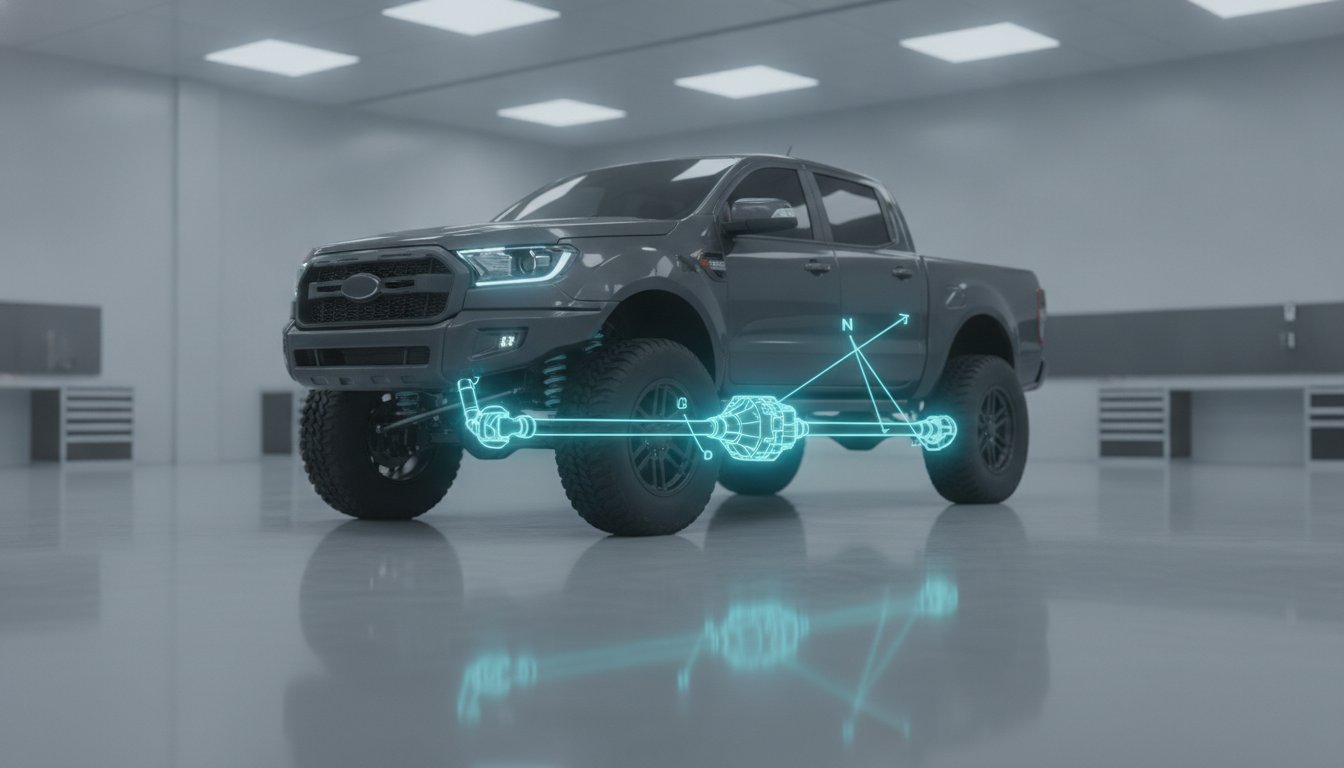
A suspension lift exceeding 50mm does more than clear larger tyres; it fundamentally compromises your vehicle's factory driveline geometry. If you've noticed high-frequency vibrations or premature U-joint failure, your standard tailshaft is likely overextended. Installing an extended driveshaft for lifted 4x4 applications is a technical necessity for maintaining mechanical integrity. Standard components often lack the required slip yoke travel to handle increased suspension articulation without binding or pulling apart.
You want a build that performs as well as it looks, but driveline issues can turn a weekend trip into a costly recovery mission. This 2026 guide provides the exact specifications needed to restore balance and eliminate driveline vibration. We examine the critical trade-offs between simple spacers and custom-length shafts while navigating current Australian lift regulations. You will gain the technical knowledge to select the right mechanical spares for a reliable, vibration-free 4WD. This ensures your ute remains durable on the bitumen and capable on the tracks.
Key Takeaways
- Understand how increased ride height reduces slip yoke engagement, leading to terminal component wear and driveline vibration.
- Evaluate the mechanical differences between budget-friendly spacers and the structural performance of a purpose-built extended driveshaft for lifted 4x4 applications.
- Master the technical measurement process at static ride height to ensure your new tailshaft fits without binding during full suspension articulation.
- Learn why sourcing precision-engineered driveline spares through specialised Australian e-commerce channels provides higher reliability than generic retail outlets.
The Impact of Suspension Lifts on Driveline Geometry
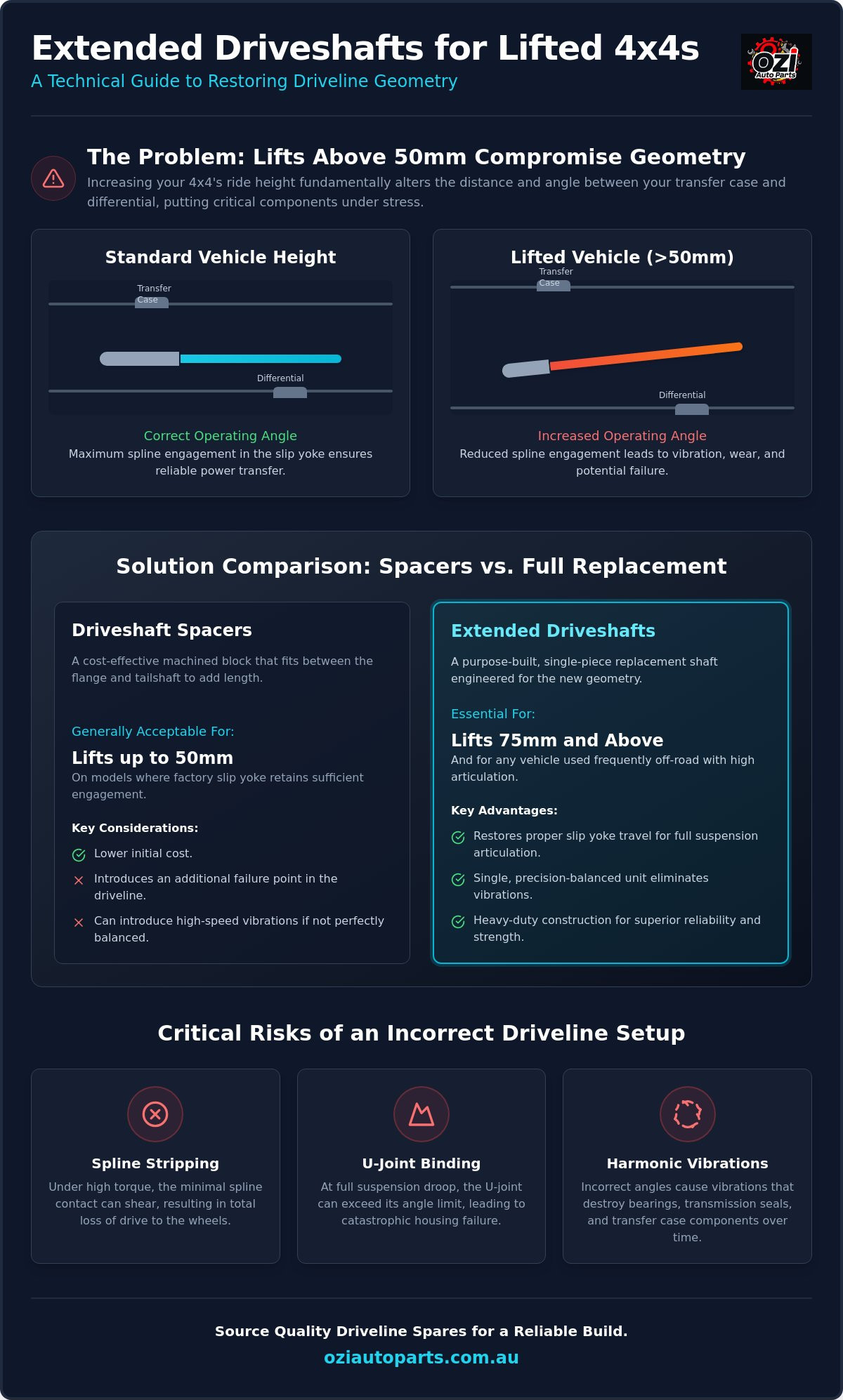
Lifting your 4x4 changes the physical distance between the transfer case and the differential. This shift alters the operating angles of the tailshaft. While a 50mm lift is standard across most Australian states, even this minor change pulls the slip yoke further out of the transmission or transfer case. An extended driveshaft for lifted 4x4 setups addresses this by restoring necessary spline engagement. Without this correction, the reduced surface contact between splines leads to accelerated wear and potential component failure under high torque loads.
To understand the core mechanics of these components, you can read more about What is a Driveshaft? and its role in torque transmission. Generic automotive superstores often stock parts designed only for factory heights. These retailers frequently ignore the specific plunge requirements needed for a Hilux, Ranger, or LandCruiser tackling corrugated Outback tracks. Relying on stock-length components for a lifted vehicle compromises the rear output seal and puts unnecessary stress on the entire drivetrain.
To better understand the relationship between driveline components and operating angles, watch this technical overview:
Critical Angles and Pinion Alignment
Standard universal joints have strict working angle limits. When a lift increases these angles beyond factory tolerances, the joint must accelerate and decelerate twice per revolution. This creates harmonic vibrations. If the pinion angle isn't corrected to match the transfer case output, you will experience rapid wear on bearings. High-speed touring on Australian highways makes these vibrations particularly destructive to your transmission seals.
Suspension Travel vs. Driveshaft Length
Off-road performance relies on maximum suspension articulation. At full droop, the axle moves further away from the chassis. A stock shaft might only have minimal spline contact remaining in this state. This leads to several critical issues:
- Spline stripping: Under high torque, the reduced contact area fails and shears the teeth.
- Binding: The universal joint hits its physical limit, causing catastrophic housing failure.
- Seal leaks: The yoke moves too far, allowing transmission fluid to bypass the rear output seal.
A precision-engineered extended driveshaft for lifted 4x4 ensures the "plunge" remains within safe mechanical tolerances throughout the entire range of travel. This is vital for maintaining reliability during heavy articulation on technical tracks.
Extended Driveshafts vs. Driveshaft Spacers
Choosing between a spacer and a full shaft depends on your lift height and intended use. Spacers are machined blocks that sit between the flange and the tailshaft. They are cost-effective but introduce additional failure points. An extended driveshaft for lifted 4x4 applications is a single, balanced unit. This eliminates the stack-up of tolerances that occurs when adding spacers to a factory shaft. It provides a more robust connection for vehicles frequently used on corrugated tracks.
Rotational inertia and balance are critical at highway speeds. A custom-length shaft is balanced as a complete assembly. In contrast, adding a spacer can shift the centre of gravity of the rotating mass. This often results in high-speed vibrations that are difficult to tune out. For those building a touring rig, sourcing high-quality driveshafts ensures long-term driveline stability. A single-piece design also reduces the number of fasteners that can vibrate loose during off-road excursions.
When a Spacer is Sufficient
Spacers are generally acceptable for suspension lifts of 50mm or less on specific models like the Isuzu D-Max or Holden Rodeo. At this height, the factory slip yoke usually retains enough spline engagement to remain safe. You must ensure the spacer is hub-centric to maintain alignment. Use high-tensile bolts and a thread-locking compound to prevent the assembly from loosening. If your lift exceeds these limits, the leverage on the output shaft increases significantly.
The Case for Full Replacement Shafts
Lifts of 75mm and above fundamentally change the requirements of the driveline. A complete extended driveshaft for lifted 4x4 vehicles provides several advantages:
- Increased Slip Travel: Accommodates extreme suspension articulation without the yoke bottoming out or pulling apart.
- Heavy-Duty Components: Often features thicker tube walls and larger universal joints compared to stock units.
- Reduced Complexity: A single-piece design is inherently more reliable than a factory shaft modified with spacers.
For vehicles used for heavy towing or technical rock crawling, the structural integrity of a purpose-built shaft is non-negotiable. It prevents the "death wobble" often associated with compromised driveline geometry. This is the professional standard for long-range Australian touring.
How to Measure for an Extended Driveshaft
Precision is the difference between a smooth ride and catastrophic drivetrain failure. You must measure for an extended driveshaft for lifted 4x4 at static ride height. This means the vehicle must be on its wheels, on level ground, with its full weight applied. Taking measurements while the vehicle is on a hoist results in an overextended reading. This occurs because the suspension is at full droop. A shaft built to these dimensions will be too long, causing it to bottom out and crack the transfer case housing during compression.
Standard Australian utes like the Hilux or Ranger typically require a flange-to-flange measurement. Use a steel measuring tape and a spirit level to ensure the tape is parallel to the ground. If you are upgrading to a larger diameter heavy-duty shaft, verify clearance around the fuel tank and chassis cross-members. A wider tube can rub against these components during high-flex off-road maneuvers.
Step-by-Step Measurement Protocol
Follow this procedure to ensure your replacement tailshaft matches your specific 75mm or 100mm lift:
- Park the vehicle on a flat, level surface. Chock the wheels for safety.
- Identify the flat mounting faces of the transmission output flange and the differential input flange.
- Run the measuring tape between these two flat surfaces. This is your "flange-to-flange" distance.
- For slip-yoke-into-transmission setups, measure from the end of the output housing to the centre of the rear U-joint.
- Account for the "slip" range. A professional shaft requires enough plunge to handle the axle moving toward the chassis under load.
- Document your vehicle's make, model, year, and the exact height of the suspension lift.
Identifying Failing Driveline Components
Before installing an extended driveshaft for lifted 4x4, inspect your existing setup for signs of geometric stress. Look for reddish-brown dust around U-joint caps. This indicates the internal needle bearings are failing due to excessive angles. Check for "shiny" spots on the slip yoke splines, which suggests the shaft is operating at the very edge of its engagement range. Maintaining a safe vehicle requires looking beyond the driveline. Review All Brake Systems: The Master Guide for a full inspection of your 4WD's safety and braking components. For rapid sourcing of technical mechanical spares, find your specific parts at Ozi Auto Parts.
Sourcing Quality Driveline Spares in Australia
Sourcing precision components from a specialist provides a level of technical reliability that generic automotive superstores cannot match. These retailers often stock broad-interest items, overlooking the specific engineering requirements of an extended driveshaft for lifted 4x4. For Australian touring, high-tensile steel remains the industry standard. It offers superior durability compared to lightweight alloys when subjected to the constant vibrations of corrugated tracks. Your selection must integrate seamlessly with your 4WD suspension upgrade kits Australia to avoid binding at full articulation.
The direct-to-customer e-commerce model facilitates rapid part sourcing. This is essential for getting your vehicle back on the track without delay. Ozi Auto Parts focuses on transactional efficiency, delivering critical mechanical spares with a no-nonsense approach that emphasises reliability and industry expertise. We prioritise technical accuracy to ensure your lifted 4WD remains dependable in harsh environments.
The Ozi Auto Parts Advantage
We act as an authoritative provider of driveshafts, CV joints, and steering components. Our system is designed for the mechanical trade and knowledgeable DIYers. We provide clear technical specifications and noun-heavy labels to ensure you select the correct part the first time. This utilitarian focus respects your time and prioritises stock availability over brand storytelling. You get the parts you need without navigating unnecessary jargon.
Logistics and Nationwide Delivery
Delivering heavy mechanical spares requires a dependable logistics network. We manage the transport of heavy assemblies to metropolitan and regional centres across the country. Shipping times for heavy driveshafts to WA and QLD are managed to ensure swift arrival for urgent repairs or upgrades. Before completing your order, follow this final verification protocol:
- Verify the output shaft spline count to ensure a precise match with your transmission.
- Confirm the differential flange bolt pattern and diameter.
- Re-check your static ride height measurements against the shaft's compressed and extended lengths.
- Confirm compatibility with your specific extended driveshaft for lifted 4x4 application based on vehicle year and model.
Restore Your Driveline Integrity
Maintaining a reliable 4WD requires mechanical precision. You now understand how suspension lifts alter operating angles and why an extended driveshaft for lifted 4x4 applications is the professional standard for correcting geometry. Spacers may serve minor lifts, but full shaft replacements provide the structural durability needed for heavy-duty Australian touring. Always prioritise static ride height measurements to ensure your components don't bind or overextend during articulation. This technical accuracy prevents terminal damage to transmission seals and transfer case housings.
Ozi Auto Parts is a specialist Australian mechanical part supplier providing critical spares for the trade and DIY sectors. We offer direct e-commerce pricing and nationwide delivery on heavy drivetrain components, including driveshafts and steering parts. Our inventory focuses on technical reliability and stock availability to ensure your vehicle remains capable in the harshest environments. Accurate specifications and utilitarian ordering processes mean you get the right part without delay.
Browse our range of heavy-duty driveshafts and 4WD spares at Ozi Auto Parts to secure your vehicle's performance. Your next off-road adventure starts with a drivetrain you can trust.
Frequently Asked Questions
Do I really need an extended driveshaft for a 2-inch lift?
Most Australian utes with a 50mm lift don't strictly require a full replacement shaft. A high-quality spacer is often sufficient at this height to restore spline engagement. You should still inspect the slip yoke at static ride height. If more than 25mm of the spline is exposed, an extended driveshaft for lifted 4x4 applications is the safer choice. This prevents the yoke from pulling out during maximum suspension droop on technical tracks.
Can a driveshaft spacer cause vibrations at high speeds?
Yes, spacers frequently introduce high-speed harmonic vibrations. This occurs because adding a separate component can shift the rotating mass away from the centreline. If the spacer isn't perfectly hub-centric or the high-tensile bolts aren't torqued evenly, the imbalance becomes noticeable at highway speeds. For long-distance touring rigs, a single-piece extended shaft is the most reliable method to ensure a vibration-free driveline and protect your transmission bearings.
How much extra length does an extended driveshaft typically provide?
Extended shafts generally provide between 10mm and 25mm of additional length over factory specifications. The exact measurement depends on your vehicle's specific lift height and suspension geometry. A 75mm lift typically requires a shaft approximately 15mm longer to return the slip yoke to its factory operating position. You must verify these requirements with a flange-to-flange measurement while the vehicle is on its wheels to ensure the splines remain correctly engaged.
What happens if a driveshaft is too long for the suspension travel?
A shaft that is too long will bottom out against the output shaft during suspension compression. This physical impact can crack the transfer case housing or destroy the internal bearings. This catastrophic failure usually happens when hitting a washout or carrying a heavy load over uneven ground. It results in a total loss of drive and expensive mechanical repairs. Maintaining a safe "plunge" range is critical for vehicle reliability.
Is it better to repair a stock driveshaft or buy a new extended unit?
Buying a new purpose-built unit is the more efficient and reliable option. Modifying a stock shaft requires professional cutting, welding, and balancing, which often approaches the cost of a new assembly. A new extended driveshaft for lifted 4x4 use often features upgraded universal joints and thicker tube walls. This provides a higher torque rating and better resistance to the harsh conditions found in Australian off-road environments compared to a modified factory part.