
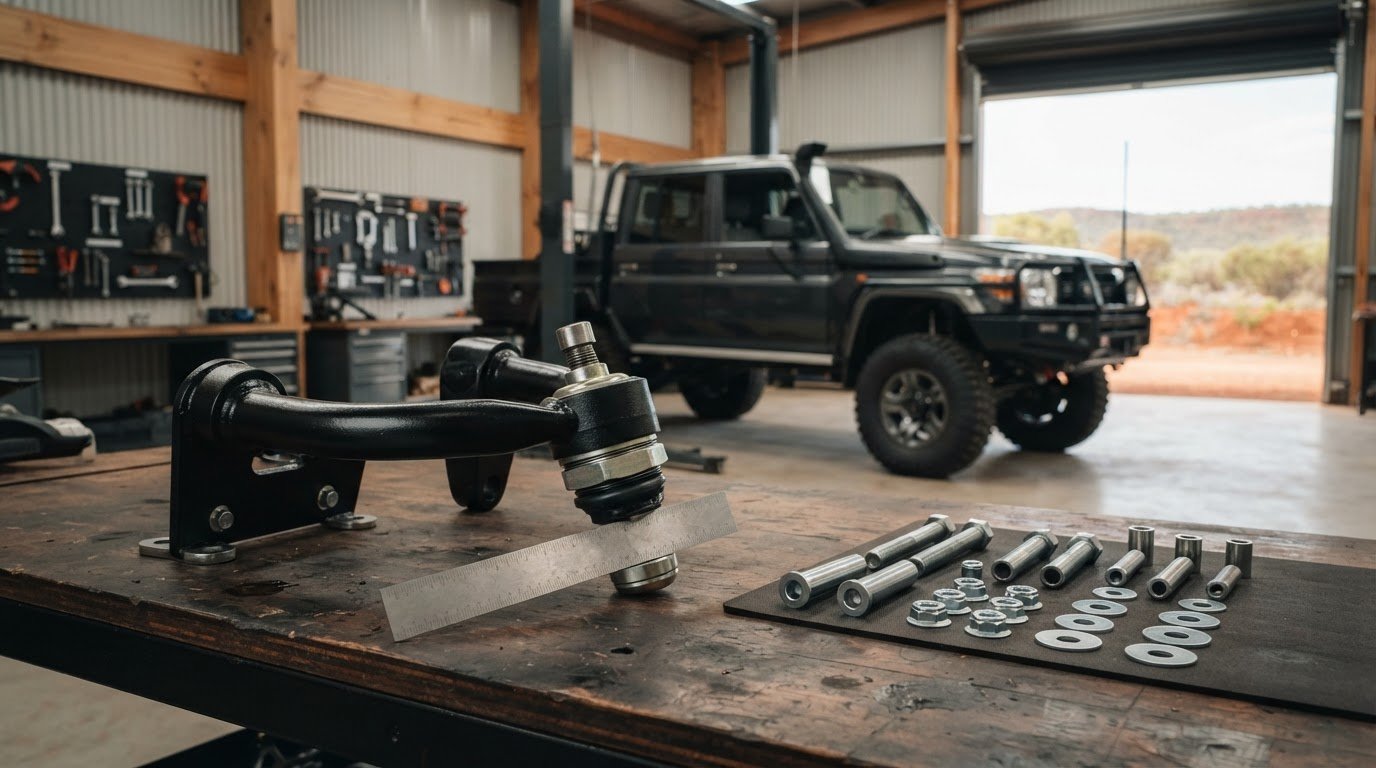
The 25 mm extended upper ball joint is listed for upper left- or right-hand positions on specified Toyota Hilux models, with fitment marked for lifted vehicles only. There’s no single price across extended upper ball joints in Australia: cost depends on the vehicle application and the part’s supplied installation hardware. The 25 mm measurement alone doesn’t establish fitment.
Choosing the right part means matching its application to your vehicle and lift setup, then understanding what hardware comes with it. This guide explains how pricing is shaped, what to look for in the installation hardware, and where the 25 mm option fits. You’ll get a practical basis for comparing specifications and selecting a part that suits your 4WD, without treating every extended ball joint as interchangeable.
Key Takeaways
- Compare the listed price against the exact vehicle application and the hardware supplied.
- Review the installation hardware details to understand what the package includes before choosing a part.
- Use the fitment details to assess whether the 25 mm option suits your 4WD setup.
- Explore Ozi Auto Parts’ 4WD Upgrade Parts and Steering and Suspension Parts when selecting related components.
Product price
The price of extended upper ball joints in Australia depends on the vehicle application and what the listing includes. Start with the product code, then match it to the vehicle’s make, model and upper control arm. A similar product description alone does not show that two parts are interchangeable.
Compare like for like. One listing may be for a single joint, while another covers a pair. Separate the part price from delivery and installation costs to understand the total. These details matter even when product codes look similar.
For context on the 25 mm measurement, watch this video:
Quantity is application-specific. Each EFS extended ball joint application lists a required quantity of 2. Treat this as the listed requirement for that application, not a rule for every vehicle or brand. Before comparing prices, establish whether each listing covers one joint or the required quantity.
For extended upper ball joints in Australia, weight and dimensions can help distinguish listings, but they do not replace fitment information. Use measurements to compare components and weight to understand the item being shipped. Do not infer a part’s overall size or weight from its extension measurement alone.
Before comparing listings, record the product code, vehicle application, quantity, dimensions, weight and package contents. This helps reveal differences that a headline price may not show. Compare parts listed for the same application and package quantity.
For a Ford Focus Mk2 front lower ball joint, the taper dimension is 18mm at the top of taper 21mm at the base of taper. An alternative front lower ball joint may have a different taper, so check its fitment before comparing it with another part. Check which taper matches the vehicle before treating two offers as comparable; a different dimension may signal a different fitment, not a better-value equivalent.
Included installation hardware
Package contents vary by listing, so read the itemised details before buying. Check whether fasteners, washers, nuts or spacers are included. These are examples of hardware to look for, not items every kit necessarily contains. Match the listed contents to the vehicle and control arm application.
Installation requires the vehicle-specific procedure and suitable workshop tools. The tools depend on the suspension design and the fasteners being removed. Follow the vehicle’s service information for safe support, disassembly and reassembly. A general tool list is no substitute for the correct procedure.
Use this sequence to assess the installation requirements:
- Match the joint’s application to the vehicle and upper control arm.
- Compare the package contents with the fasteners and components required for that installation.
- Follow the relevant fitting guide, then confirm the joint’s orientation before assembly.
Orientation is critical for directional joints. PSR states that its ball joint is directional and must be installed according to the guide, as incorrect fitting is highly likely to cause failure. Do not assume the joint can be installed in either orientation. Follow the guide for the specific part.
Before starting, organise the components and tools required for the job. Keep removed hardware separate so you can compare it with the replacement parts during assembly. If the listing provides a fitting guide, follow it rather than relying on appearance or graphics alone. Correct orientation and the specified installation sequence matter more than visual similarity to the old part.
For related suspension and 4WD components, browse 4WD parts alongside the application details.
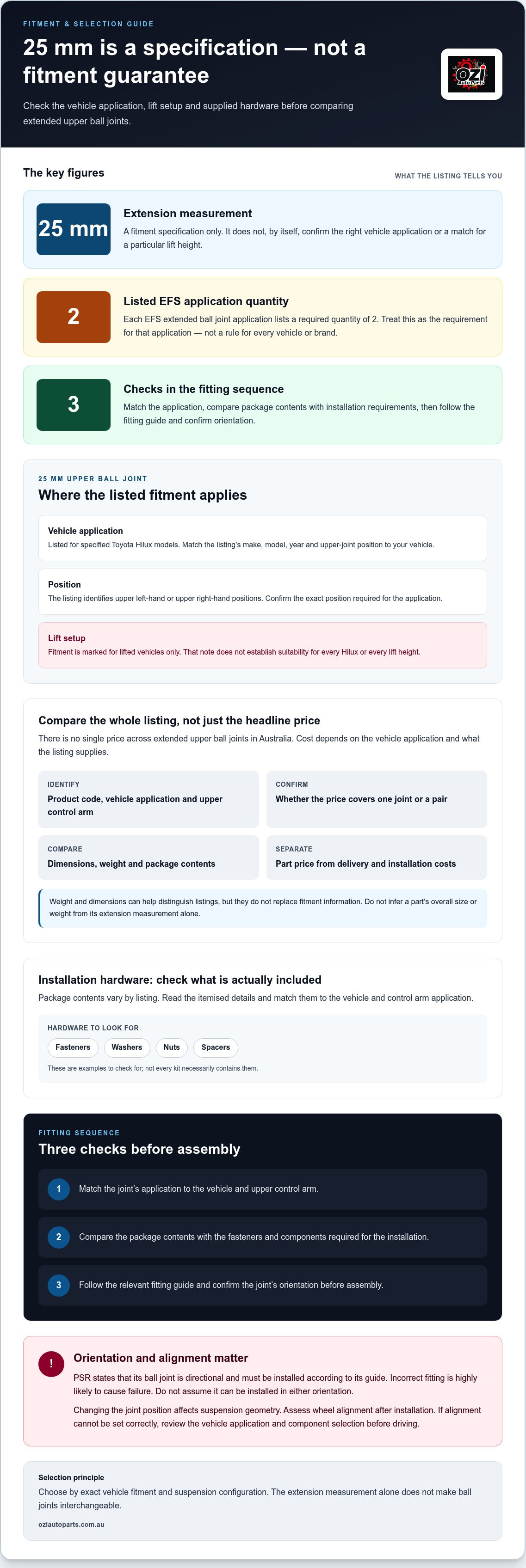
25 Mm extended upper ball joints
A 25 mm extension is a fitment specification, not a universal lift-height match. Confirm the vehicle application and suspension setup before selecting one.
Vehicle and lift-height suitability
Start with the exact make, model, year and upper-joint position in the part listing. The 25 mm option is listed for upper left-hand or upper right-hand positions on specified Toyota Hilux models, for lifted vehicles only. Match those details to your vehicle and lift setup.
Extended ball joints and adjustable upper control arms address geometry in different ways. A ball joint changes the joint position, while an adjustable arm provides adjustment through the arm. Either can affect suspension geometry and alignment, so assess the correction required rather than choosing by extension alone.
Common vehicle applications in Australia
Specified Toyota Hilux models are the application identified for this 25 mm option. The lifted-vehicle-only fitment note is essential: it does not establish suitability for every Hilux or every lift height. Check the listing’s model and position details against your vehicle before selecting the part.
For road use in Australia, the 25 mm measurement alone doesn’t establish whether a modification is compliant. The vehicle and completed modification must meet the requirements that apply to that vehicle. Confirm the relevant requirements before relying on the modified vehicle for road use.
Safety risks and failure symptoms
Incorrect orientation creates a specific risk of failure. PSR states that its ball joint is directional and must be fitted according to its guide, as incorrect fitting is highly likely to cause failure. Treat abnormal movement or visible damage as reasons to stop and arrange an inspection.
Changing the joint position affects suspension geometry, so wheel alignment should be assessed after installation. If alignment cannot be set correctly, review the vehicle application and component selection before driving. For related suspension components, browse steering and suspension parts.
Ozi Auto Parts: Brake System Parts
Ozi Auto Parts supplies Brake System Parts alongside Steering and Suspension Parts and 4WD Upgrade Parts. Turn to its range when you’re sourcing related mechanical components for a vehicle upgrade or replacement. Match the part application to your vehicle details and suspension setup before selecting a component.
For a lifted 4WD, the key decision remains correct fitment, not extension alone. Use the vehicle’s make, model and suspension configuration to narrow your selection. Ozi Auto Parts also supplies Driveshafts for other drivetrain requirements.
For parts information or to browse the range, visit oziautoparts.com.au.
Plan your next 4WD upgrade
Treat a 4WD upgrade as a whole-vehicle plan, not an isolated parts purchase. Set out the vehicle’s intended use and the changes already made before planning the next stage. Touring, work and recreational setups have different priorities, so a clear brief helps keep decisions consistent as the build develops.
When assessing extended upper ball joints in Australia, consider future suspension or drivetrain changes as well as the immediate purchase. Taking the broader setup into account gives you a practical framework for planning the next stage of your build.
Ready to move forward? Contact Ozi Auto Parts for details and take the next step with confidence.
Frequently Asked Questions
What are extended upper ball joints and what do they do?
Extended upper ball joints are suspension joints with a different position or reach from a standard joint. They connect the upper control arm to the steering knuckle, allowing the knuckle to move as the suspension travels and the wheels steer. Choose a joint designed for your suspension configuration, then follow its fitting guide for the correct orientation.
How much do extended upper ball joints cost in Australia?
There is no single standard price for extended upper ball joints in Australia. Cost depends on the specific part and its listed application, so a generic average may not reflect the component you need. Compare equivalent designs and check that the stated extension refers to the same measurement. A matching description alone does not prove that two parts are equivalent.
How are extended upper ball joints installed, and what tools are required?
Match the joint to the vehicle and upper control arm, compare the package contents with the components required, and follow the vehicle-specific procedure and fitting guide. Use suitable workshop tools for the suspension design and fasteners, and confirm the joint’s orientation before assembly.
Which brands sell extended upper ball joints in Australia?
EFS extended ball joint applications are listed, while PSR provides fitting guidance for directional joints.