
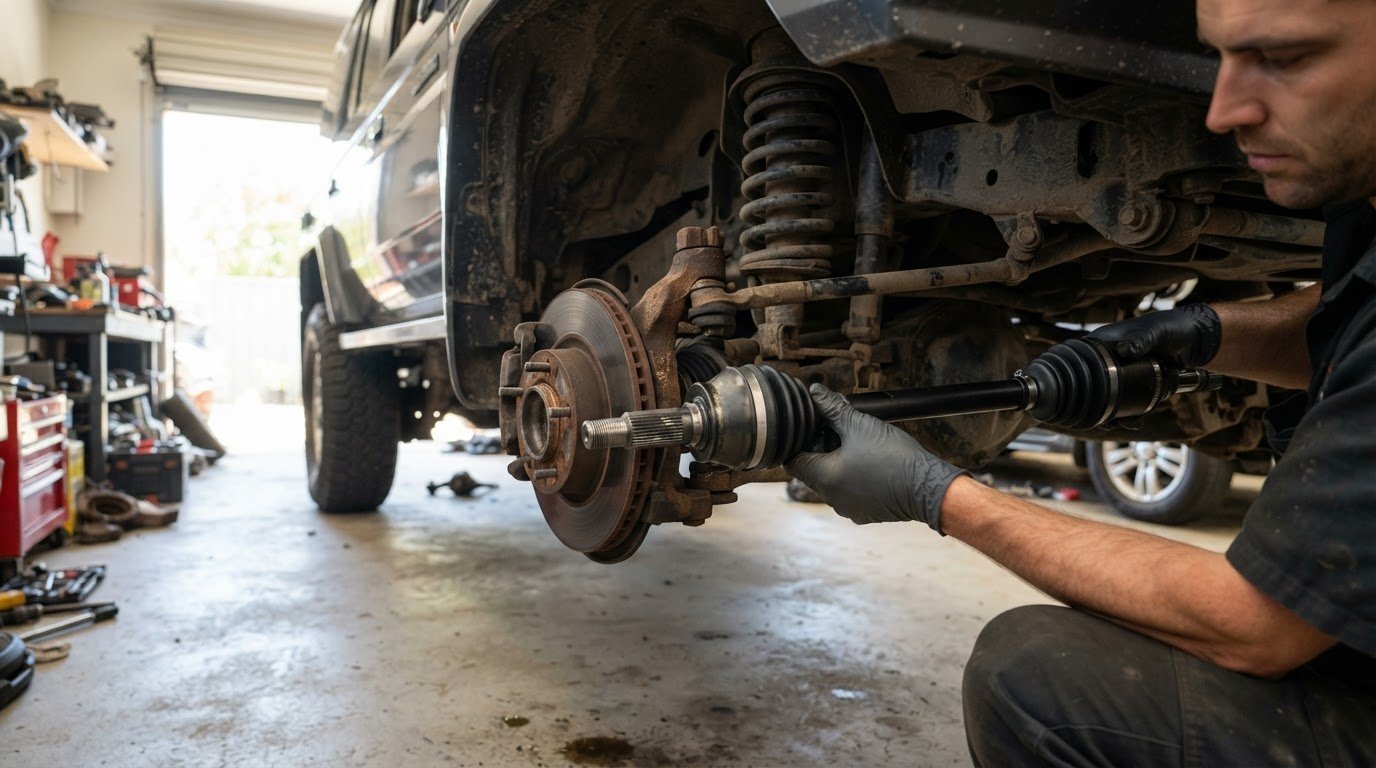
Driver-side and passenger-side CV axles don’t automatically interchange. A front CV driveshaft assembly must match the AWD vehicle and the side being replaced. The vehicle model name alone isn’t enough to confirm fitment.
That matters when ordering a replacement: the wrong side or application may not suit the vehicle. This guide explains how to check AWD fitment, how CV joints differ from universal joints, and what distinguishes driver-side from passenger-side assemblies.
It also covers signs that a driveshaft may need attention and the details to compare before selecting a part. Use these checks to narrow down the right assembly for your vehicle.
Key Takeaways
- Match the replacement assembly to the AWD vehicle’s application and the side being replaced, not just its model name.
- Recognise shuddering during acceleration, unusual noises and problems turning or controlling the vehicle as possible driveshaft trouble signs.
- Understand how CV joints support movement through turns and how they differ from universal joints.
- Compare driver-side and passenger-side assemblies carefully to identify the correct replacement for your vehicle.
How do I know whether a CV axle shaft fits an AWD vehicle?
AWD fitment depends on the vehicle’s exact application and the side being replaced. Start with the make, model and year, then match the assembly to the vehicle’s AWD configuration. A model name alone doesn’t identify the correct axle.
- Record the make, model and year shown in the vehicle documents.
- Identify the AWD configuration and whether the replacement is for the driver or passenger side.
- Compare the assembly’s listed vehicle application with those details before selecting a part.
Driveshaft problems can cause shuddering during acceleration, unusual noises, or difficulty turning or controlling the vehicle. These symptoms may indicate a fault, but don’t identify the failed component on their own. Note when each occurs, such as shuddering under acceleration or noise while turning. The pattern can help narrow down what needs inspection.
CV axle symptoms can include clicking or cracking noises during turns, especially if the sound repeats as the vehicle moves. A damaged CV boot may let grease escape and contaminants reach the joint. Look for boot damage or grease near the wheel, but remember that a visual check isn’t a full diagnosis.
Yes. An Australian roadworthiness inspection can identify a CV driveshaft fault if the defect is evident during the inspection. The assessment depends on applicable state or territory requirements and the condition found.
Driving with a damaged front axle isn’t safe if it affects turning or vehicle control. Shuddering, repeated clicking or worsening noise are reasons to stop driving and arrange an inspection instead of continuing to use the vehicle.
Universal joints and CV joints
A CV shaft uses CV joints, while a driveshaft can use universal joints. Understanding the difference helps explain turning movement and common failure points.
CV Joints and Turning Angles
CV stands for Constant Velocity. A CV shaft has a CV joint at each end, allowing it to transmit drive through a wider range of turning angles without increasing friction. This movement suits a front axle, where the wheels steer while receiving power. When selecting a replacement, match the assembly to the vehicle application and axle position.
Universal joints and CV joints aren’t interchangeable descriptions. Driveshafts can use universal joints; CV shafts use CV joints. All front-wheel-drive vehicles have CV shafts, including the Mazda 3, Ford Focus and Volkswagen Golf. Some AWD and 4WD vehicles also use CV joints, so drivetrain type alone doesn’t identify the shaft fitted.
Causes of Assembly Failure
Front CV driveshaft assemblies can fail because of joint wear or damage to the protective boot. A split boot lets grease escape and contaminants reach the joint, increasing wear. Repeated movement through steering angles also puts the joint under load. Check the boot and surrounding area for tears, grease leakage or visible damage.
A boot inspection can reveal a problem before the joint’s condition is obvious. Compare both ends of the shaft, since each has a CV joint and either boot can be damaged. Clicking during a turn can point to a worn joint, but it doesn’t confirm the fault on its own. Use the vehicle’s exact application when choosing driveshaft parts.
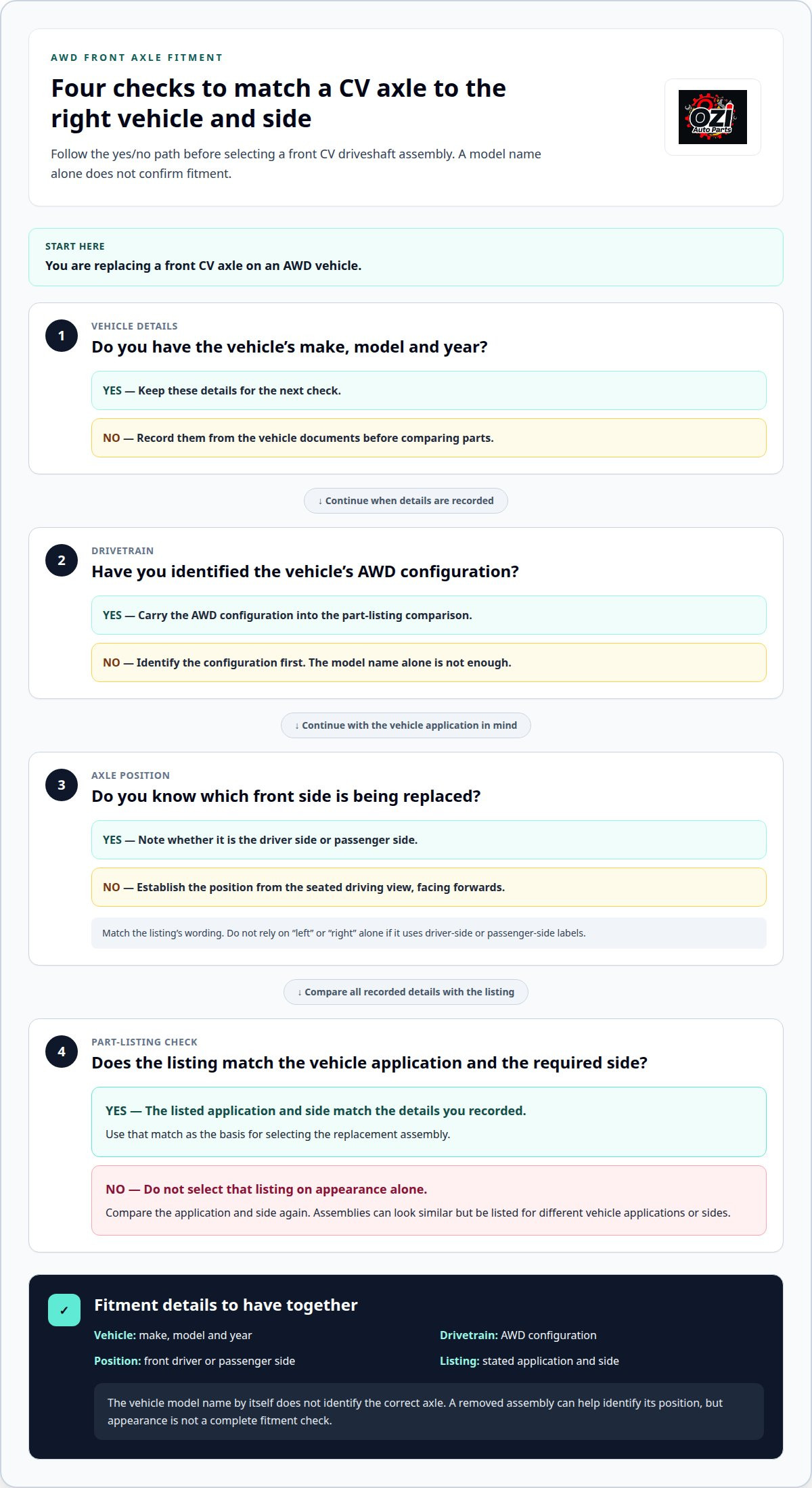
Front driver- and passenger-side assemblies
Driver-side and passenger-side front CV assemblies aren’t automatic substitutes. Choose the side specified for the vehicle’s front axle. A matching model name alone doesn’t confirm that an assembly suits both positions or every AWD configuration.
Identify the side from the vehicle’s perspective, seated and facing forwards. Then compare it with the assembly listing. Don’t rely on “left” or “right” alone if the listing uses driver-side or passenger-side labels. Match the listing’s terminology to the vehicle application before choosing a replacement.
Use these details to narrow the fitment:
- Vehicle: record the make, model and year.
- Drivetrain: identify the AWD configuration, not just the model range.
- Position: note whether the damaged assembly is at the front driver or passenger side.
- Part listing: compare its stated application and side with those vehicle details.
A removed assembly can help identify its position, but don’t use appearance as the only match. Two assemblies may look similar yet be listed for different sides or vehicle applications. Confirm the vehicle details against the replacement listing, especially if the model has multiple variants.
If you’re replacing one axle, select the same side as the fault. If the side is unclear, establish left and right from the seated driving position, then match that position to the listing. This avoids treating “driver-side” as a universal label across vehicles and markets.
Use the driveshaft parts range to find an assembly listing that matches your vehicle and required side.
Ozi Auto Parts: Brake System Parts
Ozi Auto Parts supplies driveshafts for customers choosing a replacement assembly for an AWD vehicle. Use the vehicle’s make, model, year, drivetrain and required side to narrow down the application. These details help distinguish a front driver-side assembly from a passenger-side assembly.
Ozi Auto Parts also offers Brake System Parts, 4WD Upgrade Parts, and Steering and Suspension Parts. Choose the relevant category for the component you need. If you’re selecting a driveshaft, compare the listing with the vehicle details before ordering. A symptom such as shuddering or clicking can indicate a fault, but it doesn’t establish which part needs replacement.
For a replacement component, browse the Ozi Auto Parts catalogue or contact Ozi Auto Parts.
Prepare your fitment details
Before choosing a replacement, match the vehicle details with the required axle position. This gives you a clearer basis for comparing a front CV driveshaft assembly with the listed application, rather than relying on the model name alone.
Ozi Auto Parts offers Driveshafts, Brake System Parts and 4WD Upgrade Parts. Use the relevant category for the component you need, and keep the make, model, year, AWD configuration and side being replaced handy. If the vehicle’s side labels are unclear, identify left and right from the driver’s seated position before matching the listing.
A considered parts selection starts with accurate vehicle details. Contact Ozi Auto Parts about fitment and take the next step towards identifying the right assembly.
Frequently Asked Questions
Do driver-side and passenger-side CV axles interchange?
No, don’t assume they interchange. Treat each side as a separate fitment unless the parts listing explicitly covers both. If you’re replacing an existing axle, compare its part reference with the replacement listing where available. Keep the old part until you’ve checked the new assembly’s application and side designation. Similar appearance alone doesn’t prove interchangeability.
Does clicking on a turn always mean the CV axle is bad?
No. A click is a clue, not a diagnosis. Note whether it’s a single click or a repeated sound, which way the vehicle is turning, and whether the noise changes under acceleration. These observations give an inspection more context. Avoid ordering an axle based on sound alone, particularly if the noise is intermittent or its source is unclear.
Is a CV joint axle the same as a complete CV axle assembly?
Not necessarily. Catalogue wording may refer to a joint-only replacement or a complete axle unit. Before ordering, read the listing’s included-parts description and check whether it names the shaft, joints, boots and related fittings. Don’t infer the contents from the product title alone. This helps distinguish a component replacement from a complete assembly.
Should both CV axles be replaced at the same time?
Not automatically. The decision depends on the condition of each axle, not simply on replacing one side. Have both sides assessed, then base the parts order on the faults identified. If the other axle shows no defect, replacing it just because the opposite side is being changed isn’t automatically necessary. Match any replacement to its own position.
What is a CV Shaft?
A CV shaft is the complete drive axle component, not a standalone CV joint. Parts catalogues may also call it an axle or half-shaft, so terminology varies. Read the item description to confirm whether it refers to the whole shaft or an individual component. That distinction matters when comparing replacement options and checking what the listing includes.