
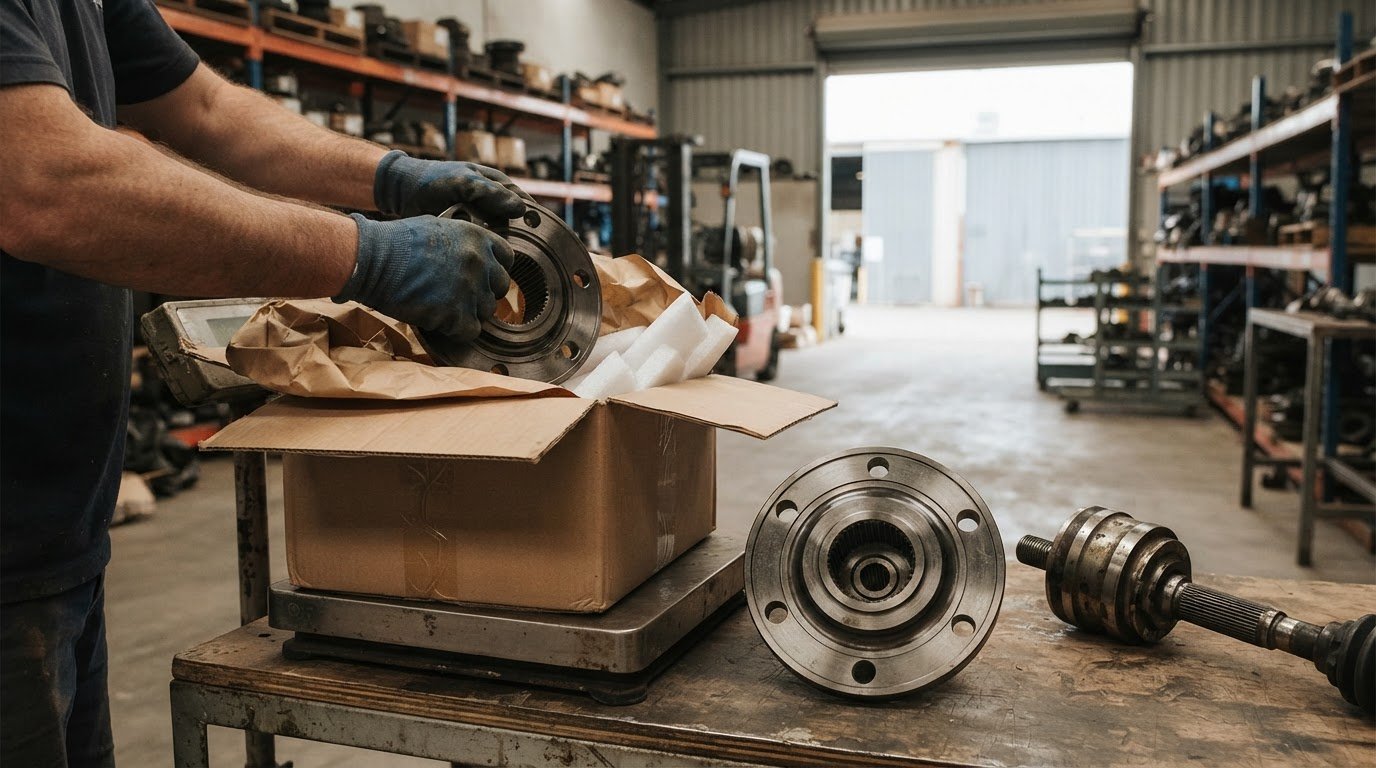
For heavy duty drive flanges in Australia, spline design is a key load factor: one heavy-duty design uses 24 splines with increased contact area to spread load across the axle. Price and shipping weight depend on the exact flange or kit and its packed consignment, so the part specification matters before comparing freight.
When comparing heavy duty drive flanges in Australia, purchase price is only one consideration. Fitment and construction determine whether a flange suits the axle. Check how the splines engage, compare like-for-like prices and freight, and distinguish Australian-made parts from products simply sold locally.
Key Takeaways
- Learn how to distinguish Australian-made flanges from parts sold in Australia, and what construction details matter.
- Match flange type and spline configuration to the axle and vehicle before weighing up purchase options.
- Understand how material and spline contact relate to load distribution, and why shipping dimensions are not the same as shipping weight.
- See how Ozi Auto Parts’ driveshafts and 4WD upgrade parts fit into the search for compatible drivetrain components.
Australian-made heavy-duty drive flanges
Australian-made and Australian-sold are different claims: a flange stocked in Australia is not necessarily manufactured here. If local manufacture matters, check the country of manufacture as well as axle fitment, spline design and material. Fitment details, not the seller’s location, establish whether a component matches the vehicle.
A heavy-duty design uses 24 splines, high-strength case-hardened steel and increased spline contact area. The wider contact spreads load across the axle splines. This design principle is relevant when comparing an upgraded flange with a standard thin-type flange, but it does not make the parts interchangeable. The axle application remains the deciding factor.
Vehicle coverage can be specific. One heavy-duty flange is designed for Land Rover Defender front and rear axles on vehicles built from 1994 to 2016 runout, from VIN LA930456. That range illustrates why a vehicle name alone is insufficient: production details and axle position also matter.
There is no single drive flange specification for every Australian vehicle. Match the replacement to the vehicle and axle application instead of treating one spline count as a universal standard. Even an Australian-made part must suit the intended axle and configuration.
Consider replacing a flange if inspection reveals damaged or worn splines, cracks, or insecure seating. These faults can affect torque transfer from the axle to the hub. Before fitting a replacement, compare the removed part’s spline arrangement and mounting profile with the replacement’s stated specifications.
When considering an Australian-made option, distinguish local manufacture from local distribution, then assess the flange’s application and construction. The key point is that origin matters, but correct axle fitment and secure spline engagement are essential.
What types and sizes of heavy duty drive flanges are available in Australia?
Drive flanges vary by axle application, spline configuration and supply format. A vehicle model alone does not establish fitment: axle position and design matter too. A flange listed for a solid front axle is not automatically suitable for a rear axle.
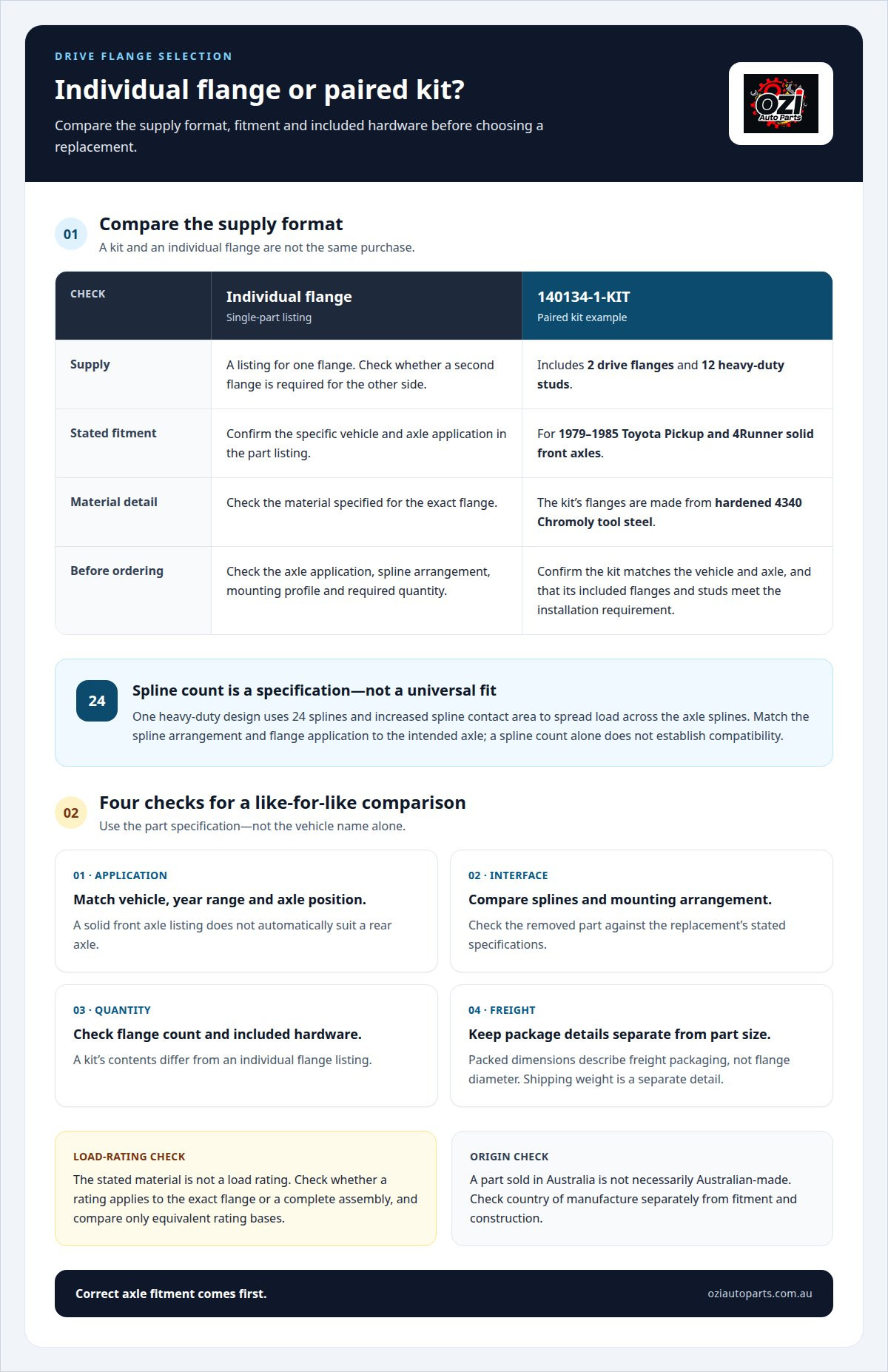
One Australian-market example is the 140134-1-KIT drive flange kit. It fits 1979-1985 Toyota Pickup and 4Runner solid front axles. The kit includes 2 drive flanges and 12 heavy-duty studs. That paired supply differs from listings for an individual flange. Replacing standard thin-type flanges requires a second flange for the other side.
Size selection involves more than measuring the flange’s outside diameter. The axle spline count, mounting arrangement and vehicle application all affect compatibility. A 24-spline design describes the spline configuration, not a universal fit across different vehicles. Use the specified application to narrow the correct type, then compare the required quantity and included hardware.
Keep the part’s physical dimensions separate from its shipping dimensions. A kit’s packed width, height and cubic measurement describe its freight packaging, not the flange diameter or axle fit. Shipping weight is separate too. This distinction helps prevent package measurements from being mistaken for component specifications when comparing options in an automotive parts catalogue.
- Individual flange: Confirm the axle application and whether a second flange is required.
- Kit: Check the included flange count and studs against the required installation quantity.
- Fitment: Match the vehicle year range, axle position and spline arrangement.
Use those details to compare options accurately and identify the correct part for the vehicle.
What materials and load ratings are common for heavy duty drive flanges?
Material is one part of a flange’s specification. The 140134-1-KIT drive flanges are made from hardened 4340 Chromoly tool steel. That identifies the steel type, but it doesn’t provide a load rating or establish suitability for every axle.
A load rating should relate to the exact flange and its intended application. Check which component the rating covers and the conditions it describes. A rating for an assembly should not automatically be treated as the rating for an individual flange. Compare ratings only when their stated basis is equivalent.
Material strength alone does not determine performance in service. The flange design, axle interface and intended use all matter. A rating for one configuration does not automatically apply to another vehicle or axle. Assess specifications alongside the part identification and application.
Use this sequence when reviewing a specification:
- Identify the part: Match the rating to the exact flange, not just its material.
- Check the application: Confirm the stated axle and vehicle use.
- Read the rating basis: Note whether it applies to a component or a complete assembly.
If a listing names a material but gives no basis for a load rating, treat the material description as a material detail, not a quantified capacity claim. For a practical comparison, prioritise the stated application and any rating attached to that specific part. This keeps the assessment relevant to the component you are selecting.
Ozi Auto Parts: Driveshafts
Ozi Auto Parts supplies driveshafts and 4WD upgrade parts for customers sourcing drivetrain components. Turn to Ozi Auto Parts when your requirements extend beyond a drive flange to a driveshaft or a broader 4WD upgrade. Correct component selection depends on matching the part to the vehicle and its intended application.
For other vehicle systems, Ozi Auto Parts offers brake system, steering and suspension parts. These categories serve separate upgrade and replacement needs; they do not determine drive flange fitment. Keep each component’s application clear when planning parts for a vehicle.
Contact Ozi Auto Parts to discuss your driveshaft or 4WD upgrade parts requirements.
Plan your next parts order
Choosing heavy-duty drive flanges in Australia is one part of planning a vehicle upgrade. Keep the intended work and parts order aligned so each component suits the same vehicle application. This gives you a practical basis for organising the purchase and freight.
Ozi Auto Parts offers Driveshafts and 4WD Upgrade Parts for drivetrain and upgrade requirements, alongside Brake System Parts for separate braking needs. Keep each item tied to its own vehicle application and purpose. For help with your parts requirements, contact Ozi Auto Parts. Take the next step with a parts plan that suits your vehicle.
Frequently Asked Questions
What are heavy duty drive flanges used for in Australia?
Heavy-duty drive flanges connect an axle shaft to the wheel hub, transmitting drive torque through the splined interface. In a 4WD, this connection transfers drive at the axle. The flange must match the vehicle’s axle design. It isn’t a universal machinery fitting, so use the equipment manufacturer’s specification before selecting an automotive flange for machinery.
How much do heavy duty drive flanges cost in Australia?
The cost of heavy-duty drive flanges in Australia depends on the part, quantity, included hardware and freight. A single flange and a kit are not equivalent purchases. Compare the same quantity and inclusions, then account for delivery separately. Freight charges depend on the packaged consignment, so the component price alone does not show the total order cost.
How do I choose the right heavy duty drive flange for my vehicle or machinery?
Start with the vehicle make, model and year, then identify the axle position and flange interface. Match these details to the part’s stated application. For machinery, use the axle or hub manufacturer’s component specification rather than assuming an automotive flange will fit. Compare the required quantity and included hardware before ordering, not just the flange’s appearance.
How do you install and maintain a heavy duty drive flange safely?
Match the flange to the vehicle and axle application, then compare its spline arrangement and mounting profile with the removed part. Keep the screw cap fitted to help prevent dirt and water entry; it can be filled with grease and tightened to grease the axle splines and reduce wear. Replace flanges with damaged or worn splines, cracks, or insecure seating.