The “heavy duty” label alone won’t tell you whether a tailshaft suits your vehicle. A heavy duty tailshaft Australia listing still needs to match your vehicle and driveline, as well as the loads and driving conditions it will face.
Start with the vehicle’s exact details, then compare them with the application and specifications stated for each part. This guide explains what to record, what to look for in a listing and which assumptions to avoid. Ozi Auto Parts sells driveshafts through its online catalogue, with nationwide delivery across Australia. Match the part to your vehicle first, then assess whether the listed details suit the job.
Key Takeaways
- “Heavy duty” describes an option, but does not confirm fitment or suitability for every vehicle.
- For a heavy duty tailshaft australia search, gather your vehicle’s make, model, year, engine and transmission details first.
- Record the driveline configuration and relevant modifications so you can compare each listing against your vehicle.
- Assess each option against your vehicle’s intended use and the specifications stated in its listing.
What does a heavy-duty tailshaft mean for Australian vehicles?
A tailshaft transfers power from the transmission to the differential in a rear-wheel-drive vehicle. Australian parts listings also commonly use “driveshaft” for this component. See the Drive shaft (tailshaft) definition and function for an overview of its role in a vehicle.
“Heavy duty” is a product description, not a complete fitment specification. It does not identify which vehicles a part suits or, by itself, state its material, dimensions, balance or joint details. For a heavy duty tailshaft australia search, distinguish the intended application from the specifications provided for the specific part.
Why the heavy-duty label is not enough to confirm fitment
Fitment depends on the vehicle configuration and the part details. A tailshaft described for towing, off-road driving or a modified vehicle is not automatically suitable for every vehicle used in those conditions. Check each specification separately:
- Material: Check what the listing says the shaft is made from.
- Dimensions: Compare any stated length and other measurements with the vehicle’s requirements.
- Balance: Treat balancing details as a separate specification, not something you can infer from material or dimensions.
- Joints: Check the stated joint type and details against the vehicle’s driveline configuration.
Compare the details in the listing with your vehicle’s configuration. Don’t assume a part is suitable simply because it is described as heavy duty. The label alone also does not establish increased towing capacity or improved vehicle performance. A sound comparison starts with the vehicle and considers the specifications stated for the part.
How to compare heavy-duty tailshafts and confirm vehicle fitment
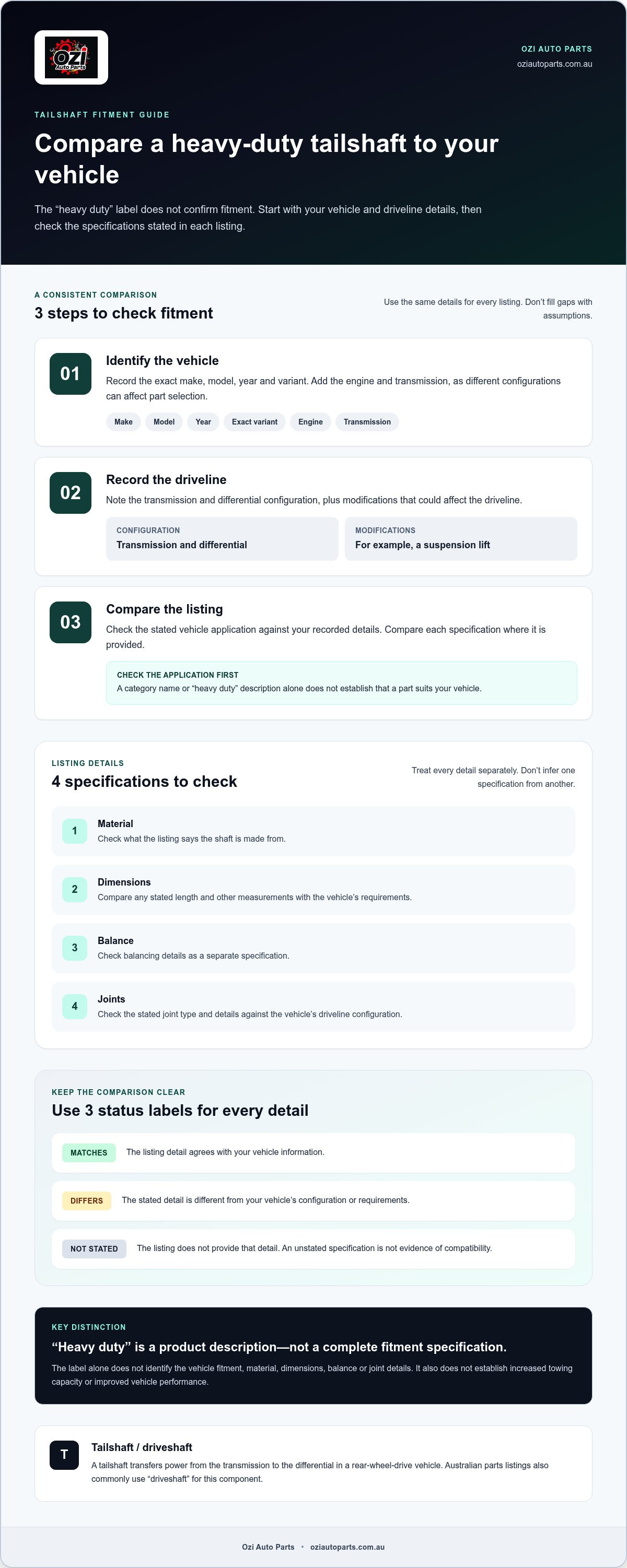
Use the same process for every listing. That keeps the comparison focused on your vehicle and the information provided, rather than assumptions based on a “heavy-duty” label.
- Identify the vehicle. Record its make, model, year and exact variant. Include the engine and transmission, as different configurations can affect part selection.
- Record the driveline. Note the transmission and differential configuration, along with modifications that could affect the driveline, such as a suspension lift or other changes to the vehicle setup.
- Compare the listing. Match your recorded details against the stated vehicle application. Compare listed dimensions, material, balance and joint details where they are provided. Don’t infer a measurement or compatibility from the heavy-duty description.
Which vehicle and driveline details should you gather?
Start with the exact vehicle variant, not just the model name. Add the engine, transmission and differential details, then record relevant modifications. This gives you a consistent reference when comparing listings for specific vehicle combinations. If you’re investigating balance-related concerns, read the published Driveshaft Balancing Symptoms: Australian Diagnostic Guide alongside the part specifications.
For a heavy duty tailshaft australia comparison, keep the same checklist beside each listing. Mark each detail as matching, different or not stated. A match across the vehicle application and stated specifications gives you a stronger basis for comparison. An unstated detail is not evidence of compatibility.
Once you’ve recorded your vehicle and driveline details, browse the Ozi Auto Parts online catalogue for automotive parts, including driveshafts.
Buying a heavy-duty tailshaft in Australia: prepare your parts search
Before browsing, put the details you’ve gathered into one checklist. Use it to compare listings consistently and keep your decision focused on your vehicle’s requirements.
- Vehicle: Make, model, year, exact variant and engine.
- Driveline: Transmission, differential configuration and relevant modifications.
- Listing: Vehicle application and any stated material, dimensions, balance or joint details.
- Comparison: Note which details match, differ or are not provided. Don’t assume an unstated specification.
This makes a heavy duty tailshaft australia parts search more focused. You can compare the information in each listing with your vehicle rather than relying on a broad product description.
Move from vehicle details to a relevant online parts listing
In the Ozi Auto Parts catalogue, the Shafts, Axles & Wheels category includes BW Drive Shafts - New. Use your checklist to review the category and the details stated in each listing. A category name alone does not establish that a particular part suits your vehicle.
For broader online-parts purchasing context, refer to Buying Online Auto Parts in Australia: 2026 Specialist Buying Guide. Keep your comparison tied to the vehicle application and the information stated for the part. Don’t infer that an item is a heavy-duty tailshaft, or suitable for your configuration, unless the listing says so.
With your details organised, browse the Ozi Auto Parts catalogue and compare the listed parts against your checklist.
Make your next parts search more precise
Keep your vehicle and driveline details with your vehicle documents, and update them if modifications change the setup. This record makes future comparisons easier, particularly when you need to replace a part and are working from older information. A deliberate heavy duty tailshaft australia search is based on the vehicle application and documented specifications, not assumptions carried over from a previous setup. Before browsing, decide which listing details you need to compare. The same process can help you make clearer decisions about future driveline parts.
Start with your vehicle details, then browse the Ozi Auto Parts catalogue to compare listed parts against your checklist.
Frequently Asked Questions
Is a heavy-duty tailshaft automatically the right choice for a 4WD?
No. A heavy-duty description does not establish suitability for every 4WD. A listing for one engine and transmission combination does not confirm suitability for a different variant, even if both vehicles share a model name. Treat intended use as context, then compare the stated vehicle application and specifications. Don’t infer a particular material or design from the label.
Can I choose a tailshaft by length alone?
No. One length measurement cannot establish a complete match. Vehicles with similar body dimensions can have different transmission or differential arrangements, which affect which listing to consider. For a heavy duty tailshaft Australia purchase, use length alongside the exact vehicle variant and other driveline details stated for the part. A measurement on its own is not a compatibility check.
What can cause driveline vibration after a tailshaft replacement?
Balance or fitment concerns can contribute, but vibration alone does not identify the cause. Note whether it occurs during acceleration, at a particular road speed or across a wider speed range. Record any recent driveline work as well. These observations can help frame diagnosis without assuming the tailshaft is at fault. The Australian driveshaft-balancing guide explains balance-related symptoms in more detail.
Does a heavy-duty tailshaft automatically increase a vehicle’s towing capacity?
No. A heavy-duty tailshaft description does not change the vehicle’s rated towing limits. Keep the replacement part’s stated application separate from the vehicle’s ratings and conditions of use. A component described for demanding use is not evidence that the vehicle can tow a heavier load. Choose a tailshaft based on its stated application, not an expected change in vehicle capacity.