Your vehicle’s odometer isn't a countdown to the scrap heap; it's a testament to engineering that requires a specific procurement strategy. Maintaining a high-kilometre vehicle on Australian roads demands more than just basic oil changes. It requires a targeted approach to sourcing high mileage car parts before critical systems fail. You want reliability. You need cost-effective alternatives to expensive OEM components. Finding discontinued spares shouldn't be a roadblock to safety.
We recognise the difficulty in locating specific mechanical spares for older models in a 2026 market. This guide delivers a prioritised maintenance checklist to keep your vehicle roadworthy. You will identify exactly which hydraulic and driveline components require replacement to prevent sudden failure. We provide clear directions on sourcing essential spares to extend your vehicle's operational lifespan. This is a technical breakdown of wear items, focusing on brake systems, steering, and suspension. Get the facts. Secure the parts. Stay on the road.
Key Takeaways
- Identify the 150,000-kilometre threshold and understand how Australian heat cycles accelerate the degradation of critical rubber seals and bushings.
- Prevent braking failure by evaluating brake booster vacuum integrity and inspecting hydraulic lines for perished rubber or corroded metal fittings.
- Ensure driveline reliability by monitoring driveshafts and steering racks for excessive play, vibration, or hydraulic fluid leakage.
- Reduce maintenance costs by sourcing high mileage car parts through online retailers that offer broader inventory and accurate technical specifications.
- Implement a prioritised mechanical checklist to extend your vehicle's service life and ensure safety on rugged Australian roads.
Identifying High Mileage Car Parts and Common Wear Triggers
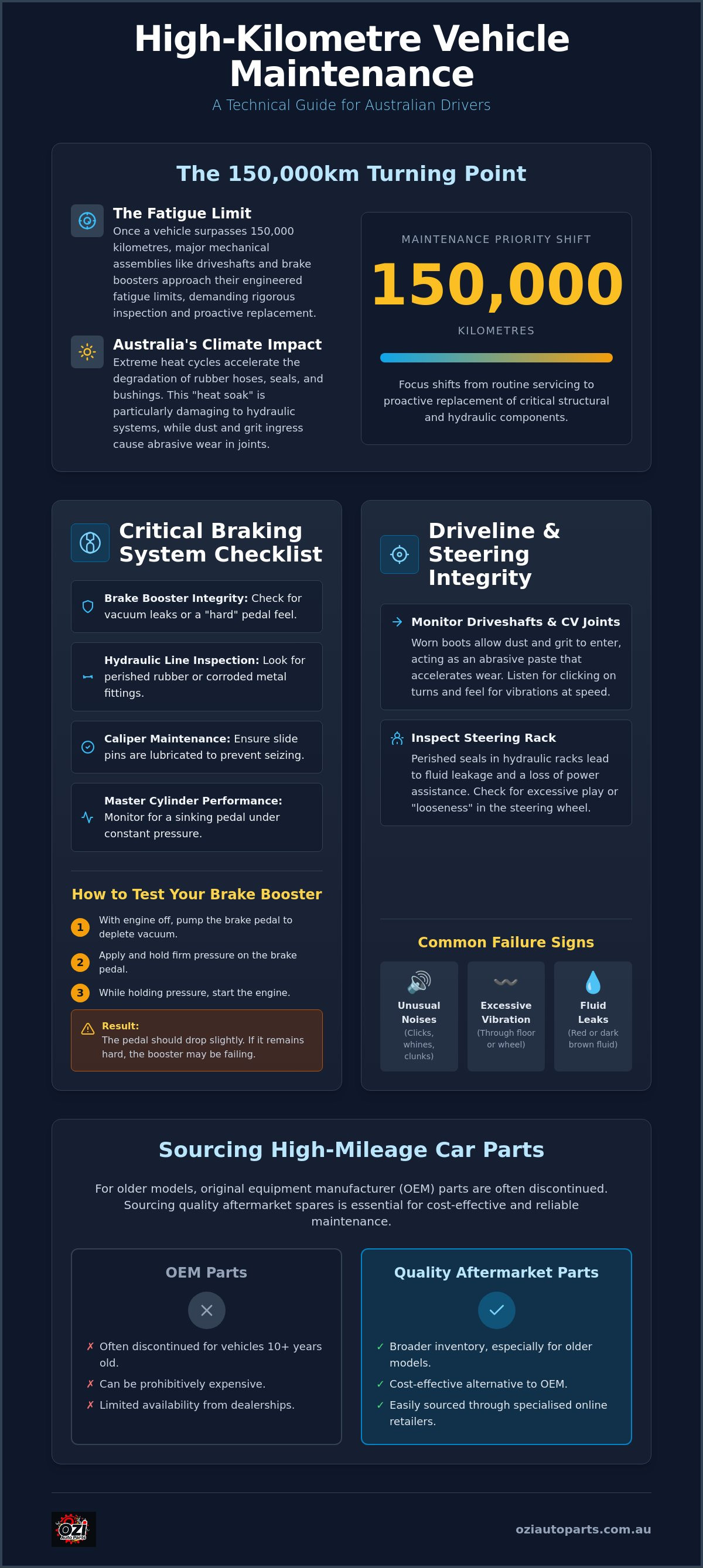
In Australia, a vehicle enters the high-mileage category once it exceeds 150,000 kilometres or ten years of service. This milestone shifts maintenance priorities from simple fluid changes to the replacement of critical high mileage car parts. Understanding vehicle longevity requires distinguishing between service items like filters and structural wear components such as driveshafts and steering racks. Mechanical fatigue in these systems directly impacts road safety.
To better understand how vehicles perform over extreme distances, watch this helpful video:
The 150,000km Threshold
At 150,000km, major mechanical assemblies reach their engineered fatigue limits. Components like driveshafts and brake boosters require rigorous assessment. Highway kilometres generally cause less stress on driveline components compared to the constant torque fluctuations of stop-start city traffic. However, long-distance driving in rural Australia introduces high-frequency vibrations. These vibrations fatigue suspension mounts and steering linkages faster than urban commuting.
Australian Climate and Component Stress
The Australian climate creates unique failure points for aging vehicles. Extreme heat cycles cause rubber hoses, seals, and bushings to lose elasticity. This "heat soak" is particularly damaging to hydraulic systems. Brake boosters and steering pumps often suffer from perished internal diaphragms or hardened seals. Dust and grit ingress also plays a role. In regional areas, fine particulates bypass worn boots on CV joints. This acts as an abrasive paste, accelerating metal-on-metal wear.
Sourcing mechanical spares for older Australian models is becoming increasingly difficult. Many OEM manufacturers have ceased production for these platforms. This makes identifying reliable aftermarket sources for high mileage car parts essential. For example, finding a replacement Ford Falcon brake booster or a Holden Commodore booster is now a common requirement for maintaining vehicle safety and performance.
Critical Braking System Checklist for Older Vehicles
Braking efficiency decreases as hydraulic and mechanical components age. Maintaining safety requires a thorough inspection of the entire system beyond simple pad wear. High mileage car parts like boosters and master cylinders often fail gradually; this masks dangerous performance drops. Identifying these issues early prevents total system failure on the road. Prioritise these checks during every major service interval.
- Brake Booster Integrity: Check for vacuum leaks or a "hard" pedal feel during operation.
- Hydraulic Line Inspection: Perished rubber lines and corroded metal fittings compromise system pressure.
- Caliper Maintenance: Ensure caliper sleeve slide pins and bolts are lubricated to prevent uneven wear or seizing.
- Master Cylinder Performance: Monitor for internal seal bypass where the pedal slowly sinks under constant pressure.
Brake Booster Failure Signs
A brake booster uses engine vacuum to multiply the force applied to the brake pedal; this significantly reduces the physical effort required from the driver. Failure usually occurs when the internal diaphragm perishes or the check valve leaks. Use the following steps to diagnose booster integrity:
- Turn off the engine and pump the brake pedal several times to deplete stored vacuum.
- Apply firm pressure to the brake pedal and hold it in place.
- Start the engine while maintaining pressure on the pedal.
- Observe the pedal movement; it should drop slightly as vacuum builds.
If the pedal remains hard or does not move; the booster requires replacement. Sourcing reliable boosters for common models like the Holden Commodore is essential for restoring factory safety standards.
Master Vac and Hydraulic Spares
Internal master cylinder seals can fail due to fluid contamination or moisture ingress. This leads to internal bypass where fluid leaks past the piston seals rather than moving the calipers. High-quality aftermarket replacements often provide better value than original equipment. When choosing between OEM vs. aftermarket parts; prioritising technical specifications ensures fitment accuracy. Contaminated fluid also damages the reservoir and master vac seals. For a complete overview; consult our All Brake Systems guide. You can find a wide range of reliable brake system components to suit most high-kilometre Australian vehicles.
Driveline and Steering Integrity Maintenance
Driveline components transfer torque under constant mechanical stress. In high-mileage vehicles, this results in cumulative metal fatigue and seal degradation. Maintaining these high mileage car parts is critical for vehicle stability, especially when towing or traversing unsealed Australian roads. Neglecting driveline wear leads to catastrophic failure and loss of propulsion. Regular inspections must focus on the following technical indicators:
- Driveshaft and CV Joints: Inspect for torn boots, grease spray on surrounding components, or excessive axial play.
- Steering Rack and Pump: Monitor for fluid loss at the rack bellows and increased physical resistance during low-speed manoeuvres.
- Suspension Bushings: Identify cracked or perished rubber that causes wandering steering and accelerated tyre wear.
- Wheel Bearings: Detect hub noise or low-frequency growling that changes pitch with vehicle speed.
Driveshaft and Universal Joint Wear
Internal wear occurs within universal joints and CV assemblies even when external boots remain intact. Driveline vibrations felt through the floorpan at specific speeds often signal failing U-joints. High-kilometre units suffer from needle bearing flattened spots or "brinelling." This creates driveline lash and harshness during gear engagement. Replacing worn shafts restores smooth power delivery and protects the transmission output seals from vibration-induced leaks.
Steering and Suspension Components
Australian corrugations and heat cycles accelerate the failure of tie rod ends, ball joints, and control arm bushings. These components maintain wheel alignment and steering precision. For high-mileage 4WDs, steering stabilisers and heavy-duty suspension spares are essential to counteract the increased leverage of larger tyres and aftermarket accessories. Precise fitment of these components prevents "death wobble" and ensures predictable handling under load. If your vehicle exhibits steering play or suspension knocks, browse our range of steering and suspension parts to find a definitive mechanical solution.
Sourcing Quality Rare Spares and Aftermarket Parts
Sourcing high mileage car parts for aging Australian vehicles requires a shift from local dealership visits to specialised online inventory. Many OEM components for Falcons, Commodores, and older 4WD platforms are now discontinued or priced beyond the vehicle's current market value. Specialist retailers bridge this gap by stocking high-volume mechanical components that meet or exceed original factory specifications. This approach ensures that older vehicles remain safe without the prohibitive costs of original equipment.
- Online Sourcing Advantages: Access a wider inventory of mechanical spares than local retailers can provide.
- Aftermarket vs OEM: Prioritise technical specifications and fitment accuracy over brand labels.
- Fitment Verification: Use specific vehicle data to ensure replacement parts match original equipment dimensions.
- Supply Chain Reliability: Choose specialist Australian retailers for faster delivery of heavy mechanical components like driveshafts.
Finding Discontinued Components
Identifying cross-compatible parts is a vital strategy for maintaining aging vehicle platforms. As original plastic or composite components degrade, metal upgrades often provide a superior solution. For example, replacing a perished unit with a steel shell upgrade for older Falcon or Fairlane boosters eliminates the common failure points found in original plastic shells. These upgrades restore vacuum integrity and pedal feel for long-term reliability.
Verifying Technical Specifications
High-mileage cars demand replacement parts that maintain safety under extreme stress. Every component must be vetted for material quality and machining precision to prevent premature failure. Direct supply from Australian specialists reduces lead times for critical repair items, ensuring your vehicle stays operational. Technical accuracy in part selection prevents costly installation errors and ensures roadworthiness. Browse our full range of mechanical spares for your high-mileage vehicle today.
Secure Your Vehicle’s Future on the Road
Don't wait for a critical system failure to compromise your safety. Secure your high-mileage vehicle with quality mechanical spares from Ozi Auto Parts. We are specialists in brake systems and driveline components, providing technical fitment expertise for aging Australian vehicle models. Our inventory is managed for accuracy and reliability. Benefit from Australia-wide shipping on all mechanical spares to keep your vehicle performing at its peak. Your car has plenty of life left; maintain it with the right components today.
Frequently Asked Questions
What are the most common high mileage car parts that fail first?
Rubber-based components and hydraulic seals are typically the first to fail due to cumulative heat stress. Australian conditions accelerate the perishing of vacuum hoses, brake booster diaphragms, and suspension bushings. Driveline components like CV boots and universal joints also reach fatigue limits after 150,000 kilometres. Regular inspection of these high mileage car parts prevents cascading failures in the braking and steering systems.
Is it better to use OEM or aftermarket parts for an older car?
High-quality aftermarket parts often provide better value and availability for older vehicles than discontinued OEM spares. While OEM parts ensure original fitment, many manufacturers stop production for models over ten years old. Certified aftermarket mechanical spares meet or exceed factory specifications and often incorporate design improvements. This makes them a more reliable choice for maintaining high-kilometre vehicles on a budget.
How do I know if my brake booster is failing on my high-mileage car?
A rock-hard brake pedal or an audible hissing sound from the footwell usually indicates a failing brake booster. You might also notice the engine idle becoming rough when the brakes are applied; this signals a vacuum leak. If the pedal doesn't drop slightly when you start the engine with your foot on the brake, the internal diaphragm has likely perished. Prompt replacement of these high mileage car parts is essential for safety.
Why are some spare parts for older Australian cars so hard to find?
Sourcing difficulties arise because many original manufacturers have ceased production for local platforms like the Falcon or Commodore. As vehicle fleets age, the demand for specific mechanical spares decreases, leading local retailers to reduce stock levels. This creates a gap in the market for rare spares required for high-kilometre maintenance. Specialised online retailers now serve as the primary resource for these hard-to-find hydraulic and driveline components.
Can I replace high-mileage suspension bushings myself?
Suspension bushing replacement is possible for experienced home mechanics but typically requires a hydraulic press and specialised pullers. Most high-kilometre bushings are press-fitted into control arms or subframes; they cannot be removed with standard hand tools. Attempting this without the correct equipment can damage the suspension arms. For safety and alignment accuracy, ensuring correct fitment of these critical mechanical components is paramount.