A higher DOT rating isn’t automatically the right upgrade. In the high performance brake fluid Australia market, performance labels can distract from the requirement that matters most: the fluid specification set for your vehicle.
Comparing DOT ratings and boiling points can be confusing, especially if you need dependable braking during repeated hard use, towing or track sessions. A higher-rated fluid still needs to meet your vehicle’s specification. Choosing by the biggest number alone doesn’t establish compatibility.
This guide explains how to find the required fluid in your owner’s manual or on the reservoir label, compare fluid types and boiling-point data, and assess your driving demands. It also explains why moisture absorption and fluid condition matter. Start with the vehicle specification, then consider how you use the vehicle. That gives you a practical basis for comparing options without relying on marketing claims alone.
Key Takeaways
- Start with the fluid specification in your vehicle handbook or near the reservoir. A higher rating alone doesn’t establish compatibility.
- Match your choice to how you drive, whether that’s daily use, towing or track sessions. Not every vehicle needs an upgrade.
- Compare compatible options against your vehicle’s requirements and driving demands.
- Have the vehicle make, model, year and handbook specification ready. Fluid selection doesn’t replace checking pads, rotors, hoses and other brake components.
High-performance brake fluid in Australia: what the specification tells you
Brake fluid is the hydraulic medium that transfers force from the pedal through the braking system to the brakes. Its specification describes performance requirements, not a general marketing claim. Choosing high performance brake fluid Australia motorists can use starts with the vehicle’s stated requirements, then takes account of how the vehicle is driven.
A “high-performance” label alone doesn’t confirm compatibility or suitability. Use the vehicle manufacturer’s specification as your reference point. Driving conditions can make additional heat capacity relevant, but they don’t override that specification.
DOT ratings, vehicle requirements and high-temperature use
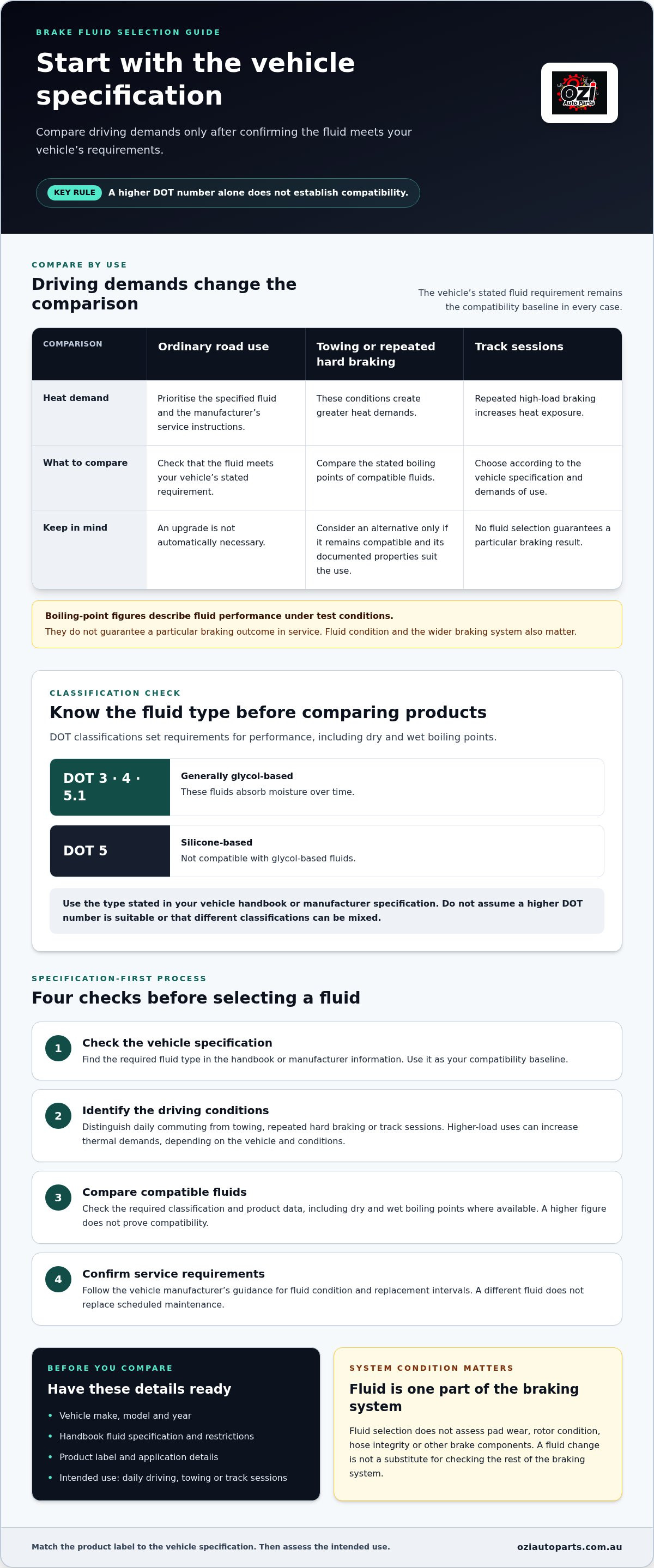
DOT classifications set requirements for brake-fluid performance, including dry and wet boiling points. DOT 3, DOT 4 and DOT 5.1 fluids are generally glycol-based and absorb moisture over time. DOT 5 is silicone-based and isn’t compatible with glycol-based fluids. For an overview of the distinctions, see brake fluid types and specifications.
Use the fluid type stated in your vehicle handbook or manufacturer specification. Don’t assume a higher DOT number is suitable, or that fluids with different classifications can be mixed. Check the product’s stated specification against the vehicle requirement before choosing.
- Ordinary road use: Prioritise the specified fluid and the manufacturer’s service instructions.
- Towing or repeated hard braking: These conditions create greater heat demands. Compare the stated boiling points of compatible fluids.
- Track sessions: Repeated high-load braking increases heat exposure. Choose according to the vehicle specification and the demands of use.
Boiling-point figures describe fluid performance under test conditions. They don’t guarantee a particular braking outcome in service. Fluid condition and the wider braking system also matter.
How to choose high-performance brake fluid for Australian driving
Use a specification-first process. Separate what the vehicle requires from any optional choice for more demanding use. The right high performance brake fluid australia drivers choose depends on both factors, not the strength of a product’s marketing claims.
- Check the vehicle specification. Find the required fluid type in the handbook or manufacturer information. Use it as your compatibility baseline.
- Identify the driving conditions. Daily commuting differs from towing, repeated hard braking or track sessions. These higher-load uses can increase thermal demands, depending on the vehicle and conditions.
- Compare compatible fluids. Check the required classification and product data, including dry and wet boiling points where available. A higher figure doesn’t prove vehicle compatibility.
- Confirm service requirements. Follow the vehicle manufacturer’s guidance for fluid condition and replacement intervals. Choosing a different fluid doesn’t replace scheduled maintenance.
Before buying, check the handbook specification, intended driving use, fluid compatibility and product data.
Match fluid choice to your vehicle and driving conditions
For ordinary road use, start with a fluid that meets the vehicle’s stated requirement. An upgrade isn’t automatically necessary. Towing, repeated hard braking and track driving can increase heat exposure. Consider an alternative only if it remains compatible and its documented properties suit that use. No fluid selection guarantees a particular braking result.
Brake fluid works within a system. Pads, rotors, hoses and other components contribute to braking performance and system condition. A general overview of the Australian brake system helps put fluid selection in context. The US Federal Motor Vehicle Safety Standard No. 116 for brake fluids outlines US requirements. For Australian fitment decisions, follow your vehicle’s specification. For related components, browse brake-system parts.
Before buying high-performance brake fluid: compatibility and next steps
Before comparing products, gather the vehicle details that determine fitment. A performance label can’t replace an exact match to the manufacturer’s requirements. For a high performance brake fluid australia purchase, base your decision on documented compatibility and intended use.
A pre-purchase checklist for confident selection
Confirm the vehicle, required fluid specification, manufacturer restrictions and intended driving use before selecting a product.
- Vehicle identification: Record the make, model and year. These details help distinguish specifications across model variants.
- Required fluid: Check the handbook or manufacturer specification for the required type and any restrictions. Don’t assume two classifications are interchangeable.
- Product information: Compare the label and application details with the vehicle information. If the stated specification doesn’t meet the vehicle requirement, don’t select that fluid.
- Driving use: Note whether the vehicle is used for daily driving, towing or track sessions. This context helps you assess whether an option that meets the vehicle specification suits the operating demands.
Keep these details together when assessing a product. Match the label to the vehicle specification, then check restrictions and intended use. Never rely on the performance claim alone.
Fluid selection covers only the hydraulic medium. It doesn’t assess pad wear, rotor condition, hose integrity or the rest of the braking system. Those components also affect system condition, so a fluid change shouldn’t be treated as a substitute for checking them.
For related components, browse brake-system parts and use your vehicle details to guide your selection.
Keep your next braking-system decision fit for purpose
Driving demands can change. If your vehicle takes on regular towing or track use, reassess the braking system’s requirements and condition rather than assuming a different fluid alone addresses every need. Keep your vehicle details and intended use in view when planning related parts decisions.
For high performance brake fluid australia, let vehicle compatibility and documented specifications guide your choice, not the strength of a marketing claim. Ozi Auto Parts is an Australian online retailer focused on brake-system parts.
Browse brake-system parts from Ozi Auto Parts to explore components for your vehicle. Use a specification-led approach to make your next parts decision with greater confidence.
Frequently Asked Questions
Can I use high-performance brake fluid in a standard road car?
A standard road car doesn’t need a fluid marketed for performance solely because of its label. For a stock daily driver, compare the product application information with the exact model and year, including any variant-specific requirements. If the vehicle is used for ordinary commuting, track-focused packaging alone isn’t a reason to choose a different fluid.
What is the difference between DOT 4 and DOT 5.1 brake fluid?
DOT 4 and DOT 5.1 are glycol-based classifications with different performance requirements. DOT 5.1 generally has higher boiling-point requirements than DOT 4, but the DOT number isn’t a complete measure of product quality. Compare the specific fluid’s published data, including dry and wet boiling points, rather than relying on the classification alone.
How often should brake fluid be changed in Australia?
Use the interval set for your vehicle, and keep a record of each fluid change. Note the date, odometer reading and fluid specification on the service invoice or maintenance record. This gives you a clear reference at the next service and helps avoid relying on memory. Don’t infer the replacement date from the vehicle’s age alone.
Does high-performance brake fluid improve braking distance?
Brake fluid isn’t a braking-distance upgrade by itself. To compare stopping-distance claims meaningfully, tests would need to use the same vehicle, tyres, road surface, load, starting speed and conditions. Otherwise, the results aren’t directly comparable. Treat a single distance figure or product claim as insufficient evidence that a particular fluid will shorten your vehicle’s stopping distance.