The lowest listed price is no saving if the part does not fit your vehicle. When choosing an idler arm assembly in Australia, start with the vehicle make, model, year and steering configuration. Prices can vary by application, so one figure cannot guide every buyer.
It’s also sensible to weigh the assembly’s condition and what comes with it, not just the headline cost. This guide explains how to narrow the correct fit, what drives price differences and how refurbished or exchange options affect the decision. You’ll also see which vehicle details and part identifiers help distinguish similar-looking components before ordering. The aim is a compatible assembly and a clear view of value, rather than a low figure that doesn’t match the application.
Key Takeaways
- Use the vehicle’s exact application and part number to distinguish assemblies across similar models.
- Compare listings by fitment and assembly type, not price alone; specifications vary by vehicle.
- For HK, HT and HG Holden applications, a refurbished option can reuse the existing GMH idler arm with a CNC-machined pin, nut and rubber boot.
- Match any related steering or suspension parts to the vehicle application before choosing a purchasing option.
Idler arm assembly australia
Idler arm assembly listings in Australia vary by vehicle application, assembly type and condition. A part number tied to a specific model and production year is more useful than a broad vehicle description. For example, listings distinguish a 1963-1982 Chevrolet Corvette assembly from a 1982-1992 Chevrolet Camaro arm. Those applications are not interchangeable simply because both vehicles are Chevrolets.
Start with the vehicle details, then compare the listing’s fitment information. Make, model, year and drivetrain can separate similar-looking parts. Chevrolet truck listings, for instance, distinguish 2WD applications from 2WD/4WD applications. Steering configuration and the exact model variant also matter. A match on make alone does not establish compatibility.
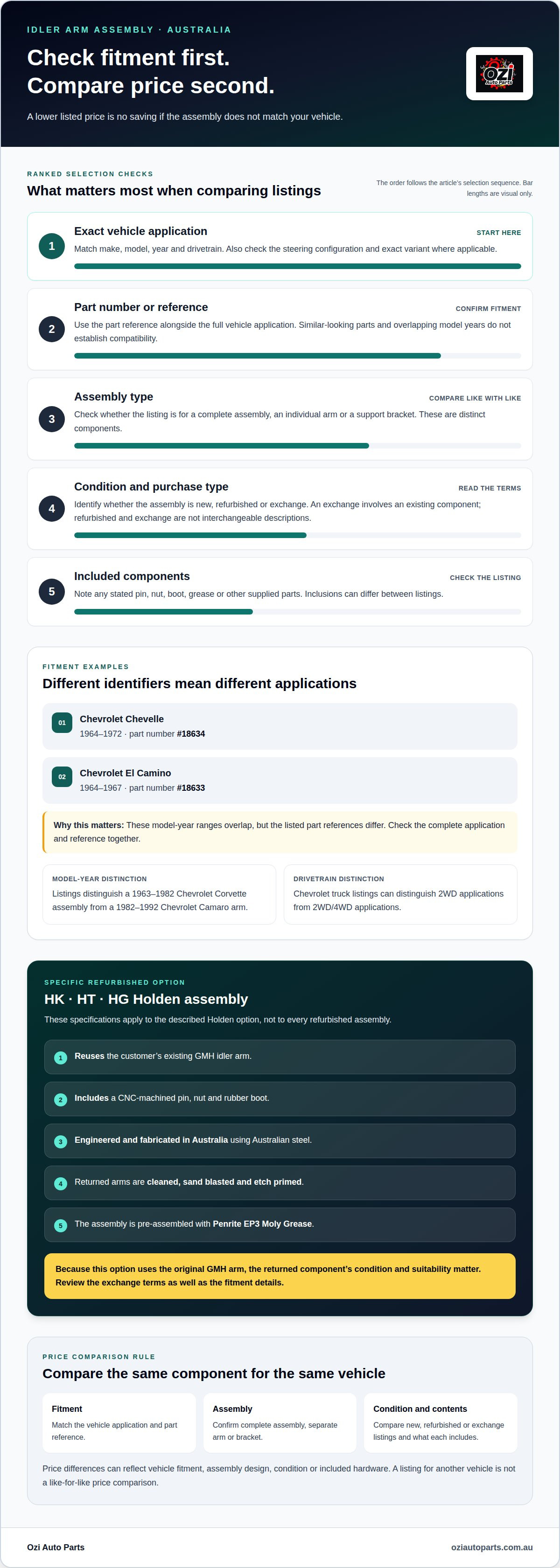
- Identify the vehicle: Record its make, model, year and drivetrain. Include the exact variant where applicable.
- Find the part reference: Compare the listing’s part number with the reference for the required application.
- Confirm the assembly type: Distinguish a complete assembly from an individual arm or support bracket.
- Compare condition: Check whether the listing describes a new, refurbished or exchange assembly.
- Review what is included: Note any stated pin, nut, boot or other supplied components.
Part numbers help resolve close applications. The Chevrolet Chevelle listing for 1964-1972 uses #18634, while the Chevrolet El Camino listing for 1964-1967 uses #18633. Their model years overlap, but their identifiers differ. Use the complete application and part reference together, rather than assuming a component suits both vehicles.
Compare prices on the same basis. Differences between listings may reflect vehicle fitment, assembly design, condition or included hardware. A refurbished assembly is also different from a standalone arm. Check that both listings describe the same type of component for the same vehicle before judging value.
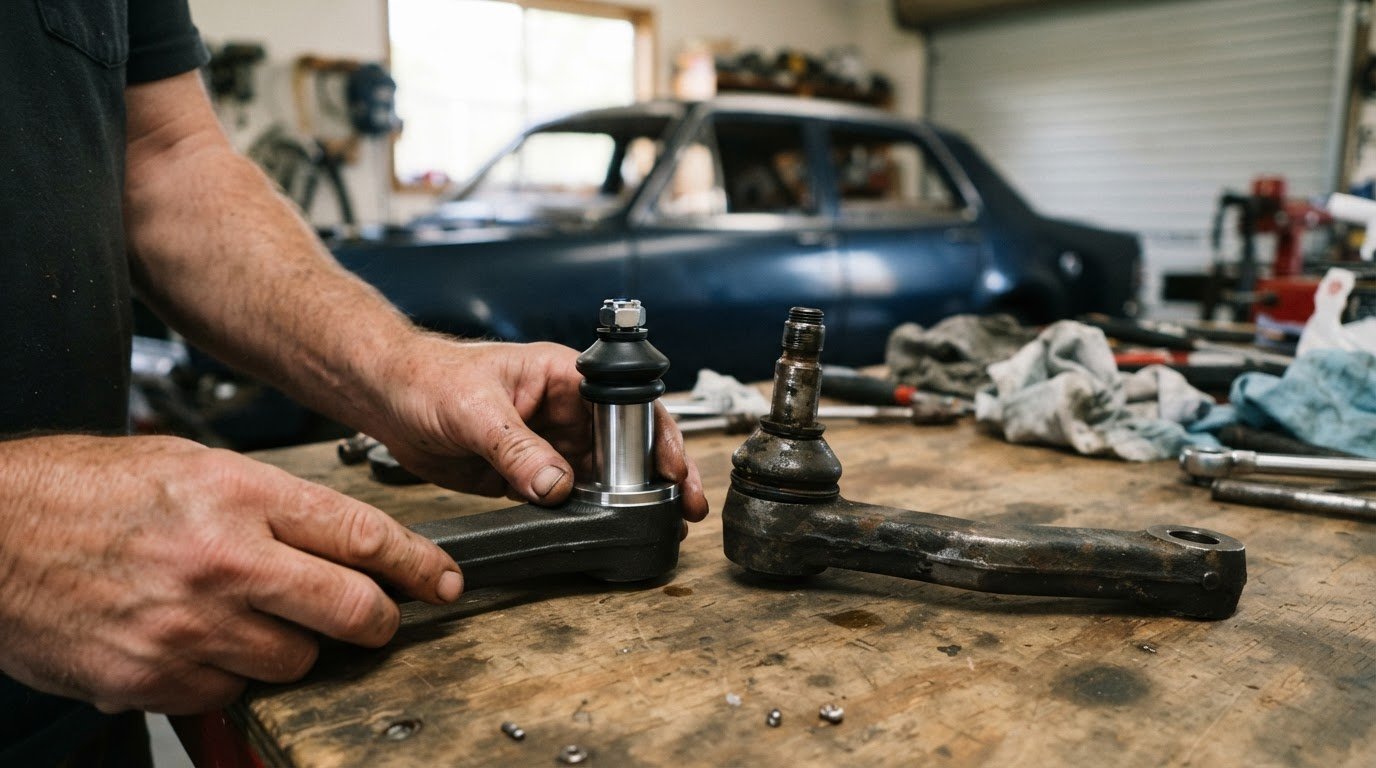
One refurbished assembly is designed for HK, HT and HG Holden models. Its specifications are:
- Reuses the customer’s existing GMH idler arm.
- Includes a CNC-machined pin, nut and rubber boot.
- Engineered and fabricated in Australia using Australian steel.
- Returned arms are cleaned, sand blasted and etch primed.
These details apply to that option, not every refurbished assembly.
An exchange differs from a straightforward purchase because it involves an existing component. The Holden example uses the original GMH arm as its base, so the returned component’s condition and suitability matter. Read the exchange terms alongside the fitment details, and do not treat “refurbished” and “exchange” as interchangeable descriptions.
Included parts can also affect the comparison. The Holden refurbished assembly is pre-assembled with Penrite EP3 Moly Grease. That feature is specific to the described assembly. Other listings need to be assessed by their own contents and specifications. A support bracket, for example, is a distinct component, not another name for a complete idler arm assembly.
For a sound purchase decision, match the vehicle application first, then compare construction, condition and included components. Use the part number as an additional fitment reference, not a substitute for vehicle details. Distinguish complete assemblies from separate arms and support brackets. This gives Australian buyers a practical basis for comparing fit and value.
Other listings show why the application and part identifier matter when comparing prices. These entries refer to different applications, so their prices are specific to each listing, not a substitute for checking fitment. Keep each description intact to distinguish an assembly from an arm when comparing options.
When reviewing prices, keep the vehicle, date range, part number and assembly wording alongside each amount. This makes clear which listing you are assessing and helps prevent treating separate applications as equivalent just because they are described as idler arms. Compare each price within its stated application, not against a listing for a different vehicle.
Ozi Auto Parts
Ozi Auto Parts supplies steering and suspension parts for customers sourcing components for their vehicle. Once you’ve identified the required application and assembly type, its parts range is a relevant next step for related steering and suspension requirements. The business also supplies brake system parts, driveshafts and 4WD upgrade parts.
Use the vehicle’s make, model, year and drivetrain details to guide part selection. Clear application information helps narrow the options and distinguish steering components from other vehicle parts. Ozi Auto Parts supplies automotive components, including steering parts, rather than repair work or vehicle sales.
For help with your parts enquiry, contact Ozi Auto Parts.
Keep your next parts decision organised
Make your final selection based on the vehicle’s exact application, not the headline price alone. If two listings look similar, treat their part references as distinct until the application matches. This keeps the decision focused on compatibility, not appearance or cost.
Once you’ve narrowed the options, include the relevant vehicle details and part reference in your enquiry. This gives the parts team a clear starting point for your idler arm assembly in Australia and keeps the discussion focused on the component you need.
For help with your parts enquiry, contact Ozi Auto Parts. A clear application is the right first step towards choosing the correct part.