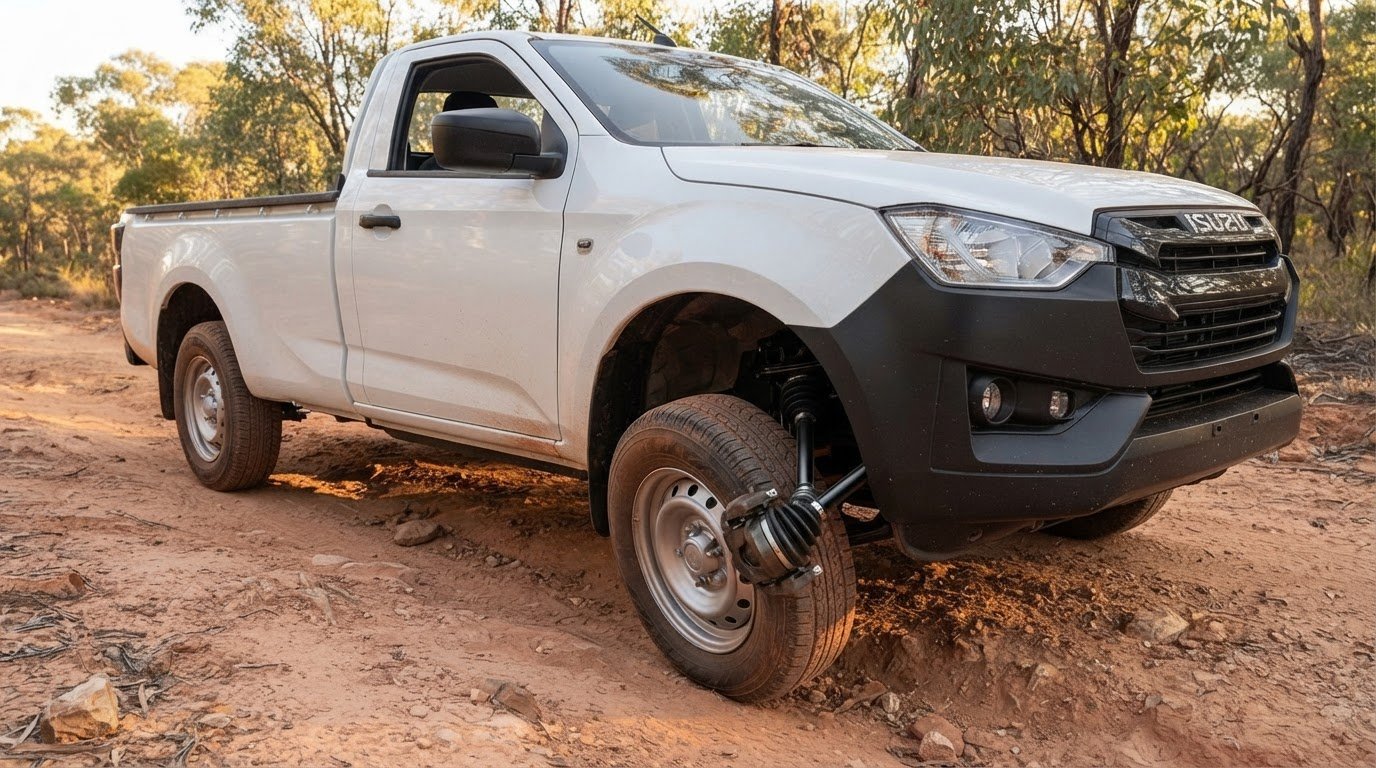
The right driveshaft isn’t identified by model name alone. An Isuzu D-MAX driveshaft upgrade must match the vehicle’s model, year, engine and installation side. One listed CV driveshaft application covers 2021-2025 Isuzu D-MAX, MU-X and Mazda BT-50 models with the 3.0-litre 4JJ3 engine; it suits either the left or right position.
Model and engine details are a useful starting point, but they don’t resolve every fitment question. The side designation and exact part number help distinguish components that may look similar but suit different applications.
This guide explains the available D-MAX driveshaft options, how to identify left- or right-hand fitment, and how to use part numbers alongside year and engine details to narrow the correct match. A practical fitment check helps you select the right part without relying on the model badge alone.
Key Takeaways
- Separate standard replacement needs from a 4WD upgrade before choosing a driveshaft option.
- Use the vehicle’s model, year and engine details together to narrow the fitment.
- Match the left- or right-hand position to the required installation side.
- Use the part number as a final fitment reference, not the model badge alone.
Isuzu D-MAX driveshaft product range
Fitment depends on the D-MAX generation, engine, drivetrain and installation position. Check each detail against the specific shaft listing.
Product Weight and Dimensions
- A CV drive shaft is listed for 2021-2025 D-MAX, MU-X and Mazda BT-50 models with the 3.0-litre 4JJ3 engine.
- Another listed application covers the D-MAX TFS40 3.0-litre diesel with the 4JJ3-TCX engine, from 2020~2027.
- A Basco EXTD shaft is listed for 4WD models.
Weight affects handling and freight. Shaft length and joint dimensions affect fit and clearance. Compare the listed specifications with the vehicle application. Assess any discount against the exact part and its fitment, not the model name alone. Vibration under load, clunking or clicking can indicate a worn or unsuitable shaft. Lifts, larger tyres, towing and added power can increase driveline stress or alter shaft operating angles.
Aftermarket and Genuine Replacement Comparison
A genuine Isuzu replacement follows the factory application. A heavy-duty aftermarket shaft is an alternative chosen for its stated vehicle fitment and intended duty. The label alone doesn’t establish suitability.
- Compare part numbers, dimensions, joints and vehicle application before choosing.
- Installation requires the correct shaft, secure fastening and alignment with the driveline.
- Balancing addresses vibration caused by shaft imbalance.
- A lift or other modification can change operating angles. Include modifications when assessing fitment.
- Warranty terms depend on the product and the vehicle’s existing coverage.
Details Needed to Order the Correct Driveshaft
- Provide the D-MAX model code, year, engine, drivetrain and required side.
- Include the existing shaft’s part number, if available, and measurements such as overall length and joint dimensions.
- Confirm whether the vehicle has a lift, larger tyres or other driveline modifications.
- Match those details to the listing and use the part number as a further fitment reference.
Australian 4WD driveline workshops handle installation and balancing. Automotive parts suppliers provide replacement and upgrade options. These details help distinguish similar-looking shafts and reduce the risk of ordering the wrong application.
Left- or right-hand side fitment
Side designation, engine and model year all affect D-MAX driveshaft fitment. A match on one detail alone doesn’t establish that a shaft suits the vehicle.
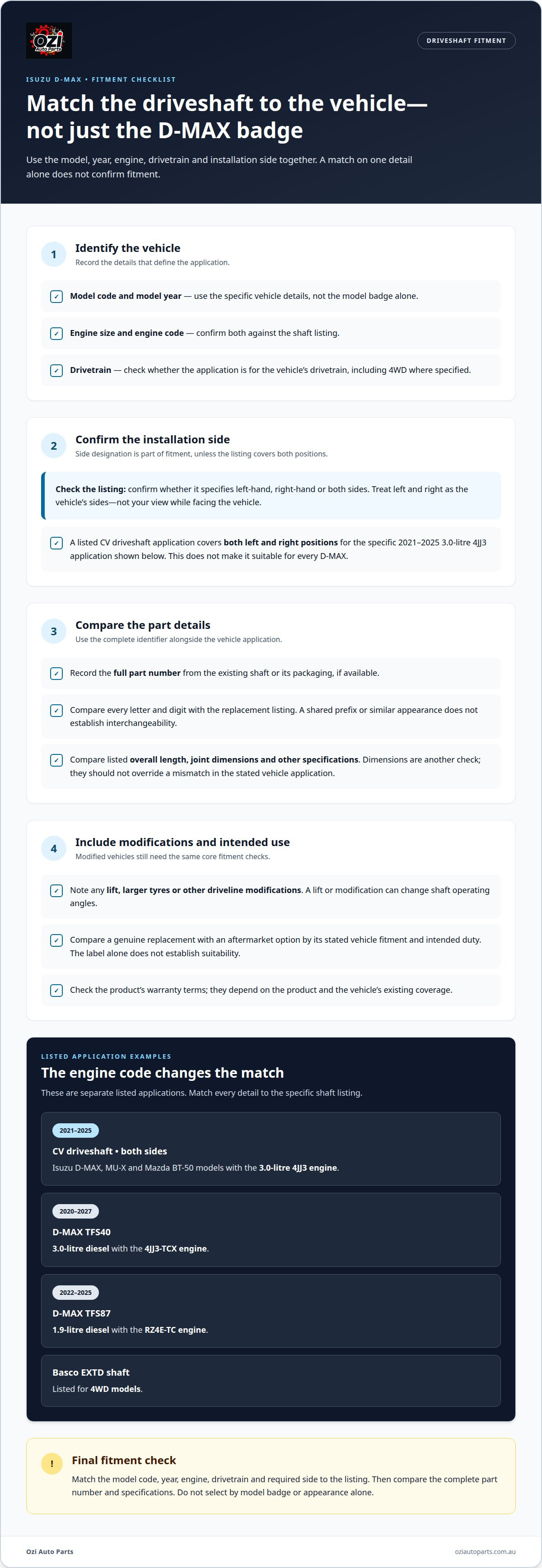
The listed CV drive shaft suits both left and right positions. Its application covers 2021-2025 Isuzu D-MAX, MU-X and Mazda BT-50 models with the 3.0-litre 4JJ3 engine. This dual-side listing simplifies side selection for that specific application, but it doesn’t make the shaft suitable for every D-MAX. Treat left and right as the vehicle’s sides, not your view while facing the vehicle.
Engine and model-year codes narrow the application further. The D-MAX TFS87 with a 1.9-litre diesel and RZ4E-TC engine has a listed fitment of 2022~2025. The TFS40 with a 3.0-litre diesel and 4JJ3-TCX engine has a listed fitment of 2020~2027. These are different applications, so don’t select by D-MAX badge or year alone.
- Identify the model code and model year.
- Match the engine size and engine code to the application.
- Confirm whether the listing specifies both sides or one position.
- Compare the part number with the vehicle’s required application.
For a modified D-MAX, retain the same checks: a lift or driveline changes don’t replace the need to match engine, year and side. Use the driveshaft and automotive parts range as the next step in narrowing the correct application.
D-MAX driveshaft part numbers
A part number gives you a precise identifier for comparing driveshaft applications. Treat it as a fitment reference, not a substitute for matching the D-MAX model, engine, year and required side. Similar-looking shafts can suit different applications, so confirm the complete identifier rather than relying on appearance.
Use this sequence to narrow the match:
- Record the full part number from the existing shaft or its packaging.
- Compare every letter and digit with the replacement listing.
- Match the listed vehicle application to the D-MAX model, engine and year.
- Confirm the required left- or right-hand position, or that the listing covers both.
Don’t assume a partial match is enough. A shared prefix or similar-looking code doesn’t establish that two parts are interchangeable. If the existing identifier is damaged or unreadable, use the vehicle’s model code, engine code, year and side to narrow the application. Dimensions can provide another comparison point, but they shouldn’t override a mismatch in the stated vehicle fitment.
For example, a listing that names a 3.0-litre 4JJ3 application should not be treated as a match for a different engine simply because both vehicles carry the D-MAX badge. Part numbers help expose that distinction and make catalogue comparisons more exact. Keep the complete number with the vehicle details when assessing a replacement.
Use the part number alongside the full application details when selecting an Isuzu D-MAX driveshaft. That combination gives you a clearer basis for choosing the correct replacement or upgrade.
Ozi Auto Parts: Driveshafts
Ozi Auto Parts supplies driveshafts for owners choosing a D-MAX replacement or upgrade. Use the vehicle’s model code, year, engine, required side and existing part number to narrow the right application. These details help distinguish similar-looking components and reduce the risk of choosing by model badge alone.
Turn to the driveshaft range when you’ve identified the vehicle details and need to select a matching part. Ozi Auto Parts also offers 4WD Upgrade Parts, Steering and Suspension Parts, and Brake System Parts for related vehicle requirements.
For help with your driveshaft selection, contact Ozi Auto Parts.
Choose the next step with fitment in mind
Plan an Isuzu D-MAX driveshaft upgrade around your vehicle’s actual configuration and intended use, rather than choosing from a broad model description. This keeps the decision specific to your D-MAX and gives you a clear basis for resolving fitment questions before selecting a component.
A part selection is also an opportunity to align replacement priorities with the vehicle’s broader upgrade plan, rather than treating each component as an isolated purchase. Ozi Auto Parts offers Driveshafts, 4WD Upgrade Parts and Brake System Parts for owners sourcing a replacement or considering related mechanical upgrades.
Contact Ozi Auto Parts about fitment to discuss your D-MAX requirements and take the next step with confidence.
Frequently Asked Questions
Which Isuzu D-MAX model years and variants need a driveshaft upgrade?
No D-MAX year or variant automatically requires an upgrade. The correct application depends on the vehicle’s existing shaft, engine, drivetrain and condition. Listed examples include the TFS40 3.0-litre diesel with 4JJ3-TCX and the TFS87 1.9-litre diesel with RZ4E-TC. Treat those as fitment applications, not a recommendation that every vehicle in those ranges needs replacement.
What driveshaft upgrade options are available for the Isuzu D-MAX in Australia?
Available options include CV driveshaft applications and a Basco EXTD driveshaft listed for 4WD models. For example, the listed CV shaft application covers selected D-MAX models with the 3.0-litre 4JJ3 engine. The right choice depends on the vehicle’s configuration and the required position. Compare the product’s application and part number before selecting a replacement or upgrade.
How much does an Isuzu D-MAX driveshaft upgrade cost in Australia, including fitting?
The total combines the selected driveshaft price with workshop fitting charges. Ozi Auto Parts sells driveshafts but does not provide automotive repair or fitting services, so installation is not included in the parts supply. The workshop’s labour charge depends on the work required. For an accurate budget, separate the parts purchase from installation costs and compare each with your vehicle’s requirements.
How is an Isuzu D-MAX driveshaft upgrade installed and balanced?
- Install the correctly matched shaft with secure fastening and alignment to the driveline.
- Balance the shaft to address vibration caused by shaft imbalance.
Which Australian workshops and suppliers offer Isuzu D-MAX driveshaft upgrades?
Australian 4WD driveline workshops handle installation and balancing, while automotive parts suppliers offer replacement and upgrade options. Ozi Auto Parts supplies driveshafts for D-MAX replacements and upgrades.