Standard OEM clutches fail under the thermal loads of Australian towing and heavy-duty off-roading. When torque output exceeds factory limits, slippage is a certainty. You recognise that a slipping clutch is a critical mechanical failure that halts productivity and risks drivetrain damage. This guide provides the technical specifications for performance clutch kits Australia, focusing on high-torque delivery and thermal stability.
You'll master the differences between organic, ceramic, and cushioned button friction materials to ensure your upgrade handles specific GVM demands. We provide a direct analysis of pressure plate clamping forces, flywheel compatibility, and fitment requirements for local vehicle models. From street performance to remote-area touring, this breakdown ensures you select a kit that delivers reliable power and precise engagement. Stop guessing about friction coefficients and start prioritising mechanical reliability.
Key Takeaways
- Evaluate friction materials like organic and cerametallic to match specific torque and heat management requirements.
- Identify high-clamp pressure kits designed for heavy-duty towing and the unique thermal stresses of Australian off-roading.
- Master the technical selection criteria for performance clutch kits australia to ensure reliable power delivery across Ford, Holden, and 4WD models.
- Streamline mechanical upgrades by sourcing direct-fit kits with nationwide shipping for rapid vehicle turnaround.
Understanding Performance Clutch Mechanics and Friction Materials
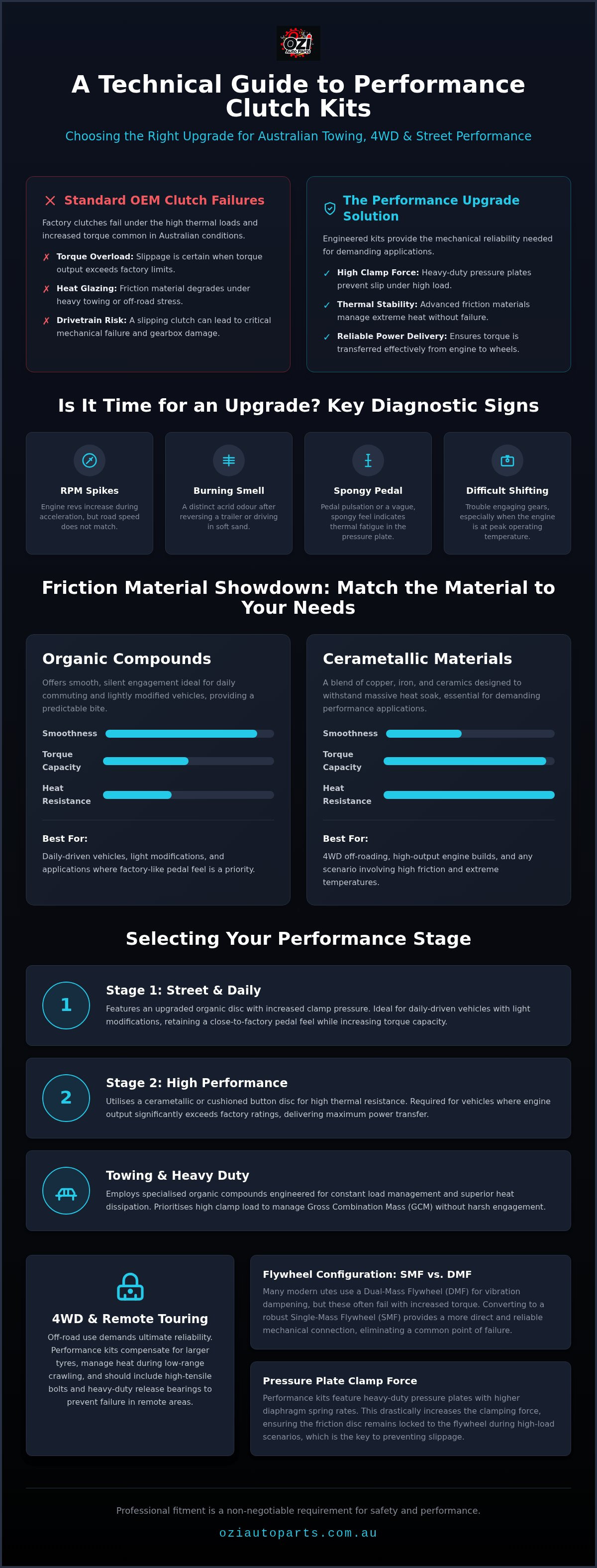
Performance clutch kits australia are engineered to manage mechanical stress exceeding factory specifications. Understanding how a clutch works is vital for identifying why OEM units fail under load. Standard kits rely on basic clamp pressure and limited thermal dispersion. Performance upgrades increase torque capacity by utilising heavy-duty pressure plates with higher diaphragm spring rates. This ensures the friction disc remains locked against the flywheel during high-load scenarios like towing heavy caravans or climbing steep grades.
Friction material selection dictates both drivability and durability. Organic compounds offer smooth, silent engagement for daily commuting. They provide a predictable bite but can glaze under extreme heat. Cerametallic materials utilise a blend of copper, iron, and ceramic to withstand massive heat soak. These are essential for 4WD applications where low-range torque and sand driving create high-friction environments. While slightly more aggressive in engagement, they prevent the catastrophic slippage common in standard units.
Reliability also depends on the flywheel configuration. Many modern Australian utes feature Dual-Mass Flywheels (DMF) designed for vibration dampening. These components often fail when engine torque is increased. Transitioning to a Single-Mass Flywheel (SMF) provides a more robust mechanical connection. It's a utilitarian upgrade that removes the internal spring failures associated with complex DMF systems.
Mechanical Diagnostic Signs: When to Upgrade
Don't wait for total drivetrain failure. Identifying early symptoms in performance clutch kits australia prevents secondary damage to the gearbox or crankshaft. Monitor your vehicle for these specific indicators:
- RPM spikes without a corresponding increase in road speed during high-gear acceleration.
- Distinct acrid burning smells after reversing a trailer or navigating soft sand.
- Pedal pulsation or a spongy feel indicating thermal fatigue in the pressure plate.
- Difficulty engaging gears when the engine is at peak operating temperature.
Selecting Performance Clutch Kits for Australian Conditions
Selection depends on specific load profiles. Towing kits prioritise clamp load to manage Gross Combination Mass (GCM) without the harsh engagement of a race clutch. Street kits balance torque capacity with pedal feel. Referring to performance clutch basics clarifies the distinction between Stage 1 and Stage 2. Stage 1 kits generally utilise high-torque organic friction material for daily-driven vehicles with light modifications. Stage 2 is required when engine output significantly exceeds factory torque ratings, often employing cerametallic materials to handle higher operating temperatures.
Consider these criteria when matching a kit to your vehicle's output:
- Stage 1: Upgraded organic disc and increased clamp pressure while retaining factory-like engagement.
- Stage 2: Cerametallic or cushioned button disc designed for high thermal resistance in performance builds.
- Towing Heavy Duty: Specialised organic compounds engineered for constant load management and heat dissipation.
4WD Performance Upgrades: Beyond the Standard Kit
Off-road performance requires managing heat during sand driving or low-range rock crawling. Standard clutches glaze quickly under these conditions, leading to permanent slippage. Upgrading to 4WD suspension upgrade kits Australia often leads to fitting larger tyres. Increased rolling diameters place higher mechanical leverage on the clutch assembly. A performance kit compensates for this leverage by providing superior bite and thermal management, ensuring the vehicle maintains momentum in soft terrain.
Remote touring demands mechanical redundancy. Performance clutch kits australia should include high-tensile bolts and heavy-duty release bearings to prevent common point-of-failure issues. Ensure your driveline components are rated for the increased clamp pressure provided by the new pressure plate. You can browse our range of 4WD upgrade parts for direct-fit solutions tailored to local vehicle specifications. This ensures your vehicle remains reliable in extreme conditions.
Sourcing and Fitment: Direct Mechanical Supply
Ozi Auto Parts operates as a high-volume resource for performance clutch kits australia, maintaining inventory depth for Ford, Holden, and common 4WD platforms. Direct e-commerce distribution ensures rapid delivery for critical mechanical repairs across the country. Efficient power delivery requires more than just a clutch upgrade; integrated systems like brake boosters must be rated for the vehicle's enhanced performance profile to ensure safe operation under load. This synergy is vital for maintaining braking margins when torque output is increased.
Professional fitment is a non-negotiable requirement for high-clamp assemblies. Incorrect torque settings or spline misalignment causes immediate vibration and eventual hub failure. Precision during the installation phase ensures the drive line retains its integrity under the increased stresses of performance friction materials. Technical accuracy prevents secondary damage to the transmission input shaft and protects the investment in high-torque hardware. Factual adherence to manufacturer specifications is the only way to guarantee reliable performance.
Fitment Verification and Drive Line Integrity
Before commencing installation, verify the input shaft spline count and flywheel bolt pattern against the specific vehicle variant. Incompatibility leads to costly downtime and potential damage to the clutch hub. During the process, monitor for driveshaft balancing symptoms, as increased clamp pressure often amplifies existing mechanical harmonics that were previously masked by a slipping OEM unit. Inspect the rear main seal and spigot bearing for any signs of wear or contamination that could compromise the new friction disc.
- Clean the flywheel and pressure plate friction surfaces using a specialised brake cleaner to remove all shipping oils and contaminants.
- Insert a precision alignment tool through the clutch disc and into the pilot bearing to ensure the disc is perfectly centred.
- Position the pressure plate over the flywheel dowels and hand-tighten all fasteners to secure the assembly in place.
- Torque the pressure plate bolts in a sequential star pattern according to the manufacturer’s specific mechanical torque data.
- Verify the release bearing position and clutch fork travel for clean, smooth disengagement before reassembling the transmission housing.
Optimising Drive Line Reliability
Mechanical precision remains the priority for any high-torque application. Selecting performance clutch kits australia requires matching friction material and clamp pressure to your specific vehicle load. Organic compounds provide daily drivability. Cerametallic options manage the extreme heat soak of heavy towing and sand driving. Correct fitment and drivetrain alignment ensure these upgrades deliver long-term reliability without premature failure. Ozi Auto Parts provides direct transactional efficiency for professional restorers and 4WD enthusiasts. We specialise in heavy-duty upgrade parts and mechanical systems. Our inventory includes direct-fit solutions for Ford, Holden, and popular 4WD models with Australia-wide shipping on all mechanical components. Secure the power delivery your vehicle requires for the toughest conditions. High-volume inventory ensures you get the right part when you need it most. Browse high-performance clutch kits and mechanical spares at Ozi Auto Parts. Your next build starts with dependable hardware.
Frequently Asked Questions
How does a performance clutch kit differ from a standard OEM replacement?
Performance kits provide higher clamp loads and superior thermal management compared to standard OEM units. They utilise upgraded pressure plate springs and specialised friction materials to prevent slippage under increased torque. While OEM kits prioritise comfort and low noise, performance clutch kits australia focus on reliable power delivery and durability during heavy-duty applications or when engine output exceeds factory specifications.
Will a performance clutch make the pedal too heavy for daily driving in Australia?
Pedal effort increases with higher clamp loads, but modern Stage 1 and heavy-duty organic kits maintain manageable levels for daily use. Extreme motorsport or Stage 3 cerametallic kits require significantly more force, which can be fatiguing in stop-start Australian traffic. Selecting a cushioned button or high-torque organic disc ensures a balance between increased torque capacity and reasonable pedal feedback.
Do I need to replace my flywheel when installing a performance clutch kit?
Machining or replacing the flywheel is essential to ensure a flat, clean friction surface for the new clutch disc. If your vehicle utilises a dual-mass flywheel (DMF) that has failed or is being upgraded for higher torque, a solid-mass conversion is often required. Reusing a glazed or warped flywheel will cause premature friction material wear and drive line vibrations.
What is the best clutch material for a 4WD used for heavy towing?
High-torque organic friction material is usually the best choice for 4WDs used for heavy towing. It provides smooth engagement for starting on inclines while offering the increased clamp pressure needed for high GCM loads. For extreme off-roading involving constant low-range work or sand driving, a cerametallic button clutch handles higher heat soak but results in more aggressive engagement during daily driving.