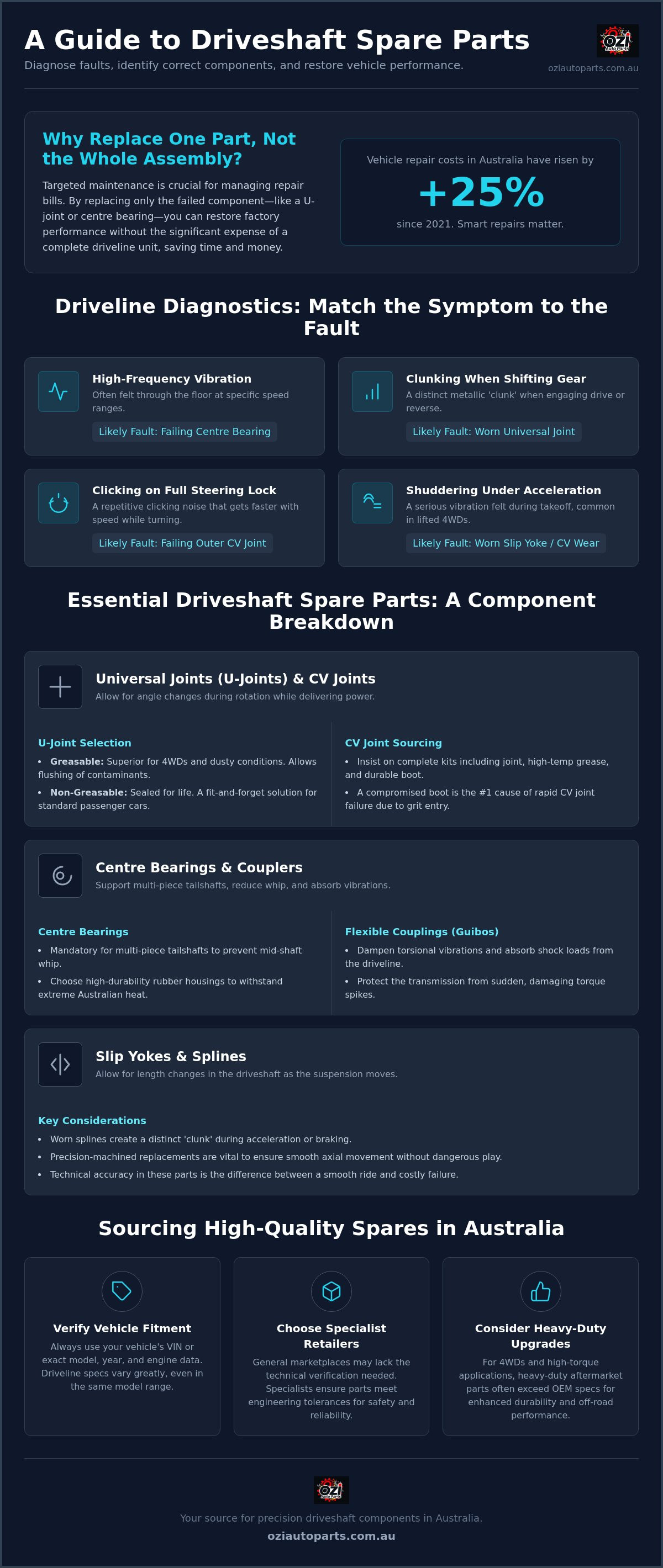
Why replace an entire driveline assembly when a single failed component is the actual cause of your vibration? Vehicle repair costs in Australia have risen by more than 25% since 2021. Targeted maintenance is now essential. Identifying the correct spare driveshaft parts allows for restored factory performance without the expense of complete unit replacement. Precision components. Technical accuracy. Rapid results.
You're likely facing excessive vibration under load or confusion over tailshaft terminology. It's a common frustration for Australian drivers. We understand the requirement for verified fitment and mechanical reliability. This guide provides the technical clarity required to diagnose failures and source the exact spares needed to restore vehicle smoothness. We will detail component identification, Australian Design Rule (ADR) compliance factors, and specific steps to eliminate driveline shudder. Expect a direct, resource-heavy breakdown of the critical parts that keep your vehicle moving safely.
Key Takeaways
- Identify critical components like universal joints and centre bearings to avoid unnecessary full-unit replacements and reduce repair costs.
- Match specific vehicle symptoms, such as high-frequency vibration or gear-shift clunking, to the exact mechanical failure for accurate diagnostics.
- Navigate the selection of spare driveshaft parts by comparing high-quality aftermarket options against OEM specifications for Australian-spec vehicles.
- Optimise driveline performance for off-road conditions by selecting heavy-duty 4WD upgrade components designed for high-torque applications.
- Restore factory smoothness and eliminate dangerous driveline shudder by following a methodical parts sourcing and installation strategy.
Essential Driveshaft Spare Parts: Component Breakdown
Maintaining a functional driveshaft assembly requires more than a visual inspection. It demands a granular understanding of the high-wear components facilitating torque transfer. Correctly identifying spare driveshaft parts is the first step in a targeted repair that avoids the cost of a complete assembly swap. Precision is vital here.
Universal Joints and CV Joints
Universal joints (U-joints) act as the primary pivot points. They allow for angle changes during rotation while maintaining power delivery. In Australia, you'll choose between greasable and non-greasable spares. Greasable units are superior for 4WDs and dusty environments because they allow you to flush out contaminants. Non-greasable variants are sealed for life, offering a fit-and-forget solution for standard passenger vehicles.
Constant Velocity (CV) joints are essential for front-wheel drive and independent rear suspension setups. When sourcing CV spares, insist on complete kits. These should include the joint, high-temperature grease, and durable rubber or thermoplastic boots. A compromised boot allows grit to enter, leading to rapid joint failure. Don't settle for partial kits that skip the critical clamps or grease.
Centre Bearings and Couplers
Centre bearings support multi-piece tailshafts and effectively reduce mid-shaft whip. For vehicles operating in extreme Australian heat, high-durability rubber housings are mandatory. Standard rubber can perish quickly, leading to excessive noise and vibration. Flexible rubber couplings, often called Guibos, provide another layer of protection. These components dampen torsional vibrations and absorb shock loads, protecting the transmission from sudden torque spikes.
Slip yokes and splines facilitate the necessary length changes as your suspension travels. Worn splines create a distinct clunking sensation during acceleration or braking. Selecting precision-machined replacements ensures smooth axial movement without the dangerous play that causes imbalance. Technical accuracy in these parts is the difference between a smooth ride and a costly failure.
Driveline Diagnostics: Identifying Which Spares You Need
Accurate diagnosis prevents unnecessary expenditure. Identifying the specific failure point allows you to purchase only the required spare driveshaft parts rather than a complete assembly. Mechanical symptoms are often specific to individual components. Recognising these signs early protects the transmission and differential from secondary damage. Precision diagnostics. Minimal downtime.
- High-frequency vibration: Typically indicates a failing centre bearing or an unbalanced shaft. This often occurs at specific speed ranges.
- Clunking when shifting into gear: A classic symptom of worn universal joint needle bearings. The play in the cross-piece creates a metallic strike under torque.
- Clicking on full steering lock: A direct indicator of failing outer CV joints. The noise increases with vehicle speed while turning.
- Shuddering under acceleration: Often linked to worn slip yokes or internal CV wear. This is particularly common in lifted 4WDs.
Common Symptoms of Component Wear
Effective physical inspection is critical. Professional standards to inspect and service drive shafts involve checking for radial and axial play in the U-joints. Look for visual indicators of failure. Torn CV boots or leaking grease around the yoke are definitive signs of seal compromise. For a detailed breakdown of front-end issues, refer to our CV Joint Failure Symptoms checklist. Precision diagnostics ensure you order the correct component first time.
Sourcing Parts by Vehicle Fitment
Driveline specifications are highly variable. You must use the VIN or exact model and year data when ordering. Technical specs often change between petrol and diesel variants due to different torque ratings and transmission lengths. Verifying these details is essential for guaranteed fitment. If you are unsure of your specific requirements, browse our range of driveshafts to find the correct technical specifications for your vehicle. Technical accuracy reduces the risk of incorrect part acquisition.
Sourcing High-Quality Driveshaft Spares in Australia
Aftermarket vs OEM Driveline Components
Many drivers assume OEM is the only path to quality. This isn't always the case for aging vehicle fleets. High-quality aftermarket components often utilise forged steel where original parts used cast materials. This results in superior tensile strength and fatigue resistance. For a detailed look at performance benchmarks, view our guide on APG Auto Parts driveshafts. Technical superiority matters in the driveline. Forged components handle stress better than cast alternatives.
Maintenance Spares for 4WD and Performance Vehicles
4WD owners frequenting water crossings need specific maintenance spares. Greasable universal joints allow you to purge moisture and grit after off-road use. This practice extends component life significantly in harsh Australian environments. CV joint spares must include high-temperature molybdenum grease. Standard lubricants fail under the intense heat of high-angle rotation. You can source these mechanical components directly from Ozi Auto Parts for guaranteed Australian fitment. We focus on parts that withstand local conditions.
Shipping heavy mechanical spares across Australia demands robust logistics. We prioritise efficient nationwide delivery to ensure your vehicle isn't off the road longer than necessary. Accurate packaging prevents spline damage and thread deformation during transit. Sourcing from a specialist ensures you receive a part ready for immediate installation. Fast. Reliable. Secure. Don't compromise on driveline integrity with unverified sources.
Restore Driveline Precision and Performance
Maintaining your vehicle's driveline doesn't require a complete assembly overhaul. It requires technical precision and the correct components. You've identified the symptoms and understood the mechanical breakdown of universal joints, centre bearings, and CV assemblies. Now, the priority is sourcing verified spare driveshaft parts that meet Australian engineering standards. Selecting forged steel components over standard cast alternatives ensures your repair withstands high-torque demands and harsh local environments. Reliable parts mean fewer repeat repairs.
Ozi Auto Parts serves as a specialised Australian mechanical part supplier focused on technical accuracy and stock availability. We maintain a comprehensive range of 4WD and passenger vehicle spares designed for immediate fitment. Our logistics network is built for efficiency, providing nationwide shipping on all heavy mechanical parts. This ensures your vehicle returns to the road without unnecessary delays. Don't let driveline vibration or shudder compromise your safety or long-term vehicle performance.
Browse our full range of driveshaft spares and driveline components to find the exact match for your VIN. Restore your vehicle's factory smoothness and drive with confidence knowing your driveline is secured by professional-grade spares.
Frequently Asked Questions
What are the most common driveshaft parts that fail?
Universal joints (U-joints) and centre bearings are the most frequent failure points in Australian drivelines. U-joints typically fail due to needle bearing wear or lubricant loss, while centre bearings succumb to perished rubber housings or seized internal bearings. CV boots also represent a high-wear item, as tears lead to grease loss and rapid joint contamination.
Can I replace just the universal joint instead of the whole driveshaft?
You can replace individual universal joints on most serviceable shafts to avoid the cost of a complete assembly. This is a standard repair procedure for many 4WD and rear-wheel drive vehicles. Some modern "staked" shafts are non-serviceable and require a full unit replacement, so verify your specific shaft design before purchasing spare driveshaft parts.
How do I know if my centre bearing needs replacing?
High-frequency vibrations or whirring noises that fluctuate with vehicle speed are primary indicators of centre bearing failure. Physically inspect the rubber carrier for perishing, cracks, or sagging. If the shaft exhibits excessive vertical movement or the bearing feels rough when rotated by hand, the unit must be replaced to avoid mid-shaft whip and further driveline damage.
Are aftermarket driveshaft parts as good as original equipment?
High-quality aftermarket spares often provide superior durability compared to OEM components, especially for aging vehicle fleets. Leading aftermarket manufacturers frequently use forged steel instead of original cast materials to enhance tensile strength and torque resistance. Sourcing spare driveshaft parts from specialised retailers ensures you receive components with verified fitment data for Australian-spec models.
What is the difference between a tailshaft and a driveshaft?
In the Australian automotive industry, a tailshaft refers specifically to the longitudinal shaft transmitting power from the gearbox to the rear differential. A driveshaft is the broader technical term encompassing tailshafts as well as the CV half-shafts used in front-wheel drive or independent rear suspension systems. Both components facilitate torque transfer but operate in different mechanical planes.