Ignoring heavy steering on corrugated tracks leads to catastrophic failure. A compromised rack isn't just a nuisance; it's a critical safety risk. You're likely dealing with diagnostic uncertainty and high repair quotes. Identifying steering rack failure symptoms Australia requires technical precision. Vague feedback from the wheel often masks deeper mechanical issues within the steering assembly. You need a clear confirmation of failure before investing in major components. Rapid identification prevents secondary damage to associated front-end systems.
This diagnostic checklist isolates specific faults common to Australian vehicle types and road conditions. It provides a direct path to identifying internal wear, seal failure, and mounting issues. You'll understand the exact cause of the fault and how to differentiate it from minor suspension noise or fluid pump issues. This guide covers essential mechanical indicators, environmental stress factors, and sourcing requirements for high-quality replacement steering and suspension parts. Precise data. Rapid diagnosis. Reliable results for your next repair project.
Key Takeaways
- Identify early indicators of hydraulic compromise, including steering stiffness and persistent fluid loss on the chassis.
- Understand how local environmental stressors like extreme thermal cycles and fine grit ingress accelerate steering rack failure symptoms australia.
- Perform a targeted visual inspection of the steering rack boots and bellows to confirm internal abrasive damage.
- Differentiate between complete rack failure and isolated component wear, such as tie rod ends, to avoid unnecessary costs.
- Optimise your repair workflow by identifying the correct replacement steering and suspension parts for popular Australian 4WD and passenger models.
Checklist: Common Symptoms of Steering Rack Failure
Rapid diagnosis is essential for maintaining vehicle safety and preventing secondary suspension damage. Identifying steering rack failure symptoms australia starts with a methodical observation of hydraulic efficiency and mechanical tolerances. A failing rack compromises directional control, often manifesting as subtle feedback changes before total hydraulic loss occurs. Immediate action prevents total loss of steering assistance on high-speed arterial roads or corrugated rural tracks.
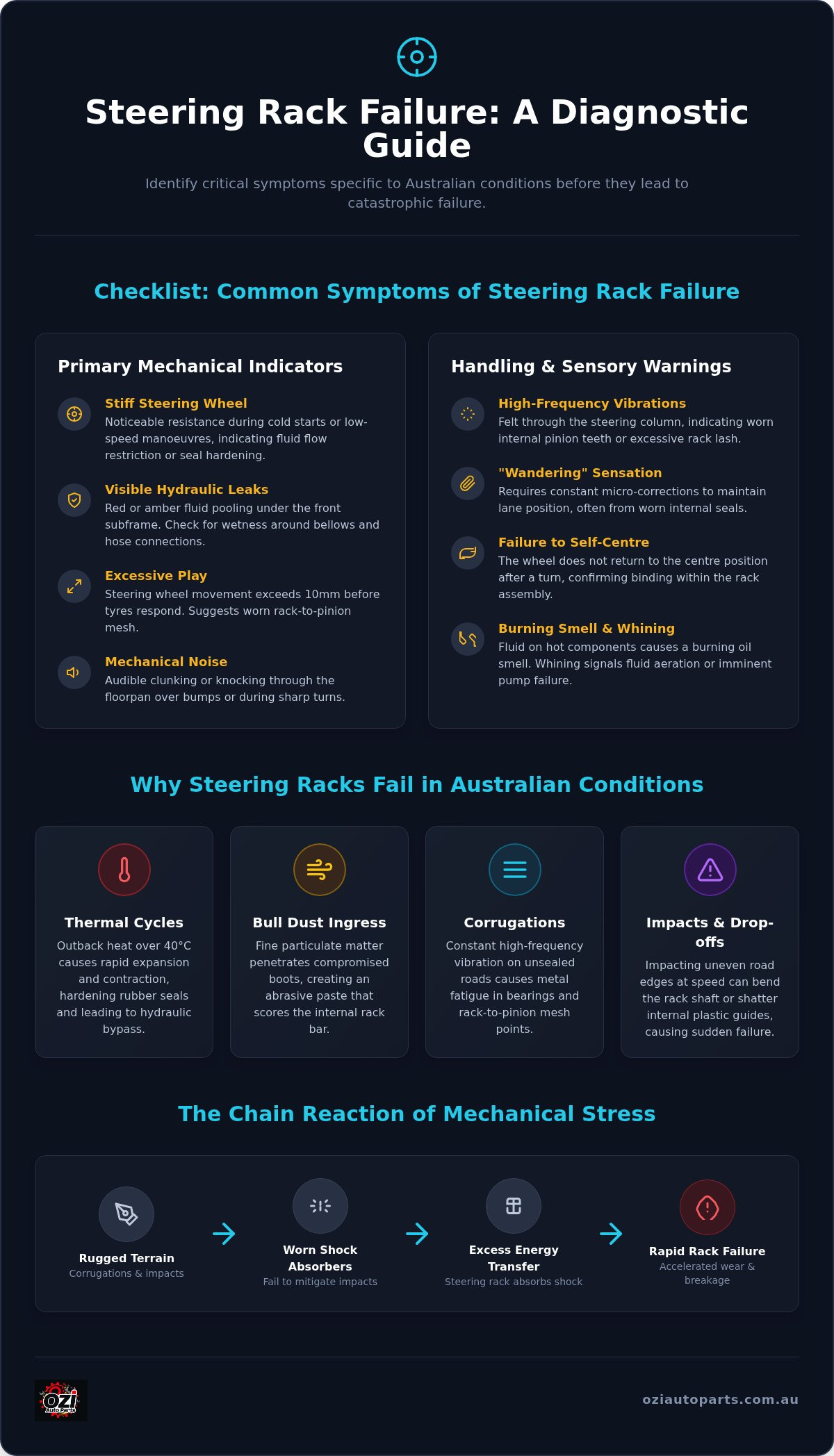
- Stiff steering wheel: Noticeable resistance during cold starts or low-speed manoeuvres. This indicates fluid flow restriction or seal hardening within the rack housing.
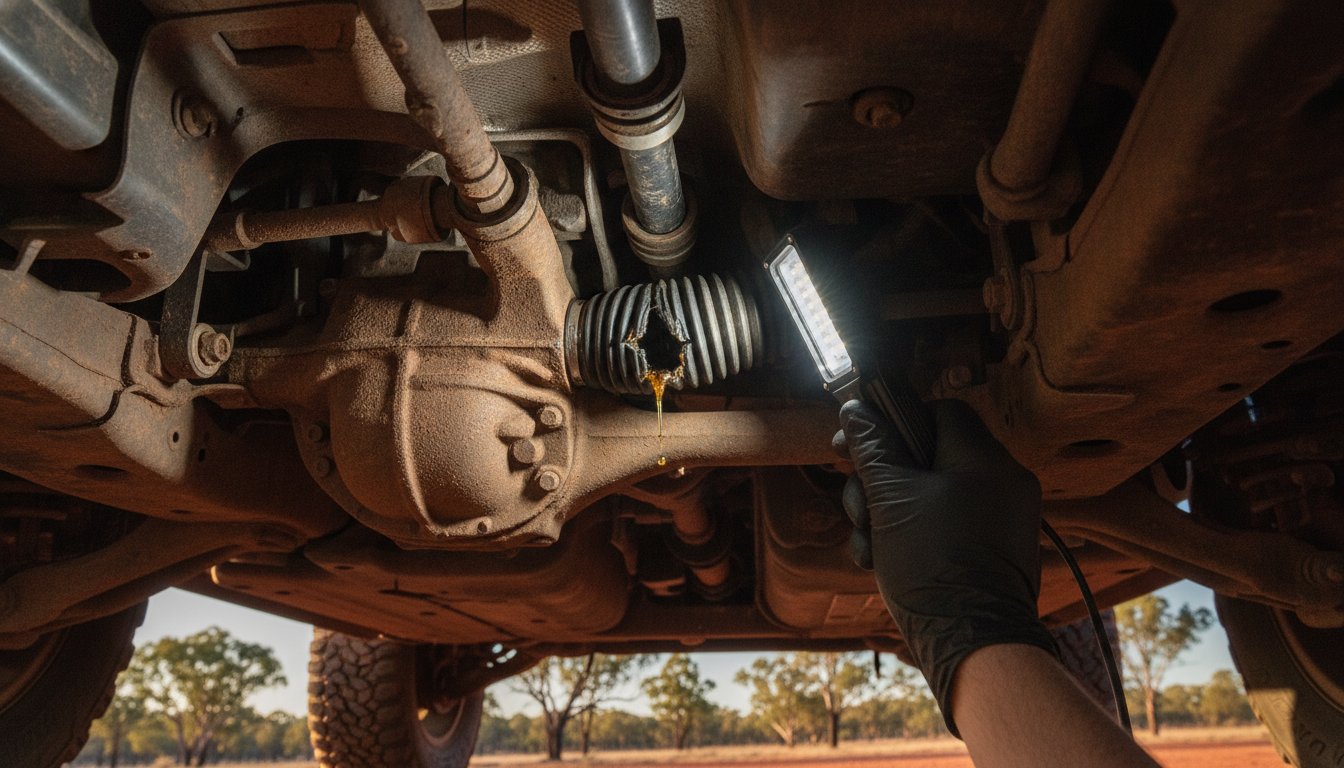
- Visible hydraulic leaks: Red or amber fluid pooling under the front subframe or steering crossmember. Check for wetness around the bellows and high-pressure hose connections.
- Excessive play: Steering wheel movement exceeds 10mm before the tyres respond at highway speeds. This suggests worn rack-to-pinion mesh or loose mounting bushings.
- Mechanical noise: Audible clunking or rhythmic knocking through the floorpan when navigating roundabouts or driving over speed humps.
Tactile Feedback and Handling Red Flags
Internal gear wear manifests as high-frequency vibrations felt directly through the steering column. This tactile signal indicates worn pinion teeth or excessive rack lash. Vehicles exhibiting a "wandering" sensation require constant micro-corrections to maintain lane position on straight stretches. This instability often stems from worn internal seals or bypassed hydraulic pressure. A critical mechanical indicator is the failure of the wheel to return to the centre position after completing a turn. This lack of self-centring confirms binding within the rack assembly or severe internal friction.
Visual and Auditory Indicators
Escaping power steering fluid often contacts hot exhaust manifolds or engine blocks, creating a distinct burning oil smell. Inspect the steering rack boots immediately for signs of saturation or splits. Auditory failures include high-pitched whining or groaning during parking manoeuvres. These sounds typically signal fluid aeration or internal rack bypass. Low reservoir levels caused by rack leaks starve the power steering pump, leading to rapid pump cavitation and total system degradation. Don't ignore these acoustic warnings; they signal imminent hydraulic failure.
Why Steering Racks Fail in Australian Conditions
Standard mechanical wear accounts for only a fraction of component degradation in local vehicles. Identifying steering rack failure symptoms australia involves understanding the specific environmental stressors found across the continent. Regional road networks and off-road tracks apply unique loads that metropolitan-focused designs often struggle to withstand. Failure is rarely a result of a single event; it's a cumulative effect of climate and terrain.
- Thermal cycles: Outback temperatures exceeding 40°C cause rapid expansion and contraction of rubber seals. This leads to hardening, loss of elasticity, and eventual hydraulic bypass.
- Bull dust ingress: Fine particulate matter penetrates compromised steering boots. Once inside, it mixes with lubricant to form an abrasive paste that scores the rack bar.
- Corrugations: Constant high-frequency vibration on unsealed roads causes metal fatigue in internal bearings and rack-to-pinion mesh points.
- Shoulder drop-offs: Impacting uneven road edges at speed can bend the rack shaft or shatter internal plastic guides.
The Impact of Heat and Dust
Australian summer heat accelerates the chemical breakdown of hydraulic fluid and seal materials. Hardened seals cannot maintain a pressure-tight interface during steering manoeuvres. This degradation is compounded by dust contamination. Bull dust is microscopic enough to pass through small boot splits or loose clamps. This grit destroys the mirror finish of the rack bar, causing immediate seal failure and fluid loss. Maintaining integrity requires high-quality steering and suspension parts designed for these specific extremes.
Mechanical Stress from Rugged Terrain
Heavy-duty 4WD applications and towing increase the torque loads on the steering assembly. Corrugated tracks transmit relentless energy into the steering column, often overwhelming standard dampening. This stress is rarely isolated. Worn steering components frequently coincide with bad shock absorbers, which fail to mitigate the impact of rugged terrain. When suspension components lose their damping efficiency, the steering rack absorbs the excess energy, leading to rapid internal wear and mounting bush failure.
Diagnostic Verification and Sourcing Replacement Parts
Accurate verification prevents unnecessary expenditure on complex assemblies. Before finalising a purchase, confirm that the observed steering rack failure symptoms australia are not caused by external linkages or mounting hardware. A systematic teardown of the diagnostic data ensures you replace only the mechanically compromised components. Focus on hydraulic purity and mechanical tolerances during your final assessment.
- Fluid Analysis: Extract a sample from the reservoir. Dark, burnt, or metallic-flecked fluid confirms internal gear scoring or seal disintegration.
- Boot Inspection: Examine the steering rack bellows for splits or saturation. Accumulated grime often masks hydraulic weeping from internal seals.
- Linkage Check: Verify the condition of the tie rod end. Play in these outer joints often accounts for steering wander and knocking noises.
- Mounting Integrity: Inspect the rack-to-chassis bushings. Perished rubber allows the housing to shift, causing vague handling and alignment drift.
DIY Inspection Protocol
- Park the vehicle on level ground and ensure the engine is switched off.
- Have an assistant move the steering wheel rapidly across the centre point while you observe the input shaft and rack housing for lateral movement.
- Clean the input shaft seal and high-pressure hose connections thoroughly with a degreaser.
- Start the engine and cycle the steering wheel to full lock in both directions several times.
- Inspect the cleaned areas for fresh fluid appearing at the pinion seal or hose crimps to confirm high-pressure hydraulic failure.
Selecting Quality Steering Spares Online
Procuring replacement components requires technical accuracy and specific vehicle data. Sourcing from a specialised online auto parts retailer ensures access to high-quality aftermarket steering components designed for Australian conditions. These units often feature upgraded seal kits and reinforced internal guides to outperform standard OEM specifications. Always verify the vehicle make, model, and exact build date. Check for specific variants such as hydraulic versus electronic power steering (EPS) to ensure 100% part compatibility. Reliable inventory depth and technical specifications facilitate a confident purchasing decision and a faster return to the road.
Restore Precision Steering Integrity
Correctly identifying steering rack failure symptoms australia is the first step toward a successful mechanical overhaul. Early detection of hydraulic leaks and tactile feedback changes prevents catastrophic failure on rugged terrain. You've learned how local environmental factors like thermal cycles and bull dust accelerate internal wear. Effective diagnosis requires verifying the rack's internal condition before replacing adjacent components like tie rod ends. Precision matters when selecting replacement units for 4WDs and passenger vehicles to ensure long-term durability.
Ozi Auto Parts is a specialist Australian 4WD and mechanical component supplier. We provide direct access to technical mechanical spares with efficient nationwide shipping on all steering assemblies. Our inventory is curated to include high-performance parts capable of withstanding the most extreme local conditions. Our efficiency-driven e-commerce model ensures you get the right parts delivered quickly to minimise vehicle downtime. Don't compromise on vehicle safety or directional control with substandard components that fail under pressure.
Browse Quality Steering and Suspension Parts at Ozi Auto Parts to secure the components you need for a reliable repair. Get your vehicle back on the road with professional-grade hardware designed specifically for the Australian landscape.
Frequently Asked Questions
Can I drive with a failing steering rack?
Driving with a compromised steering rack is dangerous and risks a total loss of directional control. Internal seal failure leads to unpredictable steering resistance, which becomes critical during emergency manoeuvres or high-speed cornering. Continued operation also causes catastrophic damage to the power steering pump through fluid starvation. Immediate replacement is necessary to maintain vehicle safety and system integrity.
How much does it cost to replace a steering rack in Australia?
Total expenditure depends on vehicle configuration, part selection, and mechanical labour requirements. 4WD assemblies for heavy-duty models often involve higher hardware costs than standard passenger vehicle racks. Sourcing high-quality aftermarket steering and suspension parts provides a durable, cost-effective alternative to expensive OEM units. Component prices vary based on whether the system is hydraulic or electronic power steering (EPS).
What is the difference between a steering rack and a steering box?
The difference lies in the mechanical method of converting steering input into wheel movement. A steering rack uses a pinion gear to move a linear rack bar, providing precise feedback for modern passenger cars and many 4WDs. A steering box uses a recirculating ball system to move a pitman arm. This older design is typically reserved for heavy-duty commercial trucks and specific older 4WD models.
Will a faulty steering rack cause my car to fail a roadworthy certificate?
Yes, a faulty assembly is a primary cause for roadworthy failure in all Australian states. Inspectors specifically check for steering rack failure symptoms australia including hydraulic leaks, split bellows, and excessive play in the rack ends. Any compromise to the steering system's structural or hydraulic integrity results in an immediate safety fail. Resolving these issues with reliable spares is mandatory for registration renewal.