
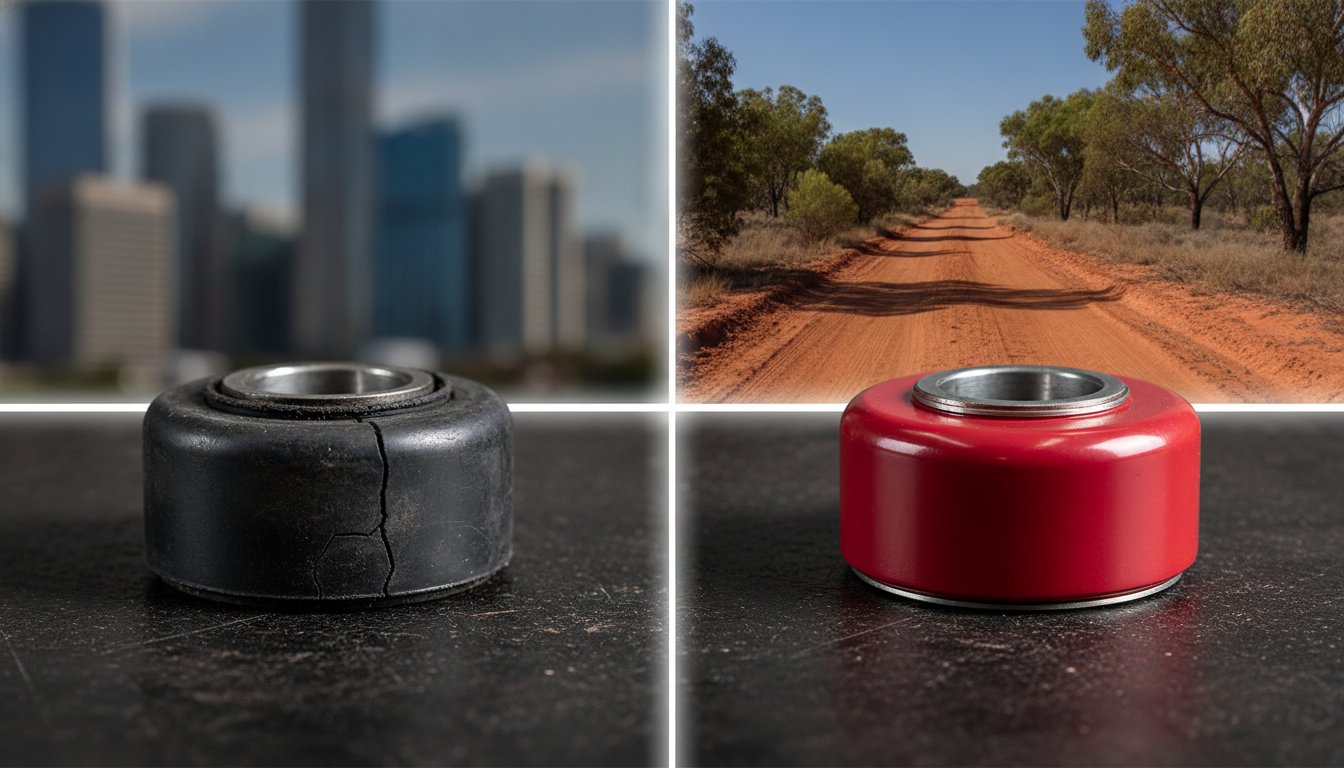
Factory rubber components are the primary failure point when tackling corrugated tracks or enduring a 40-degree Australian summer. You’ve likely noticed annoying knocking noises, uneven tyre wear, or a vague steering feel. These symptoms suggest your suspension bushings australia have reached their mechanical limit. It’s a common frustration for drivers seeking to restore factory handling while demanding long-term durability in harsh conditions.
This guide delivers a technical breakdown of the differences between traditional rubber and high-performance polyurethane. You’ll learn to identify specific failure markers and select components that withstand unique thermal and mechanical loads. We examine NVH trade-offs, material longevity, and maintenance protocols to ensure your suspension remains silent and precise. This analysis covers everything from city sedans to heavy-duty 4WDs, prioritising mechanical accuracy and part reliability. Use these technical specifications to ensure consistent performance on any terrain.
Key Takeaways
- Compare rubber and polyurethane properties to match your specific driving requirements. Identify which material offers maximum vibration dampening versus superior chemical resistance.
- Learn why extreme thermal loads and corrugated tracks accelerate the wear of suspension bushings australia. Understand the impact of chassis stress on overall vehicle alignment.
- Perform accurate home diagnostics using the visual test and pry bar method. Detect "dry rot" and off-centre positioning before components fail completely.
- Secure the correct part by verifying vehicle fitment through VIN or rego data. Discover why replacing bushes in pairs is critical for restoring factory handling and steering precision.
Understanding Suspension Bushings and Why They Fail in Australian Conditions
Suspension bushings serve as critical isolators located between metal chassis components. Their primary function involves absorbing road shock and controlling joint movement to maintain precise wheel alignment. To understand the foundational engineering, one might ask: What is a suspension bushing? Essentially, it's a flexible interface that prevents metal-on-metal contact while allowing for necessary articulation. When these components fail, the vehicle's "auto panel" stability decreases, leading to excessive chassis stress and cabin vibration.
In the context of suspension bushings australia, environmental factors play a decisive role in component lifespan. Intense UV exposure and extreme ambient heat cause standard rubber to perish and crack. This process, often called "flogging out," leads to a vague steering response and accelerated tyre wear. Maintaining high-quality suspension bushings australia is vital for vehicle safety, as worn units cannot effectively isolate the chassis from harsh road inputs.
The Mechanics of Bushing Degradation
Degradation often begins with "stiction," where static friction prevents the bushing from rotating smoothly within its housing. This restricts suspension travel and creates a harsh ride. On unsealed Australian roads, fine dust and grit infiltrate worn joints. These particles act as powerful abrasives, grinding away the internal material every time the suspension cycles. This mechanical erosion quickly turns a small amount of play into a major safety issue.
Common Failure Points in 4WDs and Passenger Cars
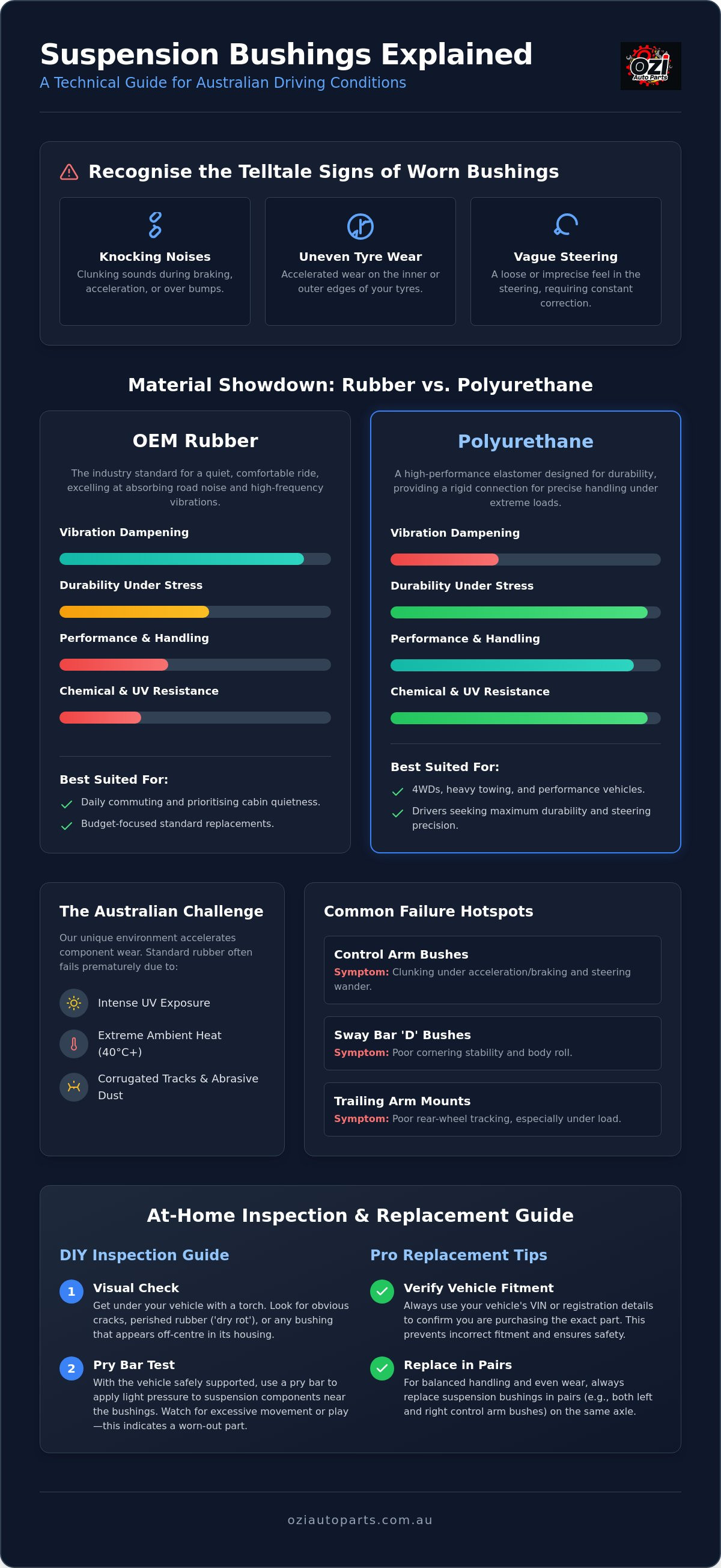
Certain components face higher stress levels than others. Control arm bushes, sway bar D-bushes, and trailing arm mounts are frequent replacement items. Heavy towing and off-roading amplify these loads. Specific failure points include:
- Control Arm Bushes: These manage braking and acceleration forces; failure causes "clunking" and steering wander.
- Sway Bar D-Bushes: These secure the anti-roll bar to the chassis; wear leads to poor cornering stability.
- Trailing Arm Mounts: Critical for rear-wheel tracking, especially when carrying heavy loads in the outback.
Continuous oscillation during off-road use generates internal heat. This thermal stress softens the material and leads to premature failure. Identifying these issues early prevents secondary damage to expensive steering and suspension parts.
Rubber vs Polyurethane: Selecting the Right Material for Your Driving Style
Choosing between rubber and polyurethane for suspension bushings australia requires balancing ride quality against mechanical precision. Standard Original Equipment Manufacturer (OEM) rubber is the industry benchmark for isolation. It excels at dampening high-frequency vibrations and road noise, making it the preferred choice for urban environments. However, rubber is susceptible to thermal degradation and chemical contamination from leaking oils, which eventually leads to material softening and alignment shift.
Polyurethane offers a high-performance alternative by providing a more rigid connection between suspension system components and the chassis. While poly generally outlasts rubber in extreme Australian temperatures, it introduces a distinct trade-off in Noise, Vibration, and Harshness (NVH). The increased material density transmits more road surface feedback into the cabin. For a family SUV, this might feel uncomfortably stiff; for a heavy-duty ute or performance vehicle, it provides the necessary control to maintain geometry under load.
When to Stick with Rubber
- Daily Commuting: Ideal for drivers who prioritise cabin quietness and a plush ride over cornering speed.
- High-Mileage Chassis: Softer rubber dampening helps mask minor wear in other aged suspension components.
- Budget-Focused Maintenance: Rubber typically offers a lower initial purchase price for standard replacements.
The Case for Polyurethane Upgrades
Polyurethane is a high-tensile elastomer that maintains its shape under extreme lateral loads. This characteristic is vital for lifted 4WDs where an increased centre of gravity places higher stress on mounting points. By resisting compression, poly bushes help correct suspension geometry and significantly reduce body roll during high-speed manoeuvres or heavy towing. If you are planning a comprehensive refresh, you can find high-quality steering and suspension parts designed for Australian conditions.
Longevity is a major advantage for polyurethane. It doesn't perish or crack when exposed to UV or road salt. To prevent "squeaking," these components require specific silicone-based lubrication during installation. When properly maintained, they provide a "fit and forget" solution for vehicles operating in the outback or high-heat coastal regions.
How to Inspect and Diagnose Worn Suspension Bushings at Home
Identifying worn suspension bushings australia requires a systematic approach to detect material fatigue before it leads to mechanical failure. Start with a visual inspection under high-intensity light. Look for "dry rot," which manifests as deep surface cracking in rubber components. This is particularly prevalent in northern and coastal regions where high UV exposure and extreme ambient heat accelerate material perishing. If the inner metal sleeve appears off-centre within its bracket, the elastomer has likely "flogged out," compromising the joint's integrity.
The pry bar method provides a definitive check for internal wear. Apply leverage against the control arms and sway bars to check for excessive movement. A "clunk" during this test confirms mechanical failure, while a high-pitched "squeak" often points to dried-out polyurethane or perished rubber seals. On the road, pay attention to steering wheel pull under heavy braking or a "loose" feeling when cornering. These symptoms suggest dynamic alignment changes as the bushings fail to maintain suspension geometry under load.
Step-by-Step DIY Inspection Guide
- Preparation: Park the vehicle on a level, solid surface.
- Stabilisation: Jack the vehicle to a suitable height and secure it with heavy-duty jack stands. Never work under a vehicle supported only by a hydraulic jack.
- Front End Check: Inspect strut mounts for tearing and examine ball joint boots for grease leaks or perishing.
- Rear End Check: Evaluate leaf spring bushes and shackle mounts for compression or lateral shifting.
Identifying Secondary Damage
Worn bushes create excessive vibration that travels through the chassis, often leading to the premature failure of brake system parts. This vibration specifically impacts caliper slide pins and mounting hardware, causing uneven pad wear. Additionally, check your tyres for "feathering" or uneven wear patterns. These are definitive signs that your suspension bushings australia are allowing the wheels to deviate from their set alignment during motion. If you identify play or cracking, order replacement steering and suspension parts to prevent further drivetrain damage.
Sourcing Quality Suspension Spares and Replacement Tips
Precision is essential when purchasing suspension bushings australia. Before ordering, verify vehicle fitment using VIN or registration data to avoid compatibility errors. This step is critical for identifying specific variations in control arm diameters or shackle widths. Always replace bushings in pairs, such as both front lower control arms, to maintain balanced handling. Installing a single new bush alongside a worn one creates asymmetrical suspension travel and unpredictable steering response.
Professional results require the correct tools. Many press-fit designs demand a shop press or specialised extraction sleeves to avoid damaging the component housing. Attempting to hammer these units into place often compromises the outer shell. For those performing home maintenance, Ozi Auto Parts serves as a reliable resource for high-quality steering and suspension spares. Their inventory focuses on components built to withstand the mechanical stresses discussed in previous sections.
Installation Best Practices
- The Ride Height Rule: Never torque bushing bolts while the vehicle hangs on a hoist. Final tightening must occur only when the suspension is under full vehicle weight. Failing to do this "pre-loads" the material, which leads to rapid perishing and tearing.
- Polyurethane Lubrication: Apply silicone-based grease to all internal and external contact surfaces. This prevents the friction-based "poly squeak" and ensures smooth articulation during joint rotation.
Post-Replacement Requirements
A professional wheel alignment is mandatory after any bushing replacement. Even minor shifts in joint positioning alter your toe and camber settings, leading to rapid tyre wear. You don't want to ruin a new set of tyres because of a skipped alignment. Perform a final safety check by re-torquing all mounting hardware after the first 500km of driving. This accounts for initial component settling and ensures all fasteners remain within factory torque specifications. Consistent monitoring prevents secondary damage to the chassis and drivetrain.
Restore Precision Handling Today
Maintaining high-performance suspension bushings australia ensures your vehicle handles corrugated outback tracks and urban streets with equal stability. You now understand that selecting the right material, whether rubber for comfort or polyurethane for durability, is a critical technical decision. Adhering to the "Ride Height" installation rule and performing regular visual inspections will prevent premature failure and protect your drivetrain from excessive vibration. These proactive steps preserve your vehicle's alignment and extend the life of your tyres.
When you're ready to upgrade or replace worn components, browse the full range of steering and suspension parts at Ozi Auto Parts. We offer specialised 4WD and passenger vehicle spares with nationwide delivery across Australia. Our inventory is backed by technical expertise in mechanical components, ensuring you receive definitive information and reliable parts every time. Get your vehicle back to factory standards and enjoy a quieter, more responsive drive on your next journey.
Frequently Asked Questions
How much does it cost to replace suspension bushings in Australia?
Total expenditure depends on vehicle complexity and the specific joint location. Labour constitutes a significant portion of the final invoice because many components require extensive disassembly of the steering and suspension systems. Replacing a single unit is more affordable than a full control arm refresh. Always factor in the additional cost of a mandatory wheel alignment to ensure new components don't cause premature tyre wear or steering pull. For community organisations or charities looking to fund these maintenance costs, you can learn more about Oktion and see how their platform supports fundraising efforts.
Can I replace suspension bushings myself at home?
Home replacement is possible if you possess specialised mechanical tools. Most suspension bushings australia are press-fitted into metal housings; this requires a hydraulic shop press for safe removal and installation. Attempting this with a hammer or vice often damages the new part or the control arm itself. If your vehicle uses "bolt-in" style housings or you are replacing complete arms, the process is significantly more straightforward for a home mechanic.
How long do rubber suspension bushings typically last?
Standard rubber units generally provide reliable service for five to seven years under normal driving conditions. However, the Australian climate can reduce this timeframe. Intense UV exposure and high ambient temperatures cause the elastomer to dry out and crack prematurely. Vehicles frequently used for heavy towing or off-roading on corrugated tracks may require more frequent inspections to detect worn suspension bushings australia before they compromise vehicle safety.
What is the difference between a bush and a bushing?
There is no functional difference between these terms in the automotive industry. "Bush" is the common Australian shorthand, while "bushing" is the formal technical descriptor used globally. Both refer to the flexible isolator that separates metal components. Regardless of the label used, the component's role remains the same; it absorbs road energy and maintains critical suspension geometry during articulation and braking manoeuvres.
Will polyurethane bushings make my car ride too rough?
Polyurethane increases the transmission of road feedback, which some drivers perceive as a firmer or "rougher" ride. This material has a higher durometer rating than rubber, meaning it doesn't compress as easily. While this improves steering precision and reduces body roll, it also allows more vibration to enter the cabin. For family SUVs, this change is noticeable; for performance or heavy-duty 4WD applications, the handling benefits usually outweigh the increased harshness.
Do I need a wheel alignment after replacing sway bar bushes?
A wheel alignment is generally not required after replacing sway bar D-bushes or link pins. These components control body roll and do not directly influence the steering geometry or wheel tracking. However, if you are replacing control arm bushes or any part that requires disconnecting the strut or steering knuckle, an alignment is essential. Always check for tyre feathering after any suspension work to confirm your settings remain within factory specifications.