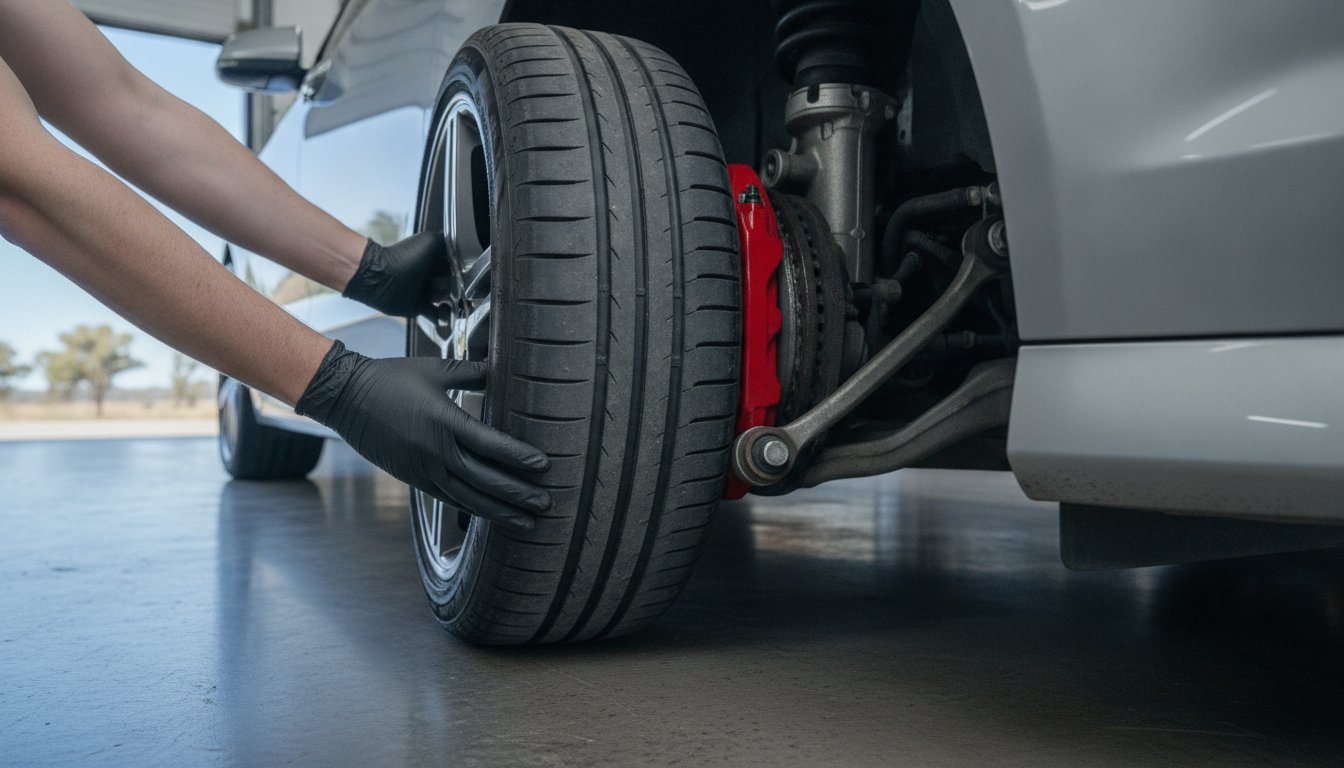
A single millimetre of play in your steering linkage can compromise vehicle safety and destroy your front tyres. Precision handling depends on zero-tolerance mechanical junctions. If your steering feels loose or unpredictable, you're likely dealing with a critical component failure. You've probably noticed uneven tyre wear or a persistent clunking sound when navigating low-speed turns. These are classic indicators of steering system degradation that demand immediate technical attention.
Identifying specific tie rod end replacement symptoms is essential for maintaining rack integrity and reducing long-term maintenance costs. We understand the urgency of a precise diagnosis. This guide provides a clear mechanical framework to distinguish worn tie rod ends from broader suspension issues. You'll learn how to execute a definitive "dry park" test, interpret tactile feedback through the steering wheel, and recognise when a component has reached its service limit. We'll move from basic symptom identification to technical diagnostic steps to ensure your vehicle remains roadworthy and safe.
Key Takeaways
- Detect early linkage failure by identifying erratic steering response and metallic clicking during low-speed manoeuvres.
- Isolate mechanical play from wheel bearing wear using the 9-and-3 wheel shake test to confirm tie rod end replacement symptoms.
- Differentiate between the constant drone of a failing wheel bearing and the sharp, intermittent clunking of steering component degradation.
- Ensure vehicle safety with mandatory wheel alignment and the "replace in pairs" principle to maintain correct steering geometry.
- Maximise component lifespan by recognising when steering rack integrity is compromised before catastrophic failure occurs.
Common Symptoms of Failing Tie Rod Ends
Early detection of tie rod end replacement symptoms prevents steering rack damage and catastrophic component separation. Identifying these indicators involves monitoring both auditory feedback and tactile response. Precision steering relies on zero-tolerance junctions; any deviation indicates mechanical fatigue. If your vehicle feels disconnected from the road, the steering linkage is the first point of inspection.
Auditory Indicators and Steering Feedback
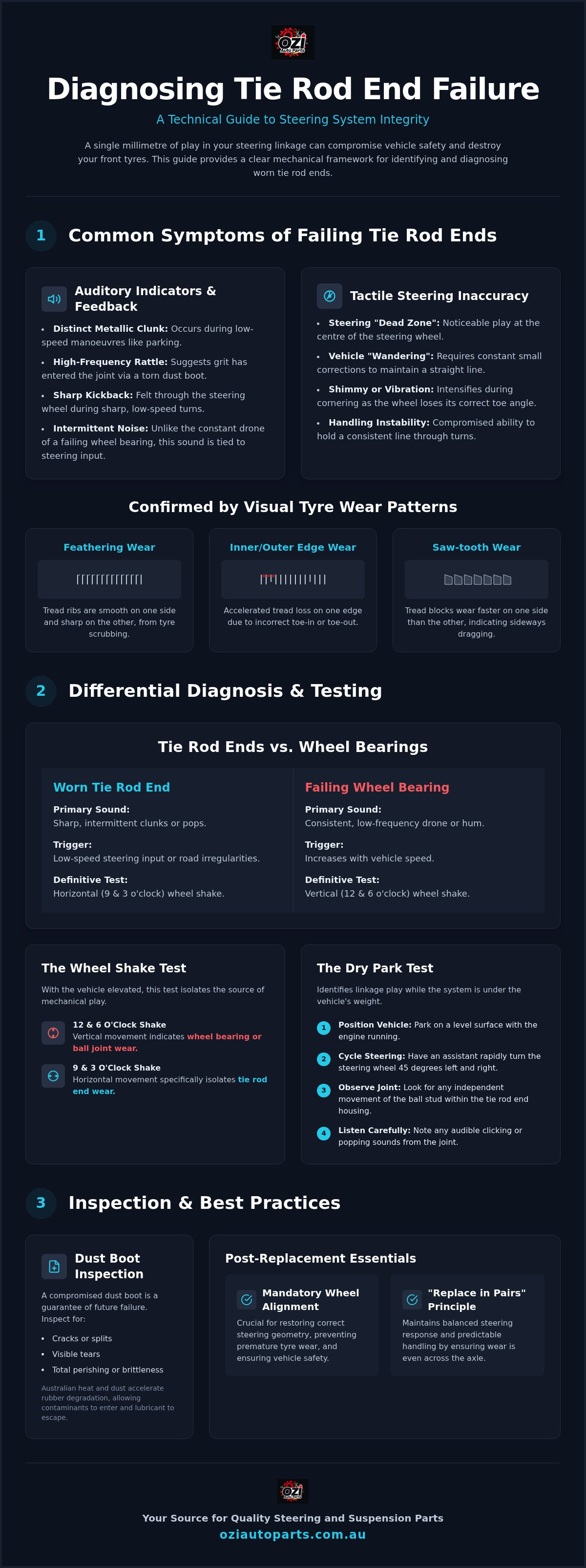
A worn tie rod end manifests as a distinct metallic clunk or rattle. This noise occurs when the internal ball socket develops excessive clearance. Without a snug fit, the ball stud moves independently of the housing, resulting in metal-on-metal contact. This sound is most audible during low-speed manoeuvres, such as parking or navigating driveways. High-frequency rattling often suggests a torn dust boot has allowed grit to enter the joint, accelerating abrasive wear. Unlike the consistent hum of a wheel bearing, tie rod noise is typically intermittent and linked directly to steering input or suspension travel. It's often felt as a sharp kickback through the steering column during sharp turns.
Tactile Steering Inaccuracy
Mechanical play in the steering linkage creates a "dead zone" at the steering wheel centre. You'll notice the vehicle fails to track straight, requiring constant micro-corrections to maintain a lane. This "wandering" effect is a primary indicator of linkage degradation. Precision drops significantly during heavy braking or rapid acceleration as torque forces shift the loose joint within its socket. If you feel a "shimmy" or vibration that intensifies during cornering, the tie rod end can no longer hold the wheel at the correct toe angle. This instability compromises your ability to maintain a consistent line through turns, especially over uneven road surfaces.
Visual inspection of the front tyres often confirms these mechanical failures. Look for these specific patterns:
- Feathering: Smooth wear on one side of the tread ribs with sharp edges on the other, caused by the tyre scrubbing the road.
- Inner or Outer Edge Wear: Accelerated tread loss on specific edges due to incorrect toe-in or toe-out settings.
- Saw-tooth Wear: A profile where one side of the tread block wears faster than the other, indicating the tyre is being dragged sideways.
Differential Diagnosis: Tie Rod Ends vs Wheel Bearings
Accurate fault isolation prevents the unnecessary replacement of functional components. Wheel bearings and tie rod ends often present overlapping auditory cues, but their mechanical signatures differ under load. A failing wheel bearing produces a consistent, low-frequency drone or hum. This sound typically increases in volume as vehicle speed rises. In contrast, tie rod end replacement symptoms involve sharp, intermittent clunks triggered by steering input or road irregularities. If the noise pitch shifts while veering slightly on a highway, the wheel bearing is the likely culprit. If the sound is a sudden "pop" during low-speed turns, the steering linkage requires inspection.
The wheel shake test provides a definitive diagnostic result. Elevate the vehicle and secure it on stands. Grasp the tyre at the 12 and 6 o'clock positions and attempt to rock it. Movement in this vertical plane indicates wheel bearing or ball joint wear. Grasp the tyre at the 9 and 3 o'clock positions. Horizontal play specifically isolates the tie rod ends and steering rack. If you detect movement here, the internal ball socket has reached its service limit. For those requiring replacement components, sourcing high-quality steering and suspension parts is the next logical step.
The Dry Park Test for Steering Play
This test identifies linkage play while the steering system is under the load of the vehicle's weight. Follow these steps for a precise diagnosis:
- Park the vehicle on a level, hard surface with the engine running.
- Instruct an assistant to cycle the steering wheel rapidly 45 degrees left and right of the centre point.
- Observe the outer tie rod joint. Any independent movement of the ball stud within the housing indicates failure.
- Listen for audible clicking or popping sounds emanating directly from the joint housing.
Physical Inspection of the Dust Boot
Visual confirmation often precedes mechanical failure. Inspect the rubber grease boots for cracks, tears, or total perishing. A compromised boot allows lubricant to escape and abrasive contaminants to enter. Australian heat and dust accelerate the degradation of these rubber components. This environmental impact is consistent with the wear patterns seen in suspension bushings australia where material fatigue leads to premature joint contamination. Once the seal is breached, the joint will fail rapidly regardless of current play levels.
Critical Considerations for Tie Rod End Replacement
Confirming tie rod end replacement symptoms is the first step toward restoring vehicle safety. Driving with a failed joint is a critical risk. Total mechanical separation leads to an immediate loss of steering control and potential catastrophic failure. Once play is identified, replacement is non-negotiable. Restoration requires more than just swapping components; it demands the recalibration of the entire steering geometry.
Professional standards dictate a mandatory wheel alignment following any steering intervention. Replacing a tie rod end inevitably alters the toe setting. Even a deviation of two millimetres will cause rapid tyre scrub and compromised handling. We follow the "replace in pairs" principle for all steering maintenance. Components on the same axle share identical duty cycles and environmental exposure. If the left outer tie rod has failed, the right side is likely near its service limit. Servicing both ensures balanced steering response and prevents a second failure shortly after the initial repair.
Sourcing Precision Steering Components
Replacement components must meet or exceed OEM specifications to ensure roadworthiness. For 4WD and heavy-duty applications, high-tensile materials are essential to withstand increased lateral loads and harsh Australian terrain. You must distinguish between inner tie rod ends, which connect to the steering rack, and outer ends, which attach to the steering knuckle. Sourcing verified steering and suspension parts ensures fitment accuracy for major makes like Toyota, Ford, and Holden. High-quality spares prevent the premature return of steering "dead zones" and wandering.
Installation and Torque Specifications
Precision installation is vital for component longevity. Follow these technical requirements:
- New Hardware: Always use new split pins to secure castle nuts. Reusing old pins risks mechanical backing-off.
- Torque Settings: Adhere to manufacturer-specific torque values. Under-tightening causes vibration, while over-tightening can shear the ball stud.
- Taper Fit: Ensure the steering knuckle taper is clean and free of scoring before seating the new joint.
For reliable nationwide delivery of high-quality steering parts, select components based on specific vehicle data to guarantee zero-tolerance fitment. Correct installation ensures the steering system remains responsive under all load conditions.
Ensure Roadworthiness with Precision Steering Components
Maintaining zero-tolerance steering junctions is the only way to ensure vehicle control and prevent excessive tyre scrub. By accurately identifying tie rod end replacement symptoms, you can address mechanical play before it leads to catastrophic linkage failure. A definitive diagnosis requires distinguishing between the constant drone of wheel bearings and the intermittent clunking of worn ball sockets through the 9-and-3 wheel shake test. Precision results depend on systematic fault isolation and early intervention.
Execution of a correct repair involves mandatory wheel alignment and the "replace in pairs" principle to maintain balanced steering geometry. High-tensile components are critical for 4WD and heavy-duty applications where standard parts often fail under load. We are a specialist Australian mechanical part supplier providing high-durability steering spares with nationwide delivery for all makes and models. Reliability starts with sourcing the correct technical specifications for your specific vehicle. Don't compromise on steering rack integrity.
Browse Precision Steering and Suspension Parts at Ozi Auto Parts for direct access to our inventory of critical mechanical spares. Secure your steering linkage and restore your vehicle's handling performance today.
Frequently Asked Questions
Can I drive with a bad tie rod end?
Driving with a compromised tie rod end is a severe safety risk. Complete failure results in the wheel disconnecting from the steering linkage; this causes an immediate loss of control. Park the vehicle immediately if you identify tie rod end replacement symptoms. Immediate replacement with high-tensile components is the only way to restore roadworthiness and ensure occupant safety.
How much does it cost to replace a tie rod end in Australia?
Total expenditure depends on vehicle specifications and workshop labour rates. While the physical components are affordable, the total cost must include a mandatory wheel alignment. Sourcing spares from a specialist Australian supplier reduces retail markups. Always replace components in pairs to ensure balanced steering geometry and long-term reliability across the entire front end.
How do I know if it is the inner or outer tie rod end failing?
Isolate the failure through a physical inspection of the steering assembly. Outer tie rod ends are located at the wheel hub and fail more frequently due to dust and heat exposure. Play at the steering knuckle confirms an outer joint failure. Inner tie rod ends are housed within the steering rack bellows. Play felt through the rubber boot indicates an internal rack-end failure requiring a different replacement part.
Do I need a wheel alignment after replacing tie rod ends?
A professional wheel alignment is mandatory following any steering component replacement. Installation inevitably alters the toe settings of the front wheels. Skipping this step results in rapid tyre scrub and unpredictable handling. Correct alignment ensures components operate within manufacturer tolerances and protects your tyre investment from accelerated wear and premature replacement costs.