Standard friction material fails when your rig carries a full GVM upgrade or a heavy caravan. You've likely experienced the wooden pedal feel and dangerous brake fade during long, steep descents. It's a common limitation of factory hydraulic systems. This 2026 performance guide provides a technical breakdown of the best toyota hilux brake upgrade kit australia options to restore driver confidence. We prioritise hydraulic leverage through booster enhancements over simple pad swaps. You'll learn how to achieve shorter stopping distances and consistent pedal pressure under extreme loads. Our analysis covers high-performance ceramic pads, slotted rotors, and ADR-compliant braided lines. We focus on mechanical reliability for Australian conditions. This ensures your Hilux maintains reliable stopping power on the job site or remote tracks. Efficiency and technical precision are the priorities here.
Key Takeaways
- Identify how increased static weight from bullbars and canopies necessitates a toyota hilux brake upgrade kit australia to overcome factory thermal limits.
- Understand the role of high-performance brake boosters in increasing vacuum assistance for reduced pedal effort and improved hydraulic leverage.
- Learn how slotted and dimpled rotors facilitate gas expulsion and heat dissipation to eliminate brake fade during long descents.
- Select components based on driving profile to ensure reliable stopping power and mechanical durability for Australian conditions.
Why Your Toyota Hilux Needs a Brake Upgrade Kit in 2026
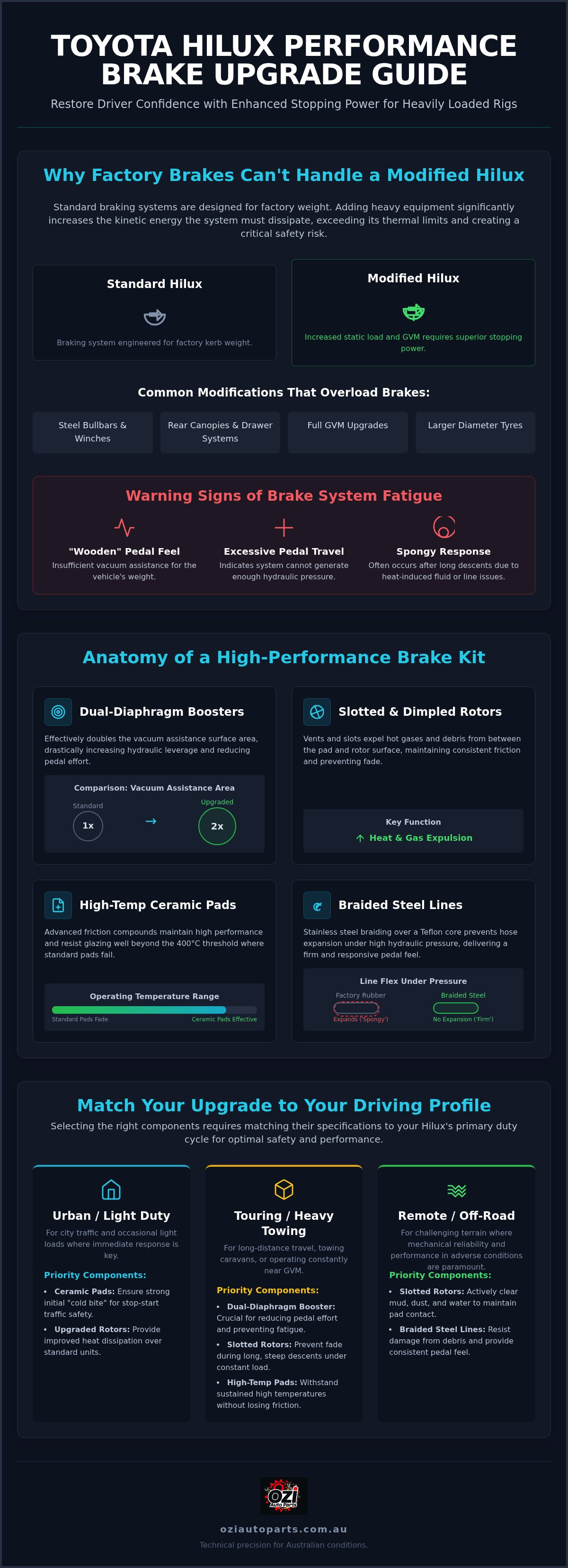
Standard Hilux braking systems are engineered for factory curb weights. Modifying your vehicle for Australian conditions increases the static load significantly. A toyota hilux brake upgrade kit australia is required to manage the following specifications:
- Steel bullbars and winch assemblies.
- Rear canopies and heavy-duty drawer systems.
- Increased Gross Vehicle Mass (GVM) certifications.
- Larger tyre diameters that reduce effective braking leverage.
These additions increase the kinetic energy the system must dissipate during deceleration. Factory rotors have finite thermal capacity. When pushed, they often reach temperatures where friction efficiency drops, resulting in what is brake fade. This is a critical safety risk during heavy towing or long descents where heat soak occurs rapidly.
To better understand how these systems are installed and improved, watch this helpful video:
Signs of Factory Brake System Fatigue
Heavy loads often result in a "wooden" pedal feel. This indicates the vacuum assistance is insufficient for the vehicle's upgraded weight. You should monitor your system for these failure signs:
- Excessive pedal travel under heavy load.
- Spongy response after long alpine descents.
- Uneven pad wear indicating seized caliper sleeve slide pins.
Installing a high-performance brake booster restores hydraulic leverage. This ensures your Hilux maintains reliable stopping power on remote tracks where mechanical reliability is the priority. Efficiency and technical precision are essential for maintaining safety standards in 2026, a principle of mechanical care that extends beyond the automotive world to other precision instruments like luxury timepieces, as explored at atozwatchrepair.co.uk.
Key Components of a High-Performance Hilux Brake Kit
A comprehensive toyota hilux brake upgrade kit australia integrates hardware capable of managing extreme thermal loads and hydraulic demands. Upgrading only the friction material is insufficient for vehicles operating at their GVM limit. The system requires a balanced approach to increase clamping force and heat dissipation. Core components include:
- Dual-diaphragm boosters: Increased vacuum assistance surface area to reduce required pedal pressure.
- Slotted and dimpled rotors: Precision-engineered vents to expel gases and maintain pad-to-rotor contact.
- High-temperature ceramic pads: Friction compounds designed to operate effectively beyond the 400°C threshold without glazing.
- Braided stainless steel lines: Teflon-lined hoses that eliminate expansion under high hydraulic pressure for a firmer pedal.
These components work in unison to provide a predictable and repeatable braking response. By replacing factory rubber and solid discs, you ensure the system maintains integrity during repeated high-stress events.
The Role of Dual-Diaphragm Brake Boosters
The standard Hilux vacuum booster often relies on a single internal diaphragm. This design provides limited assistance, requiring significant physical force from the driver when the vehicle is heavily loaded. In contrast, upgraded Hilux boosters utilise a dual-diaphragm configuration. This effectively doubles the vacuum assistance area within the same engine bay footprint. The result is a substantial increase in hydraulic output pressure at the master cylinder. These units are designed for direct fitment to factory mounting points. When modifying these hydraulic systems, ensure the work meets brake system certification requirements, such as Code LG4 for non-standard installations. You can source high-performance boosters to solve wooden pedal issues and improve overall safety.
Selecting the Right Hilux Brake Upgrade for Your Driving
Selecting the correct toyota hilux brake upgrade kit australia requires matching component specifications to your vehicle's specific duty cycle. Component selection should be based on the following driving profiles:
- Urban/Light Duty: Focus on ceramic pads with immediate cold-bite friction to ensure safety in city traffic.
- Touring/Heavy Towing: Prioritise rotors with increased thermal mass and dual-diaphragm boosters to prevent fade under constant load.
- Remote/Off-Road: Opt for slotted rotor designs that facilitate the rapid expulsion of dust, mud, and water ingress.
Verify fitment by matching the kit to your Hilux generation. N70 models (2005-2015) and N80 models (2015-present) have distinct caliper offsets and hub configurations. Most high-performance kits require 17-inch or larger wheels to accommodate the increased rotor diameter and caliper bulk. Smaller factory wheels don't provide sufficient clearance for performance calipers on some N80 upgrade kits.
Installation and Maintenance Best Practices
Adhering to correct installation and maintenance protocols prevents premature failure and ensures mechanical reliability. Follow these sequential steps for every upgrade:
- Complete a controlled bedding-in cycle to establish a uniform transfer film on the rotor surface.
- Replace standard fluid with a high-boiling point DOT 4 or 5.1 fluid to maintain hydraulic integrity under high heat.
- Remove and lubricate caliper sleeve slide pins at every logbook service to prevent caliper seizing.
- Confirm all braided line fittings are torqued to specification and clear of suspension components.
- Re-check fluid levels and pedal feel after the first 500 kilometres of operation.
Upgrade Your Hilux Braking Performance Today
Ensuring your rig stops safely under load requires a systematic approach to hydraulic and friction components. You've learned that a true toyota hilux brake upgrade kit australia goes beyond simple pad changes. Integrating high-performance dual-diaphragm boosters and thermal-resistant rotors is essential. Matching these parts to your specific N70 or N80 generation ensures mechanical compatibility and ADR compliance. Ozi Auto Parts provides the technical expertise and specialised inventory required for heavy-duty 4WD builds. We maintain deep stock of upgrade brake boosters and high-performance hardware to restore driver confidence. Take advantage of our Australia-wide shipping for heavy components. Get your vehicle back on the tracks with reliable stopping power. Browse Toyota Hilux Brake Upgrade Components at Ozi Auto Parts. Safe travels on your next Australian adventure.
Frequently Asked Questions
Is a Hilux brake upgrade legal for GVM upgrades in Australia?
Yes, upgrades are legal if components meet ADR 31 or 35 standards. Modifications altering performance significantly, like big brake kits, require engineering certification under Code LG4. Direct-fit slotted rotors and performance pads typically don't need certification. Verify local state requirements to ensure insurance compliance. Compliance ensures safety standards are met for modified 4WD vehicles.
Do I need to change my master cylinder when upgrading the booster?
You don't need to change the master cylinder when installing a specialised toyota hilux brake upgrade kit australia booster. High-performance dual-diaphragm units bolt directly to original hydraulic hardware. This increases vacuum assistance without altering fluid displacement. It's a targeted solution for reducing pedal effort on heavy GVM builds. This maintains factory brake bias while improving response.
Will a brake upgrade kit fit under my factory 17-inch wheels?
Most performance kits fit factory 17-inch wheels. Caliper clearance depends on rotor diameter and caliper bulk. N70 and N80 models have different offset requirements. Check internal rim barrel dimensions before purchase to ensure no mechanical interference occurs. Some heavy-duty kits require a minimum 17-inch rim to accommodate the larger hardware circumference.
How often should I replace heavy-duty brake pads on a modified Hilux?
Expect replacement intervals between 40,000 and 60,000 kilometres for heavy-duty pads. Constant GVM loads or frequent towing accelerate friction material wear. Off-road use in mud and sand also increases abrasive attrition. Inspect pad thickness during every 10,000-kilometre service. This prevents rotor scoring and ensures reliable stopping power on remote tracks.
Maintaining a vehicle's safety is paramount, but when an older 4WD reaches the point where upgrades are no longer viable, selling it may be the most practical choice. For those in Western Australia, Oriental Car Removal provides a professional service for buying unwanted or damaged 4WDs and commercial vehicles, helping you move on to a newer, safer rig.