
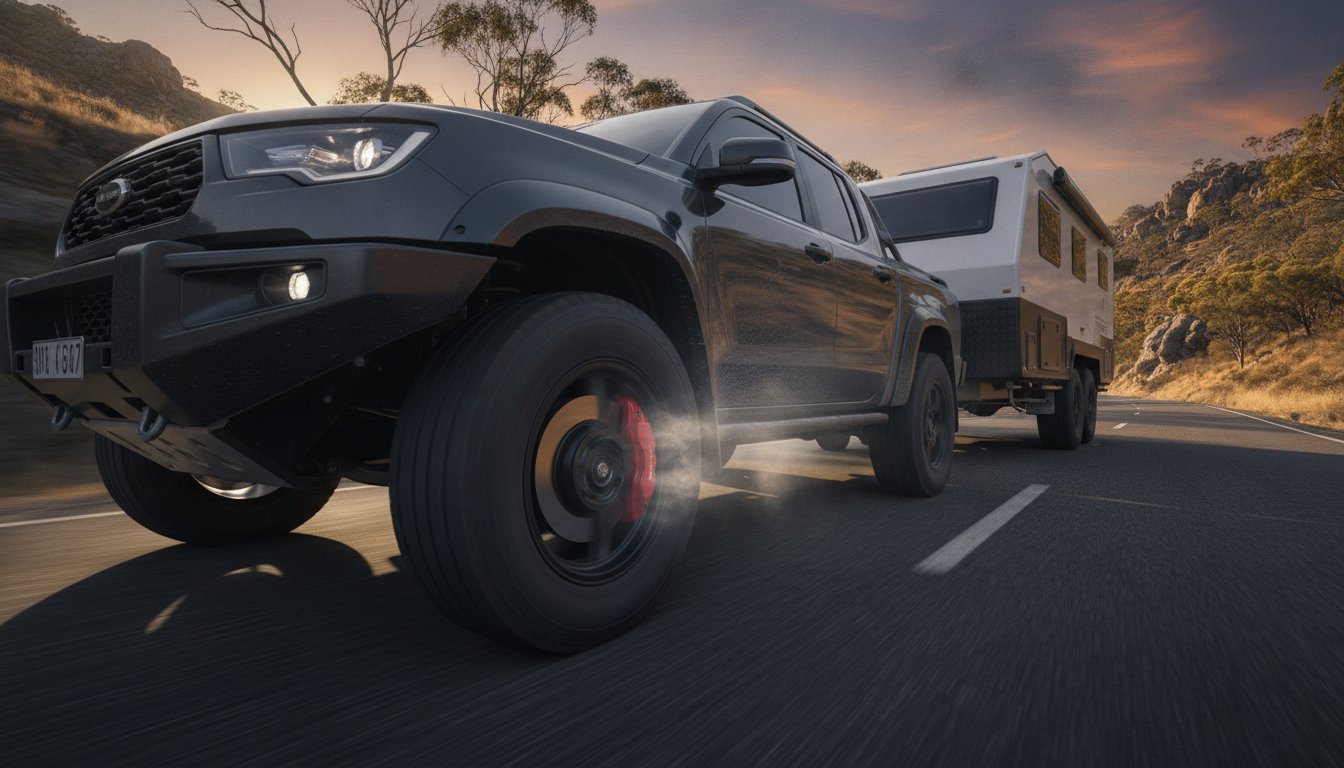
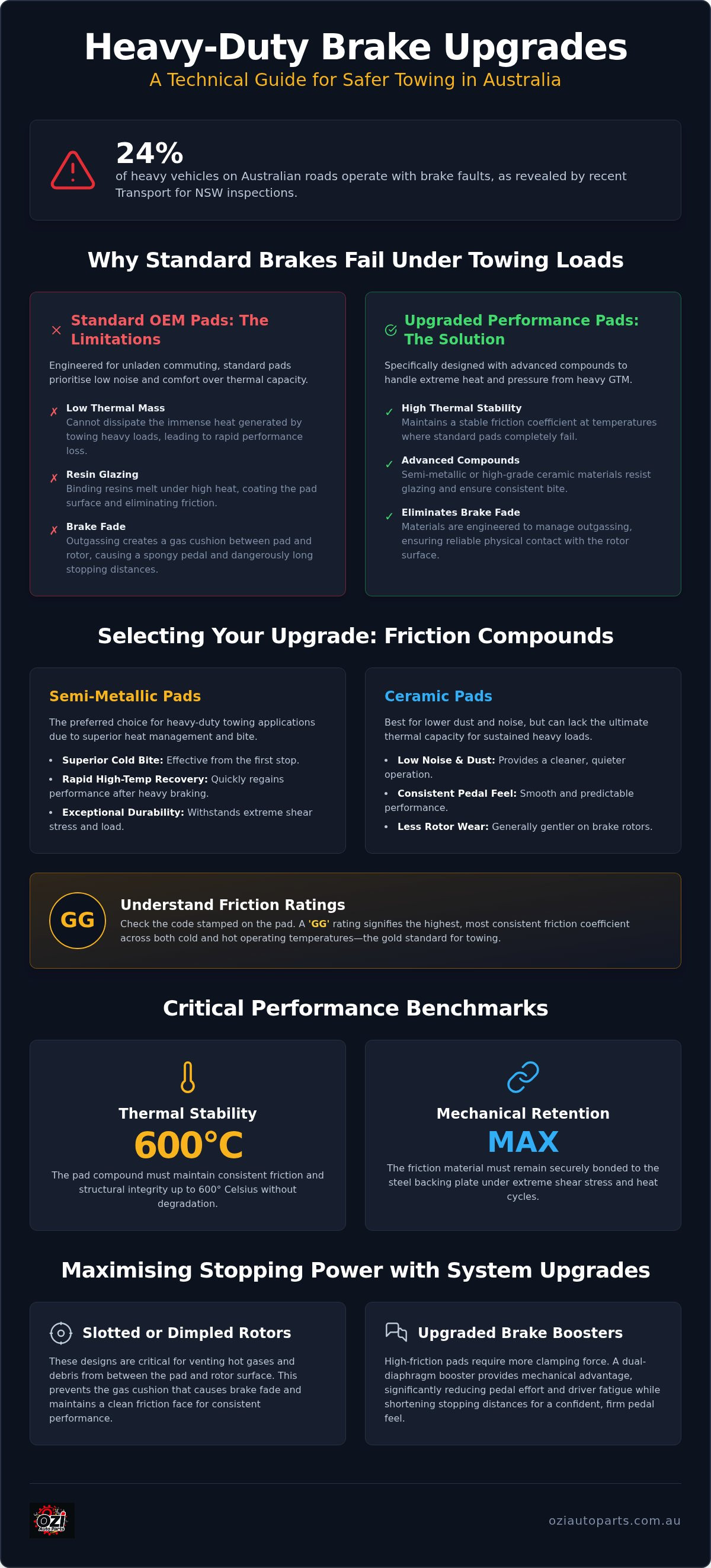
Recent inspections by Transport for NSW revealed that 24% of heavy vehicles on Australian roads operate with brake faults. Standard factory equipment often fails the thermal demands of long descents while hauling heavy caravans. You've likely experienced the excessive pedal effort required when standard pads overheat. Installing upgraded brake pads for towing australia is critical for maintaining high friction levels under extreme heat and load.
You need a system that manages increased Gross Trailer Mass (GTM) while ensuring safety. This 2026 heavy-duty guide identifies the specific high-performance compounds required to eliminate brake fade. We'll examine ECE R90 compliance, advanced thermal management, and technical specifications for maximum stopping power. This technical resource focuses on reducing stopping distances and improving pedal feel for heavy-duty applications across the Australian outback.
Key Takeaways
- Identify why standard OEM pads fail under heavy caravan loads due to resin glazing and thermal capacity limits.
- Compare semi-metallic and ceramic compounds to determine which material offers the best high-temperature recovery for your specific GTM.
- Learn how to select upgraded brake pads for towing australia to eliminate brake fade and ensure safety during long descents.
- Discover how pairing performance pads with an upgraded brake booster achieves maximum stopping power and significantly reduced pedal effort.
Why Standard Brake Pads Fail Under Australian Towing Loads
Standard OEM brake pads are engineered for unladen commuting. Manufacturers prioritise low noise and soft engagement for suburban driving. These components lack the thermal mass required for 3.5-tonne caravan loads. When your vehicle reaches maximum Gross Vehicle Mass (GVM), the kinetic energy required to stop increases significantly. Factory pads cannot dissipate this energy fast enough.
Australian environmental factors worsen the strain. Ambient temperatures of 40 degrees accelerate the breakdown of pad materials and brake fluid. High heat leads to resin glazing. This occurs when binding resins melt and coat the friction surface, creating a smooth, non-frictional glaze. The result is total brake fade when you need stopping power most. Installing upgraded brake pads for towing australia is essential to ensure the friction material remains effective under these loads.
The Physics of Brake Fade and Towing
Kinetic energy conversion dictates braking performance. Towing doubles the heat generated during every deceleration event. Standard pad compounds hit their thermal limit rapidly, leading to friction material outgassing. This process releases hot gases that create a high-pressure cushion between the pad and the rotor surface. This gas layer prevents physical contact, causing a spongy pedal and increased stopping distances. High-performance upgraded brake pads for towing australia utilise advanced semi-metallic or ceramic compounds. These materials maintain a stable friction coefficient at temperatures where standard pads fail. They ensure consistent pedal feel and mechanical reliability during heavy-duty hauling in extreme Australian conditions.
Selecting Upgraded Brake Pads for Towing: Material and Specs
Choosing upgraded brake pads for towing australia requires a technical understanding of friction compounds. Semi-metallic pads remain the preferred choice for heavy-duty applications. These compounds offer superior cold bite and rapid high-temperature recovery. This performance is vital when descending steep ranges with a 3.5-tonne caravan. Ceramic variants provide lower dust and noise. However, they often lack the extreme thermal capacity required for sustained heavy loads. Always verify the friction rating stamped on the pad edge. Look for "FG" or "GG" codes. These codes ensure a high coefficient of friction remains stable across both cold and hot operating ranges. A 'GG' rating indicates the highest level of consistent performance for towing.
Rotor configuration complements your pad choice. Slotted or dimpled rotors facilitate gas evacuation. This prevents the high-pressure gas cushion that causes a spongy pedal. Slotted rotors also clear debris and glazed resin from the pad surface. This maintains a fresh friction face during repeated braking. You can browse our range of heavy-duty brake components to find compatible hardware for your vehicle model.
Top Performance Criteria for Towing Pads
Mechanical reliability under load is non-negotiable. Performance pads must meet specific technical benchmarks:
- Thermal Stability: The compound must maintain consistent friction levels up to 600 degrees Celsius without structural degradation.
- Mechanical Retention: The friction material must stay bonded to the steel backing plate under extreme shear stress and heat.
Component health impacts pad longevity. View our range of caliper slide pins and bolts to ensure even pad wear and prevent caliper binding during heavy-duty use.
Maximising Stopping Power with Complementary Upgrades
Upgraded brake pads for towing australia are only one part of the safety equation. High-friction materials require significant clamping force to operate within their optimal temperature window. This often results in increased pedal effort. It's a common issue that leads to driver fatigue during long-distance hauling. You don't want to rely on leg strength alone when descending steep ranges. Achieving true stopping efficiency requires addressing the hydraulic and vacuum components alongside the friction material.
Vacuum assistance provides the necessary mechanical advantage. An upgraded brake booster reduces the leg pressure required to achieve maximum deceleration. This synergy between the pad compound and booster performance ensures a confident, firm pedal. System integrity is equally vital. Inspect brake lines for swelling and boosters for vacuum leaks before every trip. Maintenance must include flushing the system with high-boiling point DOT 4 or DOT 5.1 fluid to prevent vapour lock under extreme stress.
Upgraded Brake Boosters for 4WDs and Towing
Dual-diaphragm units are the industry standard for 4WD and heavy-duty towing applications. These boosters increase output pressure without necessitating a master cylinder change. The result is immediate response and shorter stopping distances. For specific vehicle applications, see these Ford Falcon and Territory brake booster upgrades for improved towing response. We also supply Holden Commodore VT-VY heavy-duty booster solutions designed for high-performance requirements. Ensuring your vacuum system is robust allows the upgraded pads to perform at their technical limit.
Secure Your Braking Performance for Heavy Towing
Standard pads reach thermal limits quickly under load. Upgrading to high-performance compounds ensures mechanical reliability and significantly reduced stopping distances. Integrating an upgraded brake booster further enhances safety by providing the vacuum assistance needed for demanding heavy-duty applications. Choosing the correct upgraded brake pads for towing australia remains the most effective way to eliminate brake fade and resin glazing. Ozi Auto Parts is your specialist Australian 4WD and towing component supplier. We provide nationwide shipping on heavy mechanical spares and expert technical support for complex brake system selection. Browse Heavy Duty Brake Systems at Ozi Auto Parts today to find the right hardware for your vehicle. Prepare your setup for the rigours of the outback and enjoy a safer, more controlled towing experience.
Frequently Asked Questions
Do upgraded brake pads squeal more than standard pads?
High-performance friction compounds can produce more audible noise due to their higher metallic content. While standard pads use soft resins for silence, upgraded brake pads for towing australia prioritise thermal stability and safety. Modern semi-metallic designs incorporate anti-squeal shims and chamfers to mitigate vibration. You should expect a slight increase in operating noise during light braking compared to the silent performance of factory units.
How often should I replace my brake pads when towing regularly?
Inspection intervals should occur every 5,000 to 10,000 kilometres when hauling heavy caravans across varied terrain. Towing significantly increases friction material wear rates compared to unladen suburban driving. You must replace pads when the friction material reaches a thickness of 3mm. Regular visual checks are essential because high-temperature cycles accelerate wear beyond the standard service schedules typically found in your vehicle logbook.
Can I install upgraded brake pads on standard rotors?
You can install upgraded brake pads for towing australia on standard rotors if the discs meet the manufacturer's minimum thickness specifications. The rotors must be machined or replaced if they show scoring, warping, or heat spots. For optimal results, pairing these pads with slotted rotors improves gas evacuation. This combination ensures the friction surface stays clean and effective during repeated braking events on steep descents.
Will heavy-duty brake pads wear out my discs faster?
Semi-metallic heavy-duty pads are more abrasive than soft organic OEM pads. This increased abrasiveness is a technical requirement to maintain a stable coefficient of friction under extreme heat. While rotor service life is reduced, the trade-off is superior stopping power and safety. You should monitor rotor thickness at every service interval when using aggressive towing compounds to ensure the system stays within legal limits.