Paying a "European premium" at the dealership doesn't guarantee superior stopping power on local roads. Australian drivers often face a choice between prohibitive service costs and long waits for international freight. You know that maintaining a Golf, Tiguan, or Amarok requires precision hardware, not inflated invoices. Finding the right volkswagen brake parts australia wide shouldn't involve compatibility guesswork or technical confusion across different vehicle generations.
We provide the technical specifications and inventory depth needed to restore factory braking performance. This guide simplifies your search for high-performance friction and hydraulic components engineered for local heat cycles. You will find definitive information on rotors, pads, and vacuum-assisted brake boosters designed for rapid domestic delivery. We detail heavy-duty upgrades for SUVs and utes, ensuring your vehicle meets the latest ADR safety standards while bypassing the delays of European imports. Expect clear-cut data points and action-oriented advice for your next brake service.
Key Takeaways
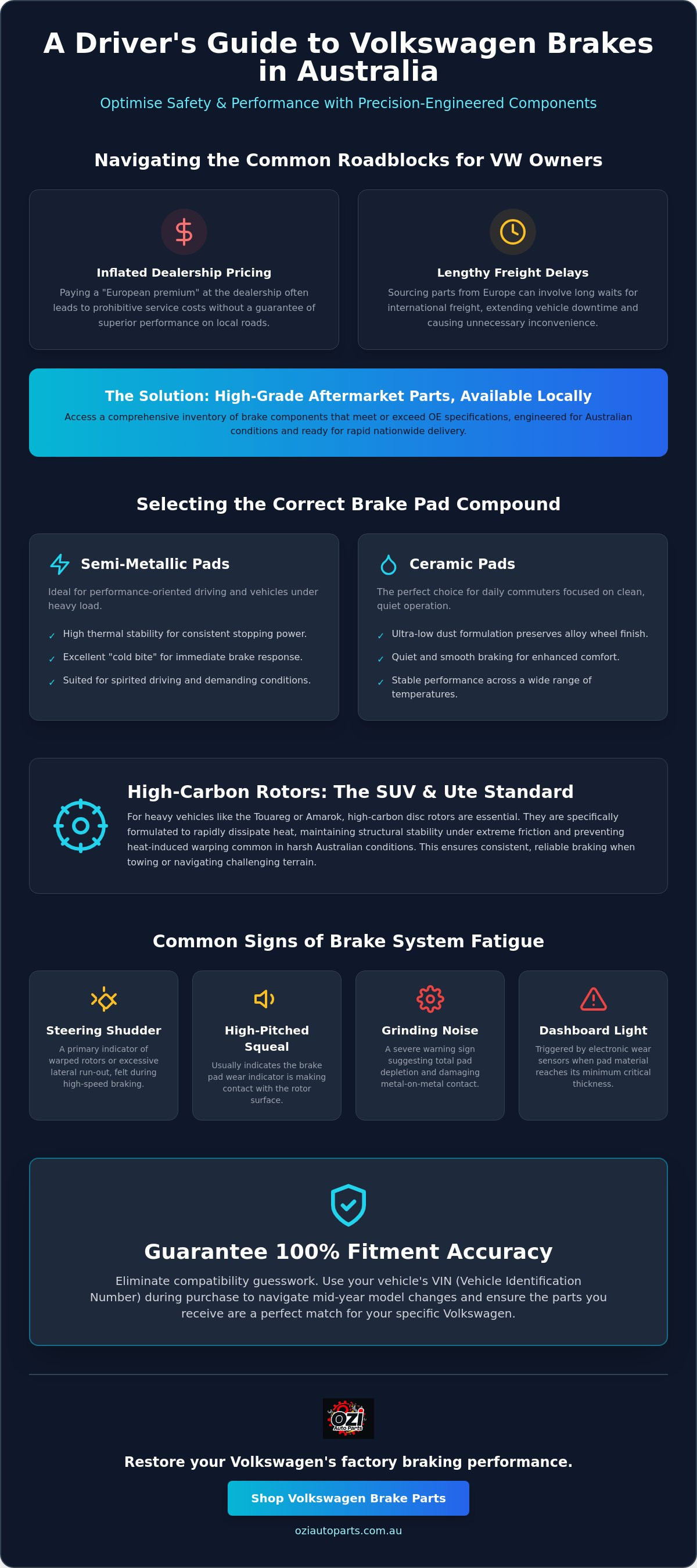
- Select ceramic or semi-metallic friction compounds based on specific Volkswagen driving profiles and thermal loads.
- Reduce service expenditure by opting for high-grade aftermarket components that meet or exceed original equipment specifications.
- Guarantee 100% fitment accuracy for volkswagen brake parts australia by utilising VIN verification to navigate mid-year model changes.
- Protect heavy SUV braking systems from heat-induced warping with high-carbon disc rotors engineered for local conditions.
- Access a comprehensive inventory of brake boosters and pads with reliable nationwide shipping to avoid international freight delays.
Volkswagen Brake Parts Australia: Safety and Performance Standards
Volkswagen braking systems are complex assemblies relying on high-pressure hydraulics and specialised friction materials. These systems achieve precision stopping through tight engineering tolerances. Maintaining the integrity of the original braking geometry is vital for the correct operation of the Electronic Stability Program (ESP) and Anti-lock Braking Systems (ABS). Many components are standardised across the MQB platform, meaning volkswagen brake parts australia suppliers often provide hardware compatible with specific Audi and Skoda models. This platform-sharing ensures that high-volume, precision-engineered parts like calipers and brake boosters remain accessible for local owners.
Australian road conditions present unique challenges for European braking hardware. Intense summer heat and heavy urban stop-start traffic on major arterials accelerate component wear. Thermal stress can lead to glazing on brake pads or structural fatigue in rotors. Selecting components designed for these high-temperature cycles is essential to prevent brake fade and ensure consistent pedal feel during long-distance commutes or heavy-load driving.
To better understand the mechanical requirements of these systems, watch this helpful video on component replacement:
The Role of Precision in VW Braking
German engineering dictates significantly tighter tolerances for brake disc thickness and pad compound than many domestic or Asian counterparts. Rotor metallurgy in Volkswagen systems is specifically formulated with high carbon content to facilitate rapid heat dissipation while maintaining structural stability under extreme friction. Even minor deviations in disc thickness can cause noticeable pedal pulsation. Worn or sub-standard components degrade the effectiveness of the Brake Assist (BA) system, which can dangerously increase emergency stopping distances in Australian suburban environments.
Common Signs of Brake System Fatigue
Identifying early warning signs prevents costly secondary damage to the braking assembly. Steering wheel shudder during high-speed deceleration on the M1 or EastLink is a primary indicator of warped rotors or lateral run-out. Audible cues provide further diagnostic data. A high-pitched squealing usually indicates the wear indicator is contacting the rotor, while a grinding sound suggests total pad depletion and metal-on-metal contact. Most modern Volkswagens also utilise electronic wear sensors that trigger a dashboard warning light when the pad material reaches a critical minimum thickness. Ignoring these signals compromises both safety and the longevity of the brake boosters and calipers.
Essential VW Brake Components: Pads, Rotors, and Boosters
High-performance stopping requires more than just fresh pads. It demands a synchronised assembly of friction materials and hydraulic assistance. Sourcing volkswagen brake parts australia wide means understanding how these individual components interact under load. Whether you're commuting in a Polo or towing with an Amarok, component synergy is the foundation of safety. Maintaining hydraulic integrity also requires regular fluid flushes and inspection of rubber lines. Over time, moisture absorption lowers the boiling point of the fluid, leading to a spongy pedal during heavy braking.
Friction compounds dictate both stopping power and wheel cleanliness. Semi-metallic pads offer high cold-bite and thermal stability for spirited driving. Ceramic options provide a low-dust alternative, preserving the finish on European alloy wheels. High-carbon disc rotors are standard for heavy SUVs like the Touareg. This material choice prevents warping by managing heat more effectively than standard cast iron. All replacement components must align with Australian braking regulations to maintain vehicle certification and safety standards.
Selecting the Right Brake Pads and Rotors
VW rotors feature specific wear limits that are often narrower than those of Japanese vehicles. Because of this, machining rotors is rarely recommended. Once the minimum thickness is reached, the risk of thermal cracking increases. You should replace rotors in pairs to ensure even braking force across the axle. Performance ventilation, such as slotted or dimpled designs, is beneficial for heavy-duty applications or performance driving where outgassing is a factor. If you're looking for precision-matched sets, you can view our range of brake system parts to find the correct specifications for your model.
Brake Boosters: The Unsung Safety Hero
The brake booster uses engine vacuum to multiply the force applied to the brake pedal. A failing booster usually presents as a "hard" pedal, requiring significantly more leg effort to slow the vehicle. Vacuum leaks in older Transporter or Golf models often stem from perished seals or cracked check valves. Diagnosing these early prevents master cylinder failure. Our inventory prioritises high-reliability brake boosters that maintain vacuum-sealed integrity under extreme Australian operating temperatures. This ensures that the power-assisted stopping power remains consistent, providing the driver with predictable feedback and reduced physical fatigue during emergency manoeuvres.
Aftermarket vs. Genuine VW Brakes: Balancing Cost and Reliability
Choosing between genuine components and aftermarket alternatives requires a clear evaluation framework. Genuine Volkswagen parts come in branded packaging with a high retail markup. However, many original equipment suppliers (OES) produce the same hardware under their own brand names. Sourcing volkswagen brake parts australia wide from reputable aftermarket specialists often yields identical performance at a lower price point. For vehicles outside the factory warranty period, high-quality aftermarket components provide a cost-effective path to maintaining safety standards without the "dealership tax".
Australian consumer law protects your right to choose. Under ACCC consumer guarantees, using fit-for-purpose aftermarket parts doesn't automatically void a vehicle's warranty. This is critical for owners of newer models like the T-Roc or Tiguan. Performance-oriented aftermarket parts often exceed factory specifications. For instance, heavy-duty rotors designed for the Amarok frequently offer better thermal management than the standard units fitted at the factory. This makes aftermarket upgrades a logical choice for drivers who tow or operate in high-temperature environments.
The Aftermarket Advantage for VW Owners
Local brands like DBA and Bendix engineer solutions specifically for Australian conditions. These parts address common European braking issues such as excessive dust and rapid rotor wear. Sourcing components for discontinued models like the classic Golf Mk4 or early Transporters is often easier via the aftermarket. "Direct Fit" engineering is a non-negotiable requirement. It ensures that calipers, pads, and sensors align perfectly with factory mounting points, removing the need for hazardous modifications during installation.
Comparing Specifications: A Quick Reference
Use the following criteria to evaluate your component selection based on driving requirements and budget.
- Genuine VW: Highest price point. Guaranteed fitment. Standard performance levels. Best for maintaining original showroom status for collectors.
- Premium Aftermarket (OES/Performance): Mid-range price. Often exceeds OEM thermal limits. Low-dust ceramic options available. Ideal for Amarok towing or heavy SUV use.
- Budget Aftermarket: Lowest price. Meets minimum safety standards. May have shorter service life or higher noise levels. Suitable for light-duty urban commuting in older, high-kilometre models.
When selecting volkswagen brake parts australia, look for TUV certification or compliance with Australian Standard AS2761. These ratings confirm the hardware has undergone rigorous stress testing. Professional-grade aftermarket parts provide the same technical precision as genuine components, ensuring your ABS and electronic brake-force distribution systems function as intended. Reliability depends on material density and manufacturing consistency, not just the logo on the box.
Identifying Correct Fitment for Your Volkswagen Model
Volkswagen frequently implements mid-year production changes, leading to different brake configurations for the same model year. A Golf Mk7 may utilise 288mm front rotors on standard variants while performance-oriented trims require 312mm discs. These hardware variations mean that simply selecting a year and model isn't always sufficient. Using your vehicle's 17-digit Vehicle Identification Number (VIN) is the most reliable method to filter volkswagen brake parts australia. This precision eliminates the risk of receiving components that physically won't fit the caliper carrier or hub assembly.
Common fitment traps exist within the Jetta and Golf ranges where rotor diameters and pad shapes overlap across different engine outputs. Checking your current rotor diameter before ordering is a standard mechanical best practice. A difference of just 24mm in diameter prevents the caliper from clearing the disc, leading to vehicle downtime and return shipping costs. Technical accuracy at the point of purchase ensures your braking system remains balanced and safe.
Using Technical Specs to Confirm Parts
The Volkswagen Group utilises Production (PR) codes to identify the specific braking system installed at the factory. These codes are essential for identifying the correct volkswagen brake parts australia for your specific chassis. Follow these steps to locate your data:
- Open your vehicle's service logbook and find the white build sticker on the first page.
- If the logbook is missing, check the spare wheel well floor for a duplicate sticker.
- Locate the three-character alphanumeric codes listed under the options section.
- Identify codes such as 1ZE, 1LJ, or 1ZP, which correspond to specific rotor and pad combinations.
Confirming rotor thickness is equally important. Use a micrometer or vernier caliper to measure the rotor's working surface. Compare this value to the "Minimum Thickness" (Min Th) specification stamped on the rotor hub or edge. If the measurement is at or below this threshold, the rotor cannot safely dissipate heat and requires immediate replacement.
Compatibility Across the VW Group
The MQB and MLB platform-sharing strategy means many components are interchangeable between Volkswagen, Audi, and Skoda. A front brake booster for a Tiguan often shares an identical part number with a Skoda Kodiaq or Audi Q3. This standardisation significantly improves part availability in regional Australia, as a single SKU can service multiple vehicle types. Ozi Auto Parts organises inventory by both model and technical PR codes to ensure 100% fitment accuracy. To guarantee you receive the correct hardware for your specific build, shop our full range of general automotive parts using your VIN or PR code data.
Shop Volkswagen Brake Systems at Ozi Auto Parts
Ozi Auto Parts maintains a comprehensive inventory of friction and hydraulic hardware. We supply pads, rotors, and brake boosters for all major VW models. This includes high-volume passenger vehicles and heavy-duty commercial variants like the Amarok and Transporter. Our technical team understands the specific requirements of European braking systems. We provide authoritative support to ensure you receive the correct specification for your chassis. Sourcing volkswagen brake parts australia wide requires a partner that prioritises technical accuracy and stock availability.
Shipping heavy mechanical parts across Australia requires robust logistics. Brake rotors and boosters are significant in weight and volume. We utilise a network of domestic warehouses to ensure rapid dispatch. This reduces reliance on international freight and avoids the long lead times associated with European imports. Every order is tracked to provide functional urgency for urgent repairs. Handling heavy freight like cast-iron rotors or vacuum boosters requires specialised packaging. We ensure all components are secured against transit damage. Our shipping partners are selected for their ability to handle heavy mechanical spares across rural and metropolitan Australia.
Why Sourcing from Ozi Auto Parts Makes Sense
Our direct-to-consumer model focuses on essential mechanical components. We prioritise stock availability for brake boosters and driveshafts. These are critical items often difficult to source outside of dealership networks. By bypassing traditional retail layers, we deliver commercial value to both DIYers and trade professionals. Fast dispatch from local hubs ensures your vehicle returns to the road quickly. We focus on technical precision and inventory depth over aesthetics. This utilitarian approach ensures that you get the right part at a competitive price without unnecessary delays.
Ordering Your VW Spares Online
Navigating our digital storefront allows for rapid part identification. Use your VIN or PR codes to filter our volkswagen brake parts australia inventory. This technical precision prevents ordering errors. We maintain a high register of security for all transactions. Reliability remains our primary value. Every component in our catalogue meets strict quality standards for mechanical reliability. You can rely on our technical specifications to make informed decisions. Our system is designed for the scanner, providing clear-cut data points to facilitate rapid decision-making.
Explore our full range of Volkswagen brake parts and boosters at Ozi Auto Parts
Restore Your Volkswagen's Braking Precision
Maintaining a high-performance braking system requires a focus on technical accuracy and material quality. You now have the framework to identify correct components using VIN data and PR codes. This precision prevents compatibility errors and ensures your vehicle's safety systems operate at factory standards. Opting for high-quality aftermarket solutions provides a cost-effective alternative to dealership pricing without compromising on thermal stability or stopping distance. Reliable volkswagen brake parts australia are essential for navigating local road conditions safely.
Ozi Auto Parts provides the inventory depth needed for complex repairs. We are specialists in critical mechanical spares, including high-reliability brake boosters and drivetrain components. Our direct-dispatch model from local warehouses ensures fast nationwide shipping across Australia. This efficiency minimises vehicle downtime and avoids the logistical hurdles of European imports. Take control of your vehicle maintenance with hardware engineered for durability and performance.
Shop Premium Volkswagen Brake Parts & Boosters
Frequently Asked Questions
Can I use aftermarket brake pads on my Volkswagen without voiding the warranty?
You can use aftermarket pads without voiding your warranty under Australian Consumer Law. The Australian Competition and Consumer Commission (ACCC) guarantees your right to choose fit-for-purpose parts for vehicle maintenance. Ensure the components meet or exceed original equipment specifications. This protection applies to all volkswagen brake parts australia sourced for standard servicing or performance upgrades.
How often should Volkswagen brake fluid be flushed in Australian climates?
Flush your brake fluid every two years regardless of mileage. Australian humidity levels accelerate moisture absorption into the hygroscopic fluid. This process lowers the boiling point and compromises hydraulic integrity. For vehicles operating in tropical or high-heat environments, annual inspections are recommended to prevent internal corrosion of the calipers and master cylinder.
Why are my VW brakes squealing even though the pads aren’t worn out?
Squealing often results from pad glazing or accumulated brake dust between the pad and rotor. This occurs when the friction material overheats and crystallises. High-frequency vibrations also cause noise if anti-squeal shims lack proper lubrication. Cleaning the assembly with specialised brake cleaner or reapplying high-temperature lubricant to the backing plates usually resolves the issue without requiring new hardware.
What is the difference between a brake booster and a master cylinder?
The brake booster is a vacuum-assisted component that multiplies the physical force you apply to the pedal. The master cylinder is the hydraulic pump that converts this force into fluid pressure to activate the calipers. A failing booster creates a hard pedal; a failing master cylinder typically results in a pedal that sinks slowly to the floor under constant pressure.
How do I find the correct rotor size for my VW Golf GTI?
Locate the PR codes on the build sticker in your service book or spare wheel well. These three-character codes, such as 1ZA or 1LJ, definitively identify the factory-fitted rotor diameter. GTI models often feature larger 312mm or 340mm front discs compared to standard Golf variants. Use these codes when sourcing volkswagen brake parts australia to ensure 100% fitment accuracy for your specific chassis.
Do you offer nationwide shipping for heavy brake rotors and boosters?
We provide reliable nationwide shipping for all heavy mechanical components, including cast-iron rotors and vacuum boosters. Orders dispatch from our Australian warehouse network to minimise transit times. We utilise specialised packaging to protect these high-density parts from damage during transit. Tracking data is provided for every shipment to ensure functional urgency and transparency.
Are ceramic brake pads better for my Volkswagen Tiguan?
Ceramic pads are superior for Tiguan owners prioritising low dust and quiet operation. They preserve the finish of alloy wheels and offer consistent performance for urban commuting. If you frequently tow or drive in mountainous terrain, semi-metallic pads are a better choice. Semi-metallic compounds manage higher thermal loads more effectively, preventing brake fade during prolonged downhill descents.
What should I do if my brake pedal feels spongy or soft?
A spongy pedal indicates air in the hydraulic lines or moisture contamination in the fluid. Inspect the system for leaks at the calipers and master cylinder immediately. Air is compressible, which prevents the hydraulic system from applying full pressure to the pads. Bleeding the system or performing a full fluid flush usually restores a firm pedal feel and safe stopping performance.